February 17, 2020 / wanderinglightning / 0 Comments
Comparisons aren’t healthy, until they are. With age, I’ve come to see the truth for the trickster it is, shapeshifting to avoid being caught. We need to stitch it to the source when we can, like Peter Pan’s shadow.
Like that shadow, when we bring together what we see before us and what we’ve seen behind us, we find similarities so striking as to be twins, repeats, patterns. The human brain, like other animal brains, developed pattern recognition for survival. We learned to rely on the patterns of seasons, weather, animal migration, growth of plants and their fruits and seeds. We watched the sun’s changing position above us during each day. We learned to find our way by the stars turning overhead at night.
We also learned to recognize disruption in a known pattern. Something’s up. What’s going on. We would seek to understand, and still do, because impactful information resides within the causes of disruption.
Our brains are absolute suckers for patterns. Especially familiar patterns. When we are immersed in familiar patterns, we think we know what to expect, and so our internal sentinel relaxes its guard. This is the great part about familiar patterns, when they’re healthy. When we’ve created patterns that support our safety and well-being, our sympathetic nervous system gets a break; no fight-or-flight adrenaline needed here. Our parasympathetic nervous system has no need to rush in and soothe the internal ruffled feathers. All is right with the world. Our brain gets comfortable, dozy. It drives us to work without really thinking. It eats food without noticing. It makes choices that replicate the familiar patterns without real intention or effort. We’re not questioning; we’re not observing, making notes. Because we’re no longer finding the pattern: we’re living the pattern.
All well and good – unless the pattern is unhealthy. When the familiar is unhealthy, troubling unhealthy reactions rise to meet it, to manage it. To make sense of it, somehow. Because what is familiar is what occurs over and over, routinely, even if it is toxic to our physical, mental, emotional, or spiritual health; if we have never seen any way that we can change the pattern, or if we have been taught that there is no need to change the pattern, we learn to accept the pattern.
This explains the insidiousness of bad patterns set in childhood. Children accept whatever patterns we lay down before them, around them, and these become patterns within them. They have no power to challenge the patterns we create. Especially when we teach them that there is no need to challenge the pattern. Or when we teach them they will suffer consequences if they even try.
As a kid, I secretly hated Peter Pan. Because the J.M. Barrie book had been made into an animated Disney movie in 1953, when it came to the local theater or was shown on TV or however it arrived in the middle of Iowa in the 1970’s, I got to see it. As if it was a wonderful adventure. Maybe it was, for some kids. For me, it visually represented sick patterns I was living, though I couldn’t have told you that at the time. I couldn’t yet recognize the pattern: I was living the pattern.
A girl in bed in a nightgown confronts a boy sneaking into her bedroom to find her. Her parents aren’t paying attention to her situation. She feels responsible for two younger siblings. The younger siblings idolize the boy, though he is completely self-focused and self-serving. He forces an adult role on the girl, to be mother to himself and the lost boys. Dangers menace in the boy’s world – a pirate, with a hook for one hand and a sword in the other; a crocodile, the unseen threat always following closely behind. The girl is misunderstood and mistreated repeatedly during her “adventure,” which is happening simply because she caught the boy’s attention. In the end, she must save her siblings from his world.
And still, of course, she loves him. So enmeshed was I in my own sexual abuse by my older brother that I could not examine these disturbing parallels. But did I openly hate Peter Pan? Of course not. He’s the hero of the story, the bringer of magic, the guide to eternal youth. As if even one more day in my distorted, confusing, horrific childhood would be desirable. As if his smug demands on Wendy didn’t set my teeth on edge.
I didn’t hate Peter Pan – I decided to put on a play, which should have been billed as “Peter Pan – a Psychodrama,” wherein I myself played our hero, my best friend played Wendy, and we invited our families to our Saturday matinee in her family room. My brother was not among the audience members.
But I did hate Peter Pan. To me, this hatred seemed completely irrational. For years after the play, I felt deeply conflicted about our theatrical debut. I had no idea why, reasoning that maybe I should have let my friend choose whether she wanted to be Wendy or Peter. But even then, I knew there had been no choice. The thought of playing Wendy made my stomach lurch, so much so that I would immediately make jokes about how silly the whole production had been. I assuaged my guilt by reminding her and myself that she got the choice double roll of playing Tinkerbell, as well. Plus Captain Hook. She was an entire theater company. I starred as my abuser.
In my adult years, I made relationship choices that reflected the patterns I had lived in childhood, powerless back then to change them, punished and ridiculed for reacting to them, taught as if following a script to accept them as familiar and normal. My normal led me as a teenager to marry a husband who didn’t care enough to love me or our children – my mother’s patterns, unexamined by me, repeating in my life. Like Wendy Darling, I had chosen him simply because he appeared. Like Peter Pan, he was only concerned with his own agenda. Like Captain Hook, my mother’s relentless vendetta against me for her own misery left me to walk the plank.
My familiar normal then led to a second husband – and here the story becomes even more interesting. Because the first marriage failed, I chose someone who was everything the first partner was not. The first was close to my age, we started college together; he was intellectually superficial but easygoing, tried to be fun but was just irresponsible, plus emotionally absent, physically absent. The second husband was thirteen years older than me, had a master’s degree and a career, was intellectually brilliant – and responsible to the point of controlling, emotionally abusive, and physically menacing. He not only owned a home, he had a wife and a child. Whom he left, supposedly for me. Because of me. Because he had noticed me, and couldn’t stop thinking about me.
I had been well taught to receive attention from whomever wanted me. When Peter Pan comes in the window, you don’t chase him off the sill like he’s trespassing – you take his hand. You go with him, because he’s convincing, and sad, and you’re kind, and neglected, and it fits your patterns, which you still have not examined. Because who wants to sit and look at painful patterns?
Why should I own those patterns? I didn’t create them. Those aren’t mine.
I liked living with him. He was attentive, and I liked the attention. He thought I was so smart, so sexy, so creative. I was magic to him. He was an adventure to me. Plus he did the dishes. He cooked. He talked about philosophy, religion, politics, history. I was interested and young and impressed by his seemingly broad scope of knowledge. We had a lot of sex. He wanted to get married.
I did not want to get married. I had seen marriage and decided it was not for me. But his brilliant intellect found ways to spin reasons in the air for why we should get married. He cajoled. He convinced. I didn’t see it for what it was, at the time: he pressured, like the smoothest, friendliest salesman, to seal the deal, get what he wanted. The clincher came when he announced he’d talked to an attorney, who had said he’d have a better chance of getting custody of his son if we were married. I looked at my own sons, little boys sitting at the supper table. His son fell chronologically right between them. My daughter looked up, watching it all.
“Common law is enough,” he’d delivered his closer. At the time, I was 26. He was 39. The tan line from his previous wedding band had nearly faded. He and his lost boy needed a mother. The sexy, Madonna-whore kind of mother popular in porn and the 1950’s when he was born. So we wrote vows, and in our living room we gave each other suitably smug, arrogant rings with Sanskrit verse written around them: Om mani padme hum. All hail the jewel in the lotus. Look at us, so evolved, becoming enlightened like Buddha. We believed no one had ever had a love as rare and deep and true as ours.
I woke up the next morning after the ring ceremony absolutely furious. Enraged. I had no idea why, except that I had awakened feeling tricked. A feeling I couldn’t shake.
It started only a few months later. He needed the more reliable car to get to and from work, so he drove my car, and left me his 1980s Corolla, with the caveat that it was old and probably shouldn’t be driven too far. I drove it to take the kids hiking; he berated me. My spending became an issue, even when it was for shoes for the kids, which I bought secondhand. My amazing, fantastic poetry was now problematic, because I went to poetry readings too late at night, and was surely flirting with all the poets and would cheat on him. Getting pregnant with his baby soothed his irritable insecurity at first, giving him an opportunity to strut his sexual prowess openly; however, he was furiously jealous when a male neighbor once carried my grocery bags in from the car while I waddled up the steps, out of breath. By the time the baby was a year old, our fighting was intense and destructive.
Because my amazing, fantastic poetry was indeed problematic. It was on those notebook pages, written in pencil, that I was beginning to examine the script I had learned as a child. Vivid, twisted scenes began playing out from the past, and I took these new pages and read them into the open mic on stage like reading them into a court record. As if the power of the truth would set me free. As if that truth would not be stitched to the feet of the truth now, here in the middle of all the old patterns.
But I was out on the far end of the plank now. Once I started examining the patterns and unearthing the abuse I had wanted so desperately not to matter, I realized how much it mattered. It was here, now, the crocodile that tick-tick-ticked from the shadows.
When the familiar is unhealthy, troubling unhealthy reactions rise to meet it, to manage it. To make sense of it, somehow. I careened emotionally, driven into a mania of writing, hysterical at times, exhausted afterward. My husband was pushed to the far end of his own plank by my process. He screamed at me, hysterical himself, waking me up in the middle of the night by ripping off the bed covers and turning on the overhead light: “We’re not done! Get up and talk to me!” Other days he would offer approaches, methods, fairy tales to me who was up to her armpits in the mud and blood and horror of her own personal war. I would reject his post-rant hyper-rationalism; as if reliving my nightmares could be anything but insane, anyway. He was terrified our fighting might lead me to leave him, so he bullied me, blocking the doorway when I wanted to exit a room, grabbing my upper arms when I tried to walk out the front door and holding me against the wall, or shoving me back into the deepest recesses of the house, back into the bedroom, onto the bed. And I would not be held captive on a bed ever again.
Yet worse by far, a thousand times worse, was the incessant chipping away at my sense of self. His pattern included this death by a thousand cuts, and he was a master swordsman, making my mother look like a cartoon caricature by comparison. The man who had loved and desired me, who wanted to marry me and raise children with me, made sure to tell me in small, hardly noticeable statements that I couldn’t manage anything – not money, not grocery shopping, not cooking, not housekeeping, not a job, not a future, nothing. Then he told me I’d never be okay. He meant I was broken, my mind was broken, and he told me I’d need therapy forever. When I attempted suicide soon after, his response was that he felt bad, too, and wanted me to comfort him.
Instead, I went to counseling. That’s where I learned that domestic violence, relationship abuse, takes many forms. I learned that abusers come in all colors, all genders, all orientations, all ages. It is based in insecurity and low self-esteem, so control is a predominant issue. It starts with frustrations, disagreements about how little things are done, like grocery shopping or cooking. Maybe he always needs to choose the restaurant, just so you go somewhere good, or makes the weekend plans, often for activities he prefers, where he drives, he decides, he pays, because that’s just treating you like a lady. Abusers can be quite charming between episodes, even as relationship roles are often seriously outdated stereotypes. Victims experience gaslighting, where your words and emotions are twisted back at you in ways you never intended or expressed, causing you to question what you remember, question your reality. You are “teased” and the butt of “jokes,” being belittled even in front of friends and family, whom the abuser will alienate, attempting to drive them away so it can be just the two of you. You’ll notice you’re being used for things, money, your car, your apartment, while the abuser has plenty of logical-sounding reasons that all just happen to serve his needs. There’s a possessiveness to the abuser’s affection. You’ll find there are topics you don’t bring up, trying not to trigger an unpleasant exchange. It becomes feeling like you’re walking on eggshells, trying not to trigger anger. I learned that educated, middle class men often don’t hit with fists, so they don’t leave a mark. You have no physical evidence of anything. They hit with words, and hook you with emotional daggers to the heart. They throw furniture, like my husband, or a log on a hiking trip, even while he carried our baby girl in the backpack. But he was just frustrated.
These things he did only in front of my older children, never in front of his son when he visited. My husband never tried to get custody of his son, which was supposedly the impetus for getting married in the first place.
My three older children remember. They have their own ugly memories of that time. They know that energy when they feel it. They recognize the shadow coming through the window for what it is.
But our baby girl does not have these memories. And what’s more, when my second husband and I split up, she lived with him every other week until she started school, and then every weekend until high school. All those weeks and weeks in the summers.
Children accept whatever patterns we lay down before them, around them, and these become patterns within them. They have no power to challenge the patterns we create. Especially when we teach them that there is no need to challenge the pattern. They learn to accept the familiar as normal.
Normal…except. Except that poetry prevailed.
Poetry saved me. I. SAVED. ME. By letting myself feel all my feelings, and by noticing the quality of my life. My one and only life. By questioning what was happening, making notes, writing what was hard to say in words. And once I wrote the words, I began to sing them. I sang half brother, half lover, “I adore you, I despise you.” I left Peter Pan behind, because I grew up. I took ownership of my past, my patterns, and the patterns my parents taught me by terrible legacy and by mistake.
If I could tell her anything now, I would say: notice the disruption of your life, the life you had before. Because impactful information resides within the causes of disruption. What seems familiar is not necessarily healthy. See the patterns. The power of your own clear-eyed understanding of the truth will most certainly set you free.
And a warning: this is the adult world. No one is coming to fix this. No one is coming to save you.
You have the power to save you.
SAVE YOURSELF.
Please.
February 13, 2020 / wanderinglightning / 0 Comments
In the middle of the night, I got up for a drink of water, trying to decide if my old ulcer was back or if I’m now just too old to eat pizza. Either way, my stomach was reminding me about my choices, a nagging ache of mild nausea and regret.
Last week, after working six days straight, I took a break – which means I took the bus uptown to the laundromat. Slouched in a plastic seat in the corner, I read a book, waiting for the washer and then the dryer to buzz. A young guy stood oddly near me, hugging the corner of the laminated folding table as I shook out my warm clothes, smoothly folded them and packed them into my bag. Once I finally gave him more than a cursory glance, I realized his attention was locked onto his phone screen. He was in his own world and not paying attention to me or anyone else.
After I finished my laundry, I went next door for a gyros sandwich. The owner of the Sahara Middle Eastern Eatery worked the counter. He tried to upsell me a salad, maybe fries, but I knew I didn’t need more. He seemed frustrated with my small appetite. I carried my sandwich on a red plastic tray, my plastic cup of mint iced tea heavy on one corner. The meat was spicy and rich, the cucumber yogurt sauce delicious in the gooey pita mess I held in thin foil between my sauce-covered hands.
Two middle-aged women sat at the next table, commiserating. The owner had advised one woman to move her SUV so it wouldn’t get hit in the small parking lot; they acted like he’d been ridiculously rude to make such a suggestion, but then the second woman went out to move her large car as well. They’d repositioned their ungainly vehicles in the tight corner parking spots.
I licked my dripping fingers, wiping them somewhat clean with paper napkins. Drinking my iced tea down to the bits of mint leaves in the bottom, I took my tray with my dishes to the counter. The man told me I could just leave it on the table next time; he has people to come pick them up, but thank you. He smiled. I smiled back and raised my hand to say goodbye before pushing out the big glass door with my laundry bag.
The bus took me back to my neighborhood. I recognized a couple of homeless people riding in the seats in front of me, but since I’m still pretty new in town, they didn’t recognize me. I hopped off the bus at my street corner and walked home.
I dropped off my laundry at my apartment, and since this was my only day off, I immediately went out again for groceries. At the store, a dark-haired woman in her 40’s kept appearing ahead of me in the aisles I chose. She would pull her shopping cart over tight to the shelves, or around a corner and huddle over it, glancing over her shoulder at me with haunted eyes. I wondered if she thought I was following her.
As I left the store, security checked the receipt of the brown-skinned couple ahead of me. They carried only a few items. As I approached with two full bags and a full daypack, security waved me through: “Have a nice day.” One of the cloth bags was zipped shut. No one checked it.
I crossed at the corner to the central bus stop platform. A young woman asked me the time. I pulled back the cuff of my jacket sleeve to check my watch. “Right at 5:00,” I told her.
“I like your look,” she said to me with interest.
“My look?”
“Yeah – is it easier, to have your hair short like that? Do you have to style it a lot?” Her hair hung in wild waves all around her face.
“I actually ignore it.”
“I’d love to cut my hair like that….” she added.
“Mine used to look a lot like yours,” I replied.
“Really?” She seemed heartened by this news, as if it might now be possible to cut her hair, change her look, maybe change a lot of things. She smiled and walked back to a different woman beside her bags, telling that woman about how she was new in town, but she saw a video of someone being robbed on the bus, and the video went viral, and the city won’t release their transit video to identify the robber, “so you have to take your own video whenever something happens.” I noticed the young woman’s bohemian skirt was torn in a few places, coming unraveled. Her bags were a hodgepodge of belongings. Her boyfriend had apparently been stabbed recently, per my eavesdropping. I was glad I’d given her the time from my watch and not pulled out my phone from the deep corner of my pack. Some people become very interested in where you keep your wallet and your phone.
At my street, I waited for a line of cars to pass the bus stop. The sun was going down and slowly adding color to the sky. After putting the groceries away, I headed out one last time. The movie didn’t start until 7:30, so I had time to get a slice of pizza and a cider at the corner pizza dive.
The Super Bowl was on the TV, so I read the news on my phone while I waited at the bar for my food. Sipping on the bottle of cold cider, I was engrossed in an in-depth story about investigations into the Saudi connection to 9/11 when suddenly the halftime show came on. Half-dressed, Shakira belly-danced, thrusting her pelvis along with a cadre of all-female dancers, each missing a sleeve and a pant leg to their costumes. I thought of the #MeToo movement compared to these movements. As I finished this thought, Jennifer Lopez burst onto the stage, her dancers wearing miniskirts and leather jackets, J-Lo in leather chaps and a leather bikini. As she and her dancers pumped their crotches at the cameras, her body being panned slowly from bottom to top, a group of little girls in white dresses appeared onstage. Shakira came back dressed in a gold lame swimsuit with fringe on the hips, at which point Lopez returned in a pearly white swimsuit with fringe on the hips.
My pizza slice had lost its flavor as it cooled, sitting half-eaten on the plate as I took another swig from the bottle before me.
So much sparkly fringe. So many costume changes. And here comes the next generation, waiting to sparkle. Nothing changes.
Around every corner, you find people making choices. I can have opinions about those choices, but that’s not always necessary, and often it’s counterproductive. Ever since I got the phone call earlier that day, I’d tried to just listen and pay attention. I’d tried to just notice what was happening around those corners. So many corners. So many lives. So many choices.
Sorry, what were the choices again? Because so much of it seemed to be waiting to catch a bus to Destiny, that place where what has to happen, happens. It’s a loop route that circles back every generation, so the wait’s not too long.
I looked up at the Super Bowl in the corner, as the players returned to the field. This momentous battle between champions reconvened every year, utterly meaningless as a result. Different teams, different costumes. Same battle. Nothing changes.
The bar was busy – too busy for good service. Surrounded by people, I watched the waitstaff hustling, trying to keep up. At a large table behind me, some women celebrated one friend’s birthday, loudly and boisterously. A man came in to pick up several pizzas to go. A family asked for a to-go box, while the men at the next table ordered another round of beer.
Another round. I’d thought of my dad when I’d gotten the call. My youngest son had phoned that afternoon to tell me he’d gotten in. He made it. Not into college – into the Marines. Not ROTC – he enlisted.
I knew it was coming. After all, I’d signed the papers.
Just like my dad, he’ll be 18 by the time he ships out to boot camp. Just. He’s not there yet. But with only five weeks until his birthday, I knew it was futile to block him. He’d simply lose the military intelligence assignment he was hoping for. So I signed to allow a 17-year-old boy to enter the Marines.
The papers were sent to the local headquarters in Denver. Once they found out he already graduated high school, HQ said his recruiter couldn’t let him wait for the military intelligence assignment that started in August. He needed to ship out now. He could have a crew chief position instead. A combat airborne position.
He jumped at it – the action, the glory. He signed for it as soon as it opened up.
After adding a decent tip, I paid my tab and stood to leave, waiting as I put on one sleeve of my jacket, paused as people pushed by, then slipped my arm into the other sleeve. The waitress called goodnight as I gave a nod and headed out the door.
I crossed at the corner and entered the theater. One couple formed the entirety of the line. I stepped in behind them.
“Next.” I ordered my ticket. “Choose your seat – any one you want.” I touched a numbered box and took my ticket. I walked down the nearly empty hallway and entered the theater. Alone.
“You’re the only one,” the man at the ticket counter had told me. I stood a moment and looked at all the empty seats, then slowly walked up a few steps and chose a seat in the center.
1917. I’d already made plans to see “1917,” before my son called, before I knew he was headed for combat. I sat quietly, silently, as the lights dimmed in the empty theater. And then I watched the World War One movie all alone, a lone witness to the flickering images, all the people missing from all the seats, dead bodies all over the screen, the horror, the grim camaraderie, the anguish, the devastating loss, the utter waste of war – shared with no one.
So many sparkly medals. So many costumes. Different teams, different costumes, same battle. And here comes the next generation, waiting to sparkle.
I walked home in the dark, hearing my own footsteps echoing under the train bridge, as if I linked the past to the future around every corner, walking an endless loop.
January 26, 2020 / wanderinglightning / 0 Comments
“I know, it’s loud,” I agreed into the phone. “I’m taking the bus to the river.”
My son had called to wish me a happy birthday; I could hardly hear him, and he could hardly hear me.
“I wanted to be lazy and have coffee this morning, and also walk along the river, so I’m taking the bus to save time,” I explained. I did not elaborate that I planned to walk a new stretch of trail that was unfamiliar, and I didn’t know how long it might take, so I was taking the bus now hoping to avoid walking home in the dark.
I got off at the Rio Grande stop. “Sorry, I know, still loud,” I continued. I had walked several blocks beside heavy traffic and wasn’t quite to the river yet. Then I saw what I was looking for. “Ah. I thought Rio Grande would be the stop by the river. But it’s not; that’s Rio Grande Avenue. There’s one coming up now – Bio Park. Apparently this one is for the river.” I crossed the final street with the WALK light; a small truck nearly turned into me. I threw out my hands and yelled, “Hey!” The driver appeared completely unaffected, barely slowing, as if he was bored with my outburst.
This happens often here in Albuquerque. Now that I’ve lived here over nine months, I’m getting better at simply walking defensively, expecting the cars that blow through red lights, turn without stopping or even glancing over, drive in the bus lanes, the bike lanes, pass in the parking lanes. It’s always very loud walking here. Albuquerque’s is a car culture, restored classics, lowriders with tiny rims, muscle cars without mufflers. People gun their engines and ride their horns when driving under the train bridge; I often hold my ears as I cross through that tunnel.
I’m still trying to get used to Albuquerque. Let’s be honest, to New Mexico. I love the landscape, but I’m struggling with some aspects of the culture. Like aggressive dogs barking and snarling from behind fences and walls. Bars on the doors and windows of nearly every home, always locked. Yet every gathering revolves around homemade food full of cheese and fat and love; I so hate cooking, I’d rather eat peanut butter with a spoon than have to learn to make delicious tamales. I want to walk and talk together, unguarded, not cook and eat together.
“I’ve made it to the river,” I told my son. He praised my accomplishment and told me to enjoy the rest of my day. I hung up and put the phone in my pocket. Then, hitching my pack straight, I took the dirt trail to the left.
I started to search for hearts. A friend of a friend collects them, photos of heart-shaped anything, tiny messages from the universe. In my younger years, I collected hearts too – one of those incongruous details you might have learned back then about my contradictory personality, if you successfully ran the gauntlet of my emotional defenses. Few know that I, too, am a heart-spotter.
Settling into the rhythm of my footsteps on the path, eyes scanning the rocks and trees for symbolism, my thoughts returned to another birthday call, this one from my daughter. A passing comment had caught my ear, and now caught my mind: so many people seem to feel the need to have opinions about things they don’t know, haven’t experienced. I knew this rebuke included me; I wasn’t sure if my daughter realized it also included her. At points in some of our recent conversations, I could hardly hear her, and she could hardly hear me.
I remember when I was a teenager, my best friend interrupted some loud, long-winded tirade of mine to interject, “God – you…are…so…opinionated, you just have…an opinion…on…everything….”
I can still see her down-turned face, one hand on her exasperated hip, the other hand passing across her closed eyes, then waving that hand to indicate “everything,” her empty arm held extended, slowly shaking her head at the floor between us.
It utterly stopped me – in that moment. It did not stop me over a lifetime.
The thing is, my friend had opinions, too; often she just didn’t voice them, or she hid them as punchlines to jokes. She later told me she thought I was popular and had lots of friends; not true. She thought I was competitive; I am not. She judged my relationships, sometimes making small derisive comments; my relationships clearly failed, but her jokes did not help. She didn’t understand my perspective, or my experience.
My friend has a kind, generous heart. And yet, she sees the world through her lens, and so that lens casts me in the particular filtered light that makes sense to her. We all do this. Sharing homemade tamales is a lens, as is taking the bus and walking, or greeting my neighborhood through the prison bars of self-protection. What my daughter was wondering sounded to me like, “How can we stop being so opinionated?” 
Stop knowing.
Sometimes we can, and sometimes, it seems like we can’t.
I stopped and leaned against an old cottonwood tree, pulled my water bottle from my pack, and took a long drink of water. I looked around, then took another slow drink.
Along the Rio Grande, cottonwoods and willows form dense, cool buffers on either side of the river. This is the Bosque. The Woods. According to “Beauty of the Bosque” by Ruth A. Smith in American Forests, the cottonwoods of the Rio Grande “have been growing in the bosque for more than a million years….” Anyone who has lived around wild, unmanaged cottonwood trees knows that in spring they release their seeds, fluffy with cotton that lifts them into the West’s winds like a snow squall, sometimes for days – until an actual spring rain or snow drench the cotton, dropping the now-heavy wet seeds and sticking them in place on the muddy clay soils of the region.
More than a million years. And now there’s a problem.
It started in the 1950s, when the U.S. Army Corps of Engineers was tasked with managing the Rio Grande’s seasonal ebb and flow, controlling its flood plain by eliminating its flooding. The prevailing opinion was that rivers should be harnessed for industrial and community development.
But a bosque needs flooding. Cottonwood trees need inundation to flourish; they need the river to flood, creating mud flats in which their seeds can sprout and grow. Flood was part of the culture of the Rio Grande ecosystem. But it hadn’t been discussed, so it hadn’t been understood. Now the old cottonwoods, known as “the heart of the bosque,” were dying. And no new seedlings were germinating and taking root to take their place.
Putting the lid on my water bottle, I stowed it back in my pack. My eye fell on a dead cottonwood leaf at my feet, dried to the exact dusty tan of the clay soil of the trail. Cottonwood leaves are heart-shaped.
“Cottonwood leaves don’t count,” I’d been told of the heart scavenger hunt for the friend of a friend. “She’s already got cottonwood leaves.”
I lifted my gaze from the trail. And I saw the dying bosque, dried dead leaves covering every inch of the forest floor. Hundreds of thousands of millions of leaves – hearts everywhere, fallen hearts, broken hearts, trampled hearts, faded hearts.
I saw that opinions are hearts. Because opinions are beliefs. Each heart thinks it knows, believes what it knows, through the lens of its culture and environment. But if those beliefs and experiences are not articulated, not offered, not requested, or not shared, they cannot be understood. Life and growth cannot be nourished without understanding.
If they’re not shared, cottonwood leaves don’t count. None of ’em. Sharing and beginning to understand – that’s the messy flood, where new beliefs, new hearts, can grow.
I’ve been doing this all wrong, I thought. Walking down Coal or Lead, over the train tracks, turning right at the river, coming back up Central Avenue. So loud. Always so loud. By the time I get home from my walk, my walk has turned to dust along the busy streets, and I don’t gain the solace of the river and the bosque.
Opinion, I thought wryly. Experience, I answered myself. I like this left hand turn instead. It’s quieter.
I followed the trail, away from the paved bike lanes, under the canopy of dying branches, walking among the quiet of old leaves, hearts strewn along the way as if asking me to remember their stories. I saw a small side path that opened wider through a vertical wall of red willow canes. I stepped through onto sand, a beach-like sand bar reaching far into the slow water.
A couple with a dog played directly in front of me; the dog was off leash. Without hesitation, I picked up an old, twisted cottonwood branch, a walking stick about as thick as my arm, and walked far to the left, to a quiet area screened by more red willows. The dog started to run my way. I stood with the stick, and it turned back immediately to its people.
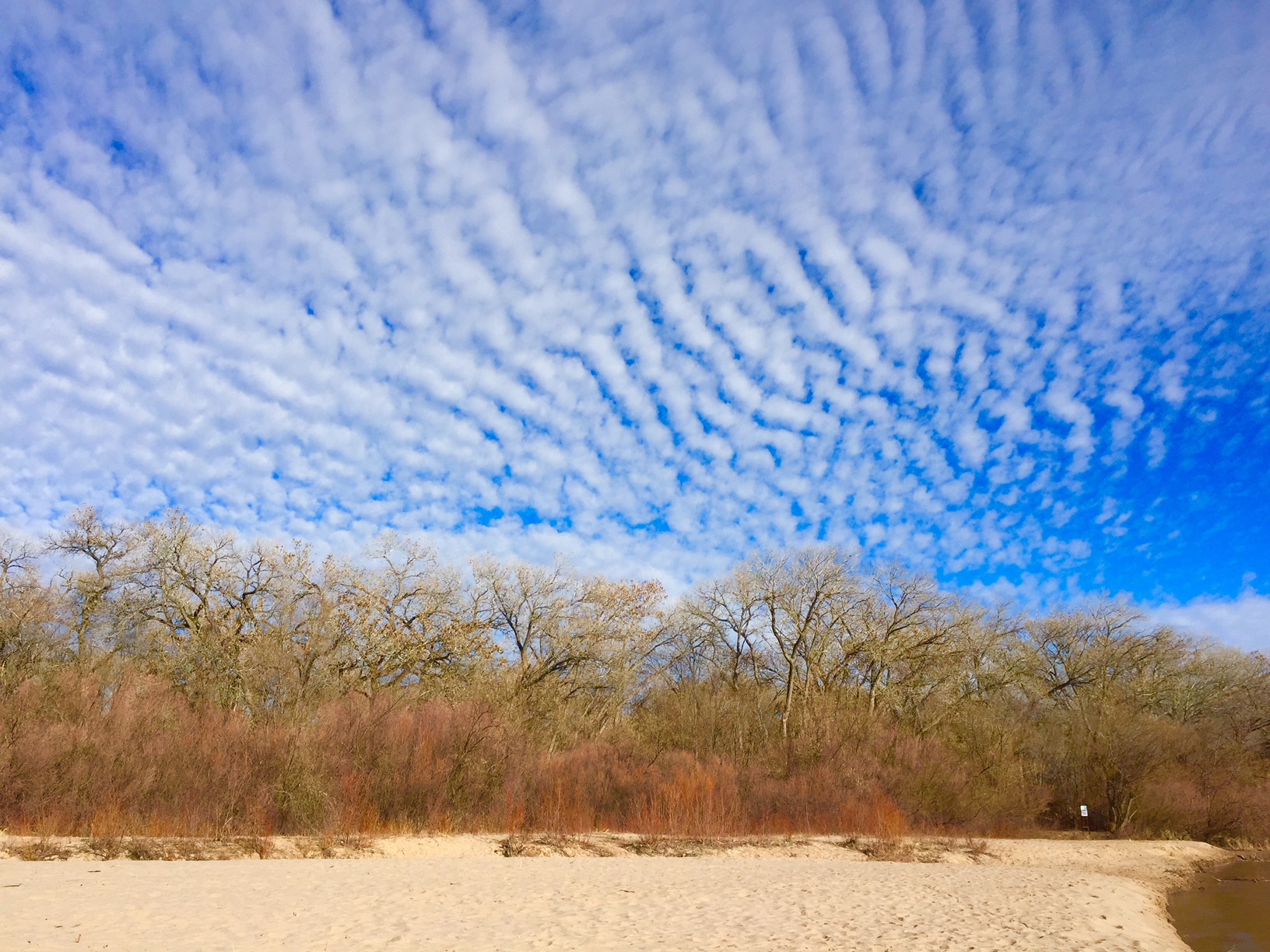
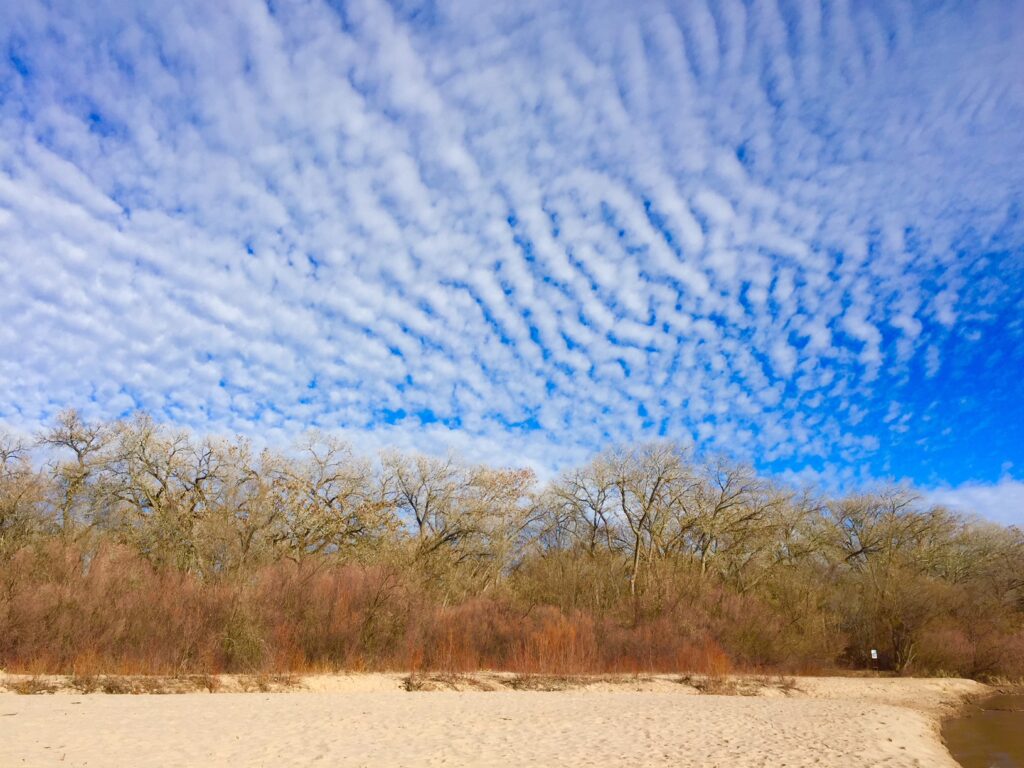
When the dog had not returned after a few minutes, I settled, sitting and eating an apple from my pack. The sand was thick and soft, the same dusty tan color as the clay and the dried cottonwood leaves. Above the bosque, an army of small white clouds covered the sky, mimicking the leaves covering the ground below. Traffic double-crossed each other over a distant bridge, the roar just a low humming rumble. Leaning back on my pack, I could block the view of the bridge with one bent knee, the other leaned into it like two cottonwood trees. I pulled my hat down low over my eyes, the sun shining off the river. Ducks flew over in a whisper of quick wings. Geese called vaguely to each other from much farther upstream. I grew comfortable and sleepy.
After 20 minutes or so, I heard a gentle voice from down where the people had been playing with their dog. Sitting up, I saw a different dog scampering through the sand, heading for the water’s edge – and me. I immediately stood with the stick. The dog made an easy arc and turned toward me. A young man came jogging through the soft sand after the dog, calling softly to it, and to me, saying, “She’s really friendly. Don’t worry, she’s friendly.” Meanwhile, the dog had reached my sandy nest, and I kept turning, keeping the branch between us. The dog did not seem aggressive, but did not stop trying to reach me. She seemed more curious than anything.
The man called her over to him, and she went readily. “You know,” I called back to him, “people always say that. They always say their dog is really friendly.” He continued to pet the dog, but looked up, focused and listening. “And that’s not always the case. People don’t think to ask me what my experience of dogs has been.”
He looked at me with the same gentle kindness he had shown the dog. “What has your experience been with dogs?”
“Being chased, menaced. Having my kids chased. A dog lunged at my toddler in the stroller – he was at the dog’s face level, you know? Having a pit bull – not the dog’s fault, but it was a pit bull – run up, silently, at me from behind while I had my baby in a backpack, so that I had to keep whirling around to keep it in front of me.” I had picked up my pack while I talked, pulling my jacket back on.
“Those experiences sound scary.” He patted the dog, rubbing her sides.
“Yeah.” I watched him pet the dog. The dog laid down, relaxed. “So some people’s dogs are friendly. But some people raise them to be aggressive, you know?”
He smiled. “She’s a puppy still. I’m trying to teach her, we can’t run up and greet every friend we see. I like to bring her here, let her run, let her be off her leash for a little bit. But she still gets a little excited.”
I cocked my head, watching her. “I know they have those dog parks, but they seem like places the dogs get way too excited.”
“That seems like where they do get aggressive sometimes,” he agreed. “I think some people, that’s the only time they take their dogs out at all. I try to get her out here a couple times a week, up in the mountains once a week, but….”
I nodded. “It seems like you’re doing a great job of training her. Those light eyes – is she part husky?”
“Part husky, part coyote, part shepherd. She likes it in the wild.”
“Yeah, she must like it in the wild,” I agreed, my own light eyes shining. “I do too.”
The dog whimpered quietly once, and the man stood up from where he’d been crouching over her. “But you were having a moment here, in the quiet, and we interrupted,” he added. “We’re going to head along the trail. Thanks for sharing your experience. It’s helpful to hear, and to remember.”
“Thanks for listening, and talking,” I replied, smiling at his dog, and then at him.
They wandered away happily, over the sand and into the woods.
I stood, looking out over the quiet river. In my opinion, an excellent birthday.
This sand bar was a flood zone. That’s what made it so soft, the flooding, unprotected, the friction of resistance giving way. It’s what we need to flourish. It’s what our hearts need, to be flooded, with feelings and then with understanding. After all, it’s the full, green leaves that feed the trees; it’s our hearts, shaped by our beliefs and our experiences, that feed our lives. What shape my heart takes is up to me.
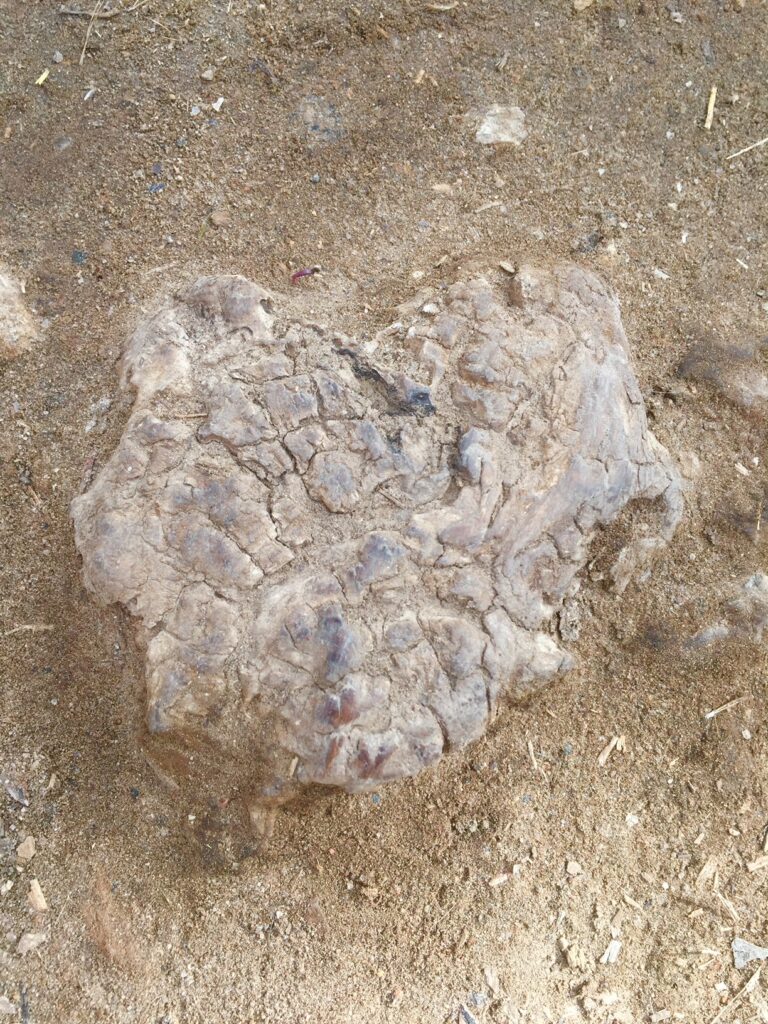
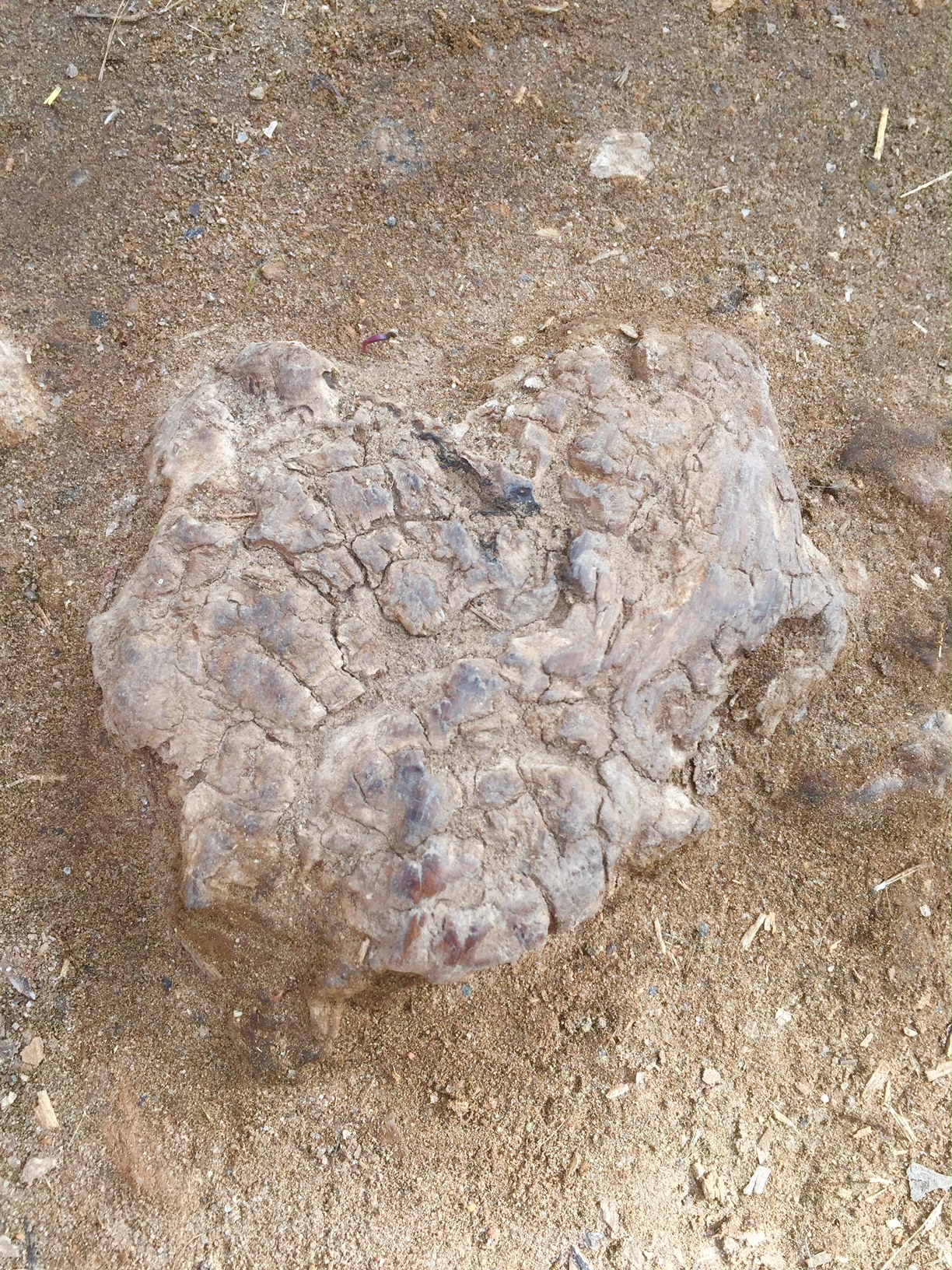
knot on a cottonwood root in the Bosque Trail, size of my curled hand, which is the size of my actual heart
January 25, 2020 / wanderinglightning / 0 Comments
I’ve been reading “The Book of Joy,” about five days the Dalai Lama and Archbishop Desmond Tutu spent together. Both in their eighties, their friendship is relatively recent, yet open, warm, and blatantly affectionate. Archbishop Tutu had invited the Dalai Lama to his 80th birthday some four years previous; the Chinese government had decided the meeting of these leaders should be prevented, and so, pressuring the South African government, the Dalai Lama was denied a travel visa. Now four years later, the Chinese government could not stop Archbishop Tutu from attending the Dalai Lama’s 80th birthday celebration – in Dharamsala, India, where he lives in exile. And so Tutu arrived, and the two spiritual brothers spent their days together discussing the nature of suffering, and of joy. Joy’s path, they found, led through the valley of sorrow and grief, that deep place where compassion is born.
* * * * * * * * * * * * *
Jacky has been missing for weeks. Many weeks. His mommy has been distraught. All the usual steps have been taken since he’s gone missing. A reward was even offered for his safe return, a last desperate offer like a sobbing plea to an indifferent god.
The grassy courtyard of our apartment complex has been eerily quiet…except for tentative bird calls, one to another, wondering if it was safe to come out.
The “Missing” posters blanketed our neighborhood – on the mailboxes, lightpoles, seemed like on every corner. You’d turn, and there’s Jacky…except, of course, Jacky’s not there.
In the poster photo, his inky black hair stuck out, unruly and shining; his dark eyes didn’t miss a thing. Jacky’s picture on the missing poster was not adorable, though; I mean maybe it was, I wouldn’t know, really. Because Jacky’s a damn cat, and I don’t like cats.
To be fair, I don’t like dogs, either. It’s all of them; I’m anti-pet. I love wildlife instead. Pets drive wildlife away. Pets often kill wildlife.
And Jacky killed birds. My birds. The birds in the long-needled pine tree by my porch, in the gambel oak outside my living room window. He and his adopted brother, Elron, a hefty kitty with dull, crossed eyes, oddly split paws like baseball mitts, and long, cream-colored fur, roamed the tiny courtyard like a hairy George and Lenny from “Of Mice and Men,” Jacky doing all the smooth talking, Elron petting the birds a little too hard.
Yeah, but Jacky was the killer. And I really detested him for that. That and he loved to poop in my tiny garden along the back wall. But so did Lenny. I mean Elron. Whoever. It killed my flowers and rendered my herbs inedible, showered and over-fertilized as they were with cat urine and feces.
The damn cats didn’t even live indoors. Their mommy, a sweet young woman who lives a couple apartments down from me, called them in each evening as she came home from work, a high soprano singsong of their names: “Jack? Jacky? Jacky Jack? Elron?” Why do cat people always call their cats in with that operatic falsetto of endearment? And why was Elron always an afterthought? He was probably sitting right there near her porch and she didn’t notice him; Elron’s kind of like that. Anyway, she’d call them in and feed them and cuddle them or whatever you do with cats, and then in the morning, there they always were, huddled in the courtyard grass, Jacky looking guilty and defiant, Elron always kind of dozy and confused. I’d look at them, distrustful, then sigh, locking my door and going off to work.
It’s when I would come home from work that Jacky’s surprises waited for me. A wet pile of cedar mulch in the middle of my otherwise dry garden. Beside my sunny back steps, the delicious smell of warm cat poop, a place NOT to sit and relax after work. My front porch mat wadded from a leaping cat landing on it and skidding across my porch into the large potted plant (that one seemed like Elron, to be honest). Shredded spider plants or similar potted spikes if I left them out to get sun and air. And my favorite: stepping into the courtyard and stumbling on the scene of a grizzly crime, a dead bird clutched in black cat claws on the grass in front of my porch, the body reluctantly abandoned without haste or remorse as I came up the walk.
I shook my keys at Jacky, who bolted away.
Sigh.
Then over the winter holidays, the unthinkable happened: Jacky disappeared. Unthinkable for his mommy, and probably for Elron; for me, Christmas had come early. I’m not a cat killer or someone who sets out traps for strays and calls Animal Control. Cats aren’t worth all that bother. Besides, more will just come to take their place anyway. I was just so glad not to interact with Jacky for weeks. Months. Nearly a season without him.
I went to work, I came home: no garden piles. I traveled, I returned: all was as I left it. I passed an electrical box on my walk to work that had graffiti written on it in black script: RIP gato. A small smile would tug at my lips.
But as the weeks continued, the corner posters began to feel somewhat sad. RIP, gato, I’d think when I saw them on my way to the market, knowing by now that no reward would bring Jacky back. When my neighbor came home in the evenings, she just called out quietly, “Elron…,” who, being Elron, was always right there, waiting for her. No real need to call.
I wondered how she was doing, Jacky’s mommy. Would she adopt another stray? And how was Lenny functioning without his George?
I came home one evening to find Elron sitting awkwardly on my porch, almost hanging off into the periwinkle vines. Cat didn’t even know how to sit lazily on a porch without Jacky. I shook my keys at Elron. He slowly turned one of his eyes to look in my direction, his gaze unfocused. “Go on,” I said, which he did not understand. I waved my hands at him. No response. Elron had either had the most loving upbringing of any cat ever or he had significant brain damage. I walked past him to my front door, turning the key in the deadbolt. He rose expectantly.
“No. Go home,” I said, and used my bag to slowly steer him toward the stairs. He plopped down onto the periwinkle instead, missing the steps. I felt bad for him. “Go home,” I told him again, bothered by his incapacity. He looked up at me and then all around the courtyard, confused. For a minute, I wondered if he was looking for Jacky. I went inside and closed the door.
* * * * * * * * * * * *
“One is reminded of one’s humanity and one’s fragility,” said Archbishop Tutu. Relationships, loss, sorrow; sometimes, we find ourselves like Elron, don’t even know how to sit lazily on our porches for the weight of our heavy hearts. We look around our homes and all that is familiar, and we feel confused, bereft. Or like Mommy, all the musical trill gone out of her voice, calling without really calling, gathering without joy.
Tutu advised, “…I think we shouldn’t think we are superwomen and supermen. To hold down emotions in a controlled environment, as it were, is not wise. I would say go ahead and even maybe shout out your sadness and pain. This can bring you back to normal. It’s locking them up and pretending that they are not there that causes them to fester and become a wound.”
The Dalai Lama added, “When I used to get angry, I would shout,” describing his younger days. “When anger develops, think, what is the cause? And then also think, what will be the result of my anger, my angry face, my shouting?” He advises training our minds to take this step back, examining anger as a cover story, an arrow pointing back toward an earlier fear or hurt, disappointment. Toward our sadness.
The writer who recorded their conversations, Douglas Abrams, explained further:
Sadness is seemingly the most direct challenge to joy, but as the Archbishop argued strongly, it often leads us most directly to empathy and compassion and to recognizing our need for one another.
Sadness is a very powerful and enduring emotion. In one study it was found that sadness lasted many times longer than more fleeting emotions like fear and anger: while fear lasted on average thirty minutes, sadness often lasted up to a hundred and twenty hours, or almost five days.
…Sadness is in many ways the emotion that causes us to reach out to one another in support and solidarity.
Archbishop Tutu had said it clearly: “…I think some suffering, maybe even intense suffering, is a necessary ingredient for life, certainly for developing compassion.” Later in their conversations, he added, “It is the hard times, the painful times, the sadness and the grief that knit us more closely together.”
* * * * * * * * * * *
The cold weather had retreated, and I sat curled lazily on my couch, still reading “The Book of Joy” by the warm light of Sunday’s late afternoon. A car parked out front, and then I heard Mommy’s high-pitched glee: “Jack? Jacky!”
Jacky Jack the Black Cat was back.
I half-rose from the couch, stretching to look out the porch window. There he was, arrogantly poised in the grassy courtyard, much to my neighbor’s utter relief and joy. She chattered happily along the sidewalk and back to her door, offering food, treats, love and affection.
I felt a small smile tugging at my lips. As I took my trash out along the back sidewalk before going to work Monday morning, I found a huge pile of wet mulch in my garden. Damn cat. All was right in our little world.
You show your humanity by how you see yourself not as apart from others but from your connection to others.
— Archbishop Desmond Tutu
The ultimate source of happiness is within us.
— HH Fourteenth Dalai Lama
January 19, 2020 / wanderinglightning / 0 Comments
And as life itself began in the sea, so each of us begins his individual life in a miniature ocean within his mother’s womb, and in the stages of his embryonic development repeats the steps by which his race evolved, from gill-breathing inhabitants of a water world to creatures able to live on land.
— Rachel Carson, “The Sea Around Us”
I was reading “The Sea Around Us” when I was offered a companion piece of a very different kind.
“Becoming Ocean: When you and the world are drowning,” her essay is titled. Eiren Caffall is a writer and musician based in Chicago; a denizen of the Great Lakes talking about rising waters. Lake Michigan is not an ocean. But the lake is not her point of reference: her own body is.
Caffrall has inherited PKD, polycystic kidney disease. Her kidneys are riddled with fluid-filling cysts, slowly, almost imperceptibly, flooding her body with the polluted waters of a lifetime, quietly “letting fluid and poison back up into my blood until I die.”
“The ocean and I have a conversation every day, even though I live very far from its shores. It is rising, and I am drowning from within. I have been drowning all of my life….”
— Eiren Caffall, “Becoming Ocean”
The grief of this tragedy pulses through my heart, the saltwater of bad blood inching forward with every beat.
This is how her family has been dying, most before the age of 50. Drowning in their inheritance. Choked with the weight of their broken DNA, unable to rise above. Hope is an organ transplant, not a healthier lifestyle choice. She compares her PKD to the march of climate change across our planet. Her metaphor is slowly drowning ourselves.
My metaphor is self-immolation. Burning myself alive.
As my heart beats this moment, Australia is on fire, another result of climate change. 46 million acres already burned. How do I measure 46 million acres? How do I measure the pain of burning?
The dusty memories of what was Australia are completing a full circumnavigation of the earth. Ash covers us all. There is nowhere to run, nowhere to hide.
My life’s losses carry as ash on the winds of my years. It’s such an easy metaphor, it’s ridiculous I didn’t see it before Caffall’s story. My grief, my filter, blotting out the sun, letting me see only red.
Her loss will be her life, slowly darkening as she goes under the weight of too much water.
Must my loss be my life as well, given as the fragile nothing of ashes, darkening as I myself come between the sun and earth, between the source and the now?
I have carried tragedy for too long. I have used it for kindling, carried it in my pack as firestarter for each evening’s campfire. Tragedy, my old friend, my constant companion: it has paid the bills as casework with the homeless; it has chosen my life partners and doomed us to failure; it has been the limestone foundation of the old farmhouse where I grew up, tornadoes swirling above, rainwater flooding through cracks below. Nowhere to run, nowhere to hide.
The new earth, freshly torn from its parent sun, was a ball of whirling gases, intensely hot, rushing through the black spaces of the universe on a path and at a speed controlled by immense forces.
— Rachel Carson, “The Sea Around Us”
Liquid metals, flowing minerals, red and seething; yet somehow, even the earth cooled. The image Rachel Carson gave was one of heavy elements consolidating into a molten planet while other lighter elements, hydrogen, oxygen, remained as gases, becoming steam. Rock formed. Clouds gathered around the layering earth. And over eons, the elements returned to each other. It began to rain.
What an image. Rachel wrote quite a few years ago; her science may be simplistic compared to what is known now. But the poetry of her imagery soothes my fiery heart.
As soon as the earth’s crust cooled enough, the rains began to fall. Never have there been such rains since that time. They fell continuously, day and night, days passing into months, into years, into centuries. They poured into the waiting ocean basins, or, falling upon the continental masses, drained away to become sea.
— Rachel Carson, “The Sea Around Us”
What Australia needs is rain. What I need is rain.
But I fear Caffall’s drowning. I, too, have been drowning all of my life, in the overwhelming sadness and hopelessness of damage and loss. As if the burning core of me could stop the inexorable rising of the seas of generations who will cry and suffer. As if my volcanic roar could keep making more solid ground under my feet, your feet; as if I might be an unending rock of ages for all I love.
But no one is unending. And no one can be the solid ground under someone else’s feet. We are cracked, leaky foundations of aging stone, barely holding up our own house in the storms of this life. Storms of suffering, but clearing into calm, and even joy; tears that fall like rain, rain we need, even as we fear it.
From the moment the rain began to fall, the lands began to be worn away and carried to the sea.
— Rachel Carson, “The Sea Around Us”
Eiren Caffall seems to agree, even as she is dying. Because we are all dying.
For years, I told strangers we were dying, the climate was going to make every single thing over, that they just had to open their eyes to see.
In my experience, a life-threatening diagnosis is one that must be faced. Facing it looks like letting go of the world and the life you had up until the second you heard the news of collapse. That life ends. That world ends. And the world is reborn for you alone. It is reborn and it is destroyed. And you are there to see it, stranded, solitary and broken.
But in that brokenness, if you face it, is the power to change everything, because destroying the old world can break open a light that shines on a new one.
— Eiren Caffall, “Becoming Ocean”
I am terminally human. And I’m tired from carrying my tragedy. It has been heavy, and cold, like an anchor dragging me down when I want to rise above.
Carson says the sea contains the means of its own renewal. The impulse I had as I first reached adulthood was to go out into the world, meet other people, and hear their stories. Bear witness to their tragedies, and their triumphs.
And whenever two currents meet, especially if they differ sharply in temperature or salinity, there are zones of great turbulence and unrest, with water sinking and rising up from the depths and with swift eddies and foam lines at the surface. At such places, the richness and abundance of marine life reveals itself most strikingly.
— Rachel Carson, “The Sea Around Us”
I have started on this journey; I need to continue. I cannot simultaneously travel the sea and remain landlocked. That old farmhouse collapsed into its broken foundation years ago; I didn’t have to burn it to the ground. I didn’t have to do anything except continue living my life.
Here where I stand, in the warm light of a new day, I am seeking the balance that can save me: mind and heart, fear and courage, respect and empathy.
Lived experience is the best way to feel a thing. Tragedy gives you experience, but not everyone has the same tragedy; we require openness to each other’s tragedies to reach wisdom. Empathy with those tragedies wakes you up, lets you cross into communication, clarity and eventually action.
— Eiren Caffall, “Becoming Ocean”
January 9, 2020 / wanderinglightning / 0 Comments
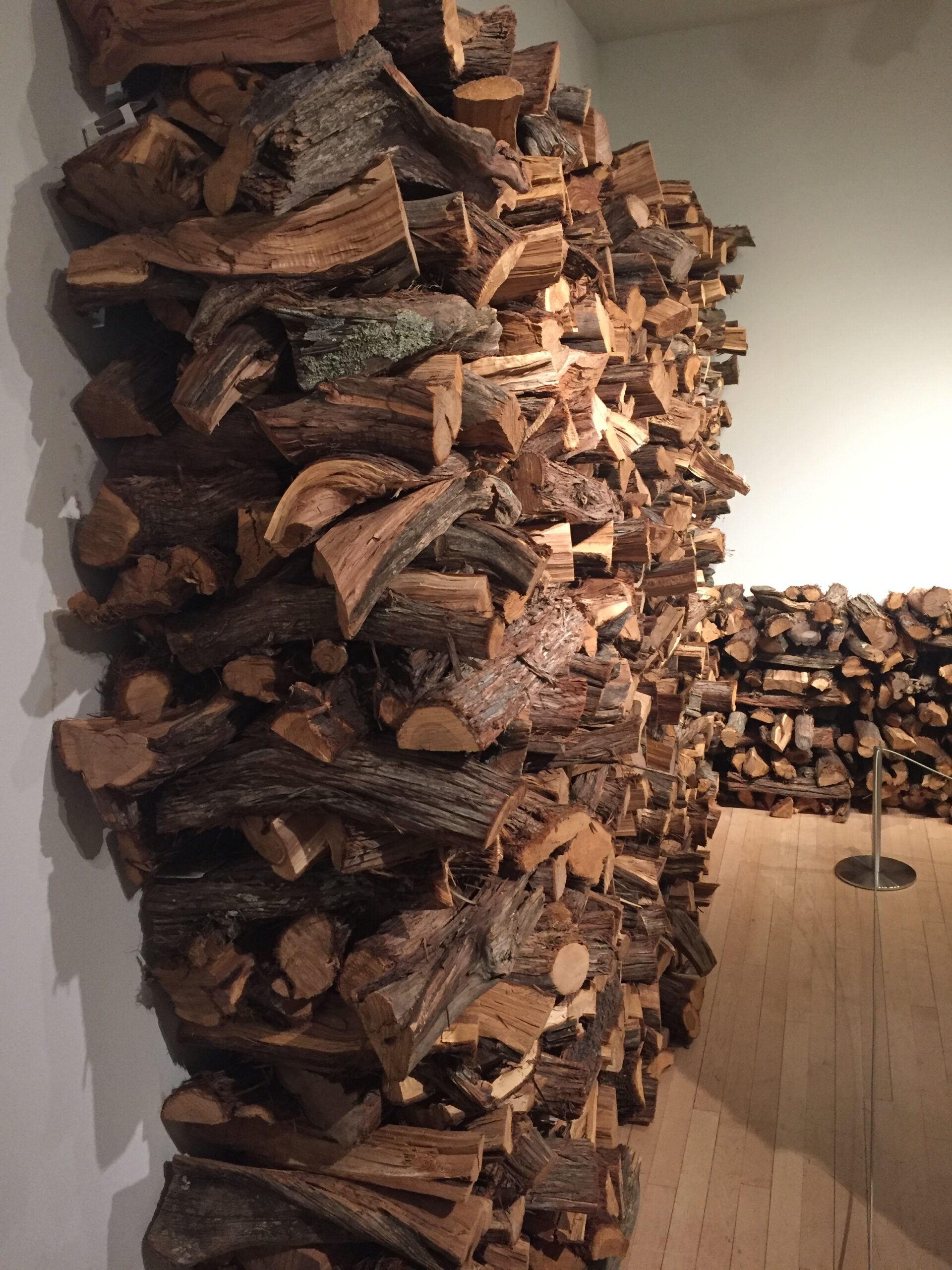
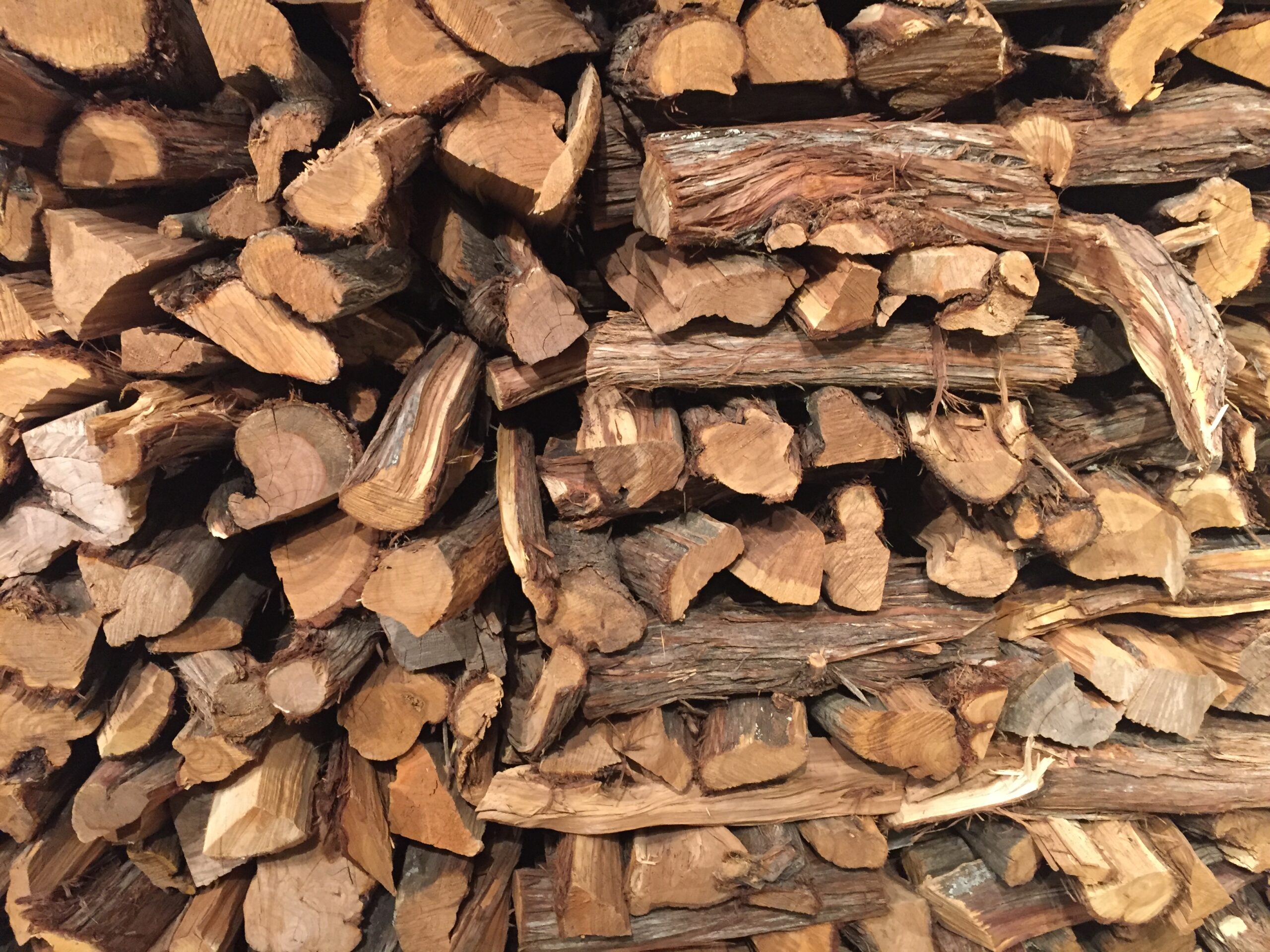
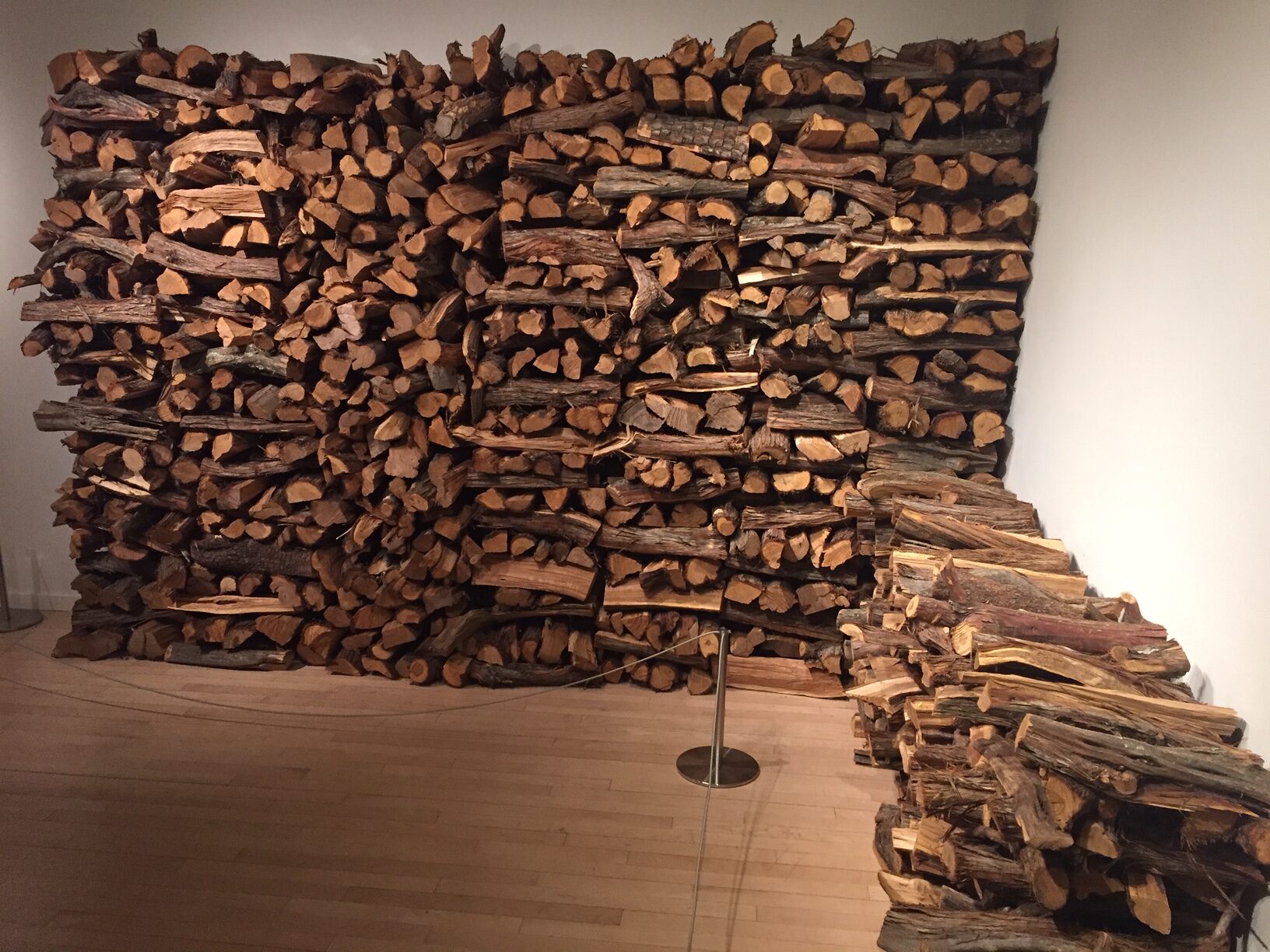
I don’t know what I was expecting at the contemporary art museum, but a wall of stacked firewood? No, I was not expecting that.
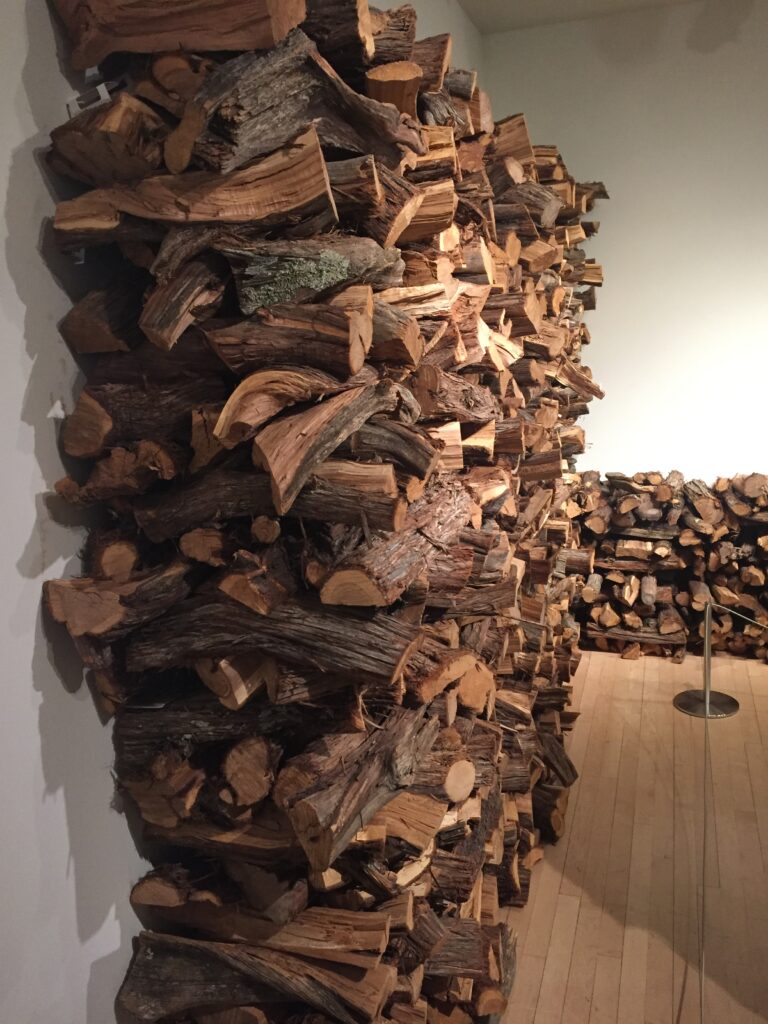
I was immediately intrigued. It reminded me of home, all the firewood I had cut and stacked behind the ramshackle house with the big fireplace where I raised my kids in Colorado. The house wasn’t so much home, as the fire was. Story time together on the couch, the fire snapping softly; cuddled in a cozy chair with a small boy in jammies, little feet warm and sleepy head nodding. The firewood brought all those memories back as I slowly stepped along the length of the indoor woodpile. It stood cordoned off with a silver cable, my earlier robust life held two feet at bay from where I walked now.
This particular woodpile was built through a long-distance love affair of sorts. Two artists, both indigenous women from opposite sides of the Earth, connected through their written words an idea of hearth and home and family. One envisioned the woodpile for the other; the other chose and laid the wood in neat rows, supporting the one’s offered vision. It was a simple gift, split cedar given and received, given by both, received by both, in physical and spiritual form.
They wrote each other letters, these women who had never met, never seen each other.
The Sami artist in Sweden wrote:
How strange it is, having put you to work without us meeting yet. Not one word spoken.
I am picturing you putting logs on top of the other. Bending your back, lifting…. Small bits and splinters cover the gallery floor…. The sweetness of forest filling the room. An unexpected strength of this sculpture.
She said the exhibit piece, this work, was about dialogue. “An excuse really, for engaging in a conversation, too private for most strangers.”
During these moments,
I perceive the other person as an undiscovered sea,
and I plunge.
It is as a necessity for the survival of our peoples. For the human species. Many men and women of my Nation have drowned alone in their own seas.
I have the urge to talk to another mother. A mother who carries the weight of the past but has her sight on the horizon. Is that you?
What does it mean?
I wish I could see your face. Please tell me, how has it been for you? How old is your child now? Is your body the same?
Is anything the same?
My son is a little more than a year now, and I’m overwhelmed and exhausted.
And all the love. The love!
The Sami artist talked of feeling like she understood nothing before her son came into her life. As if she suddenly woke up with a different brain. “Or is it a different heart?”
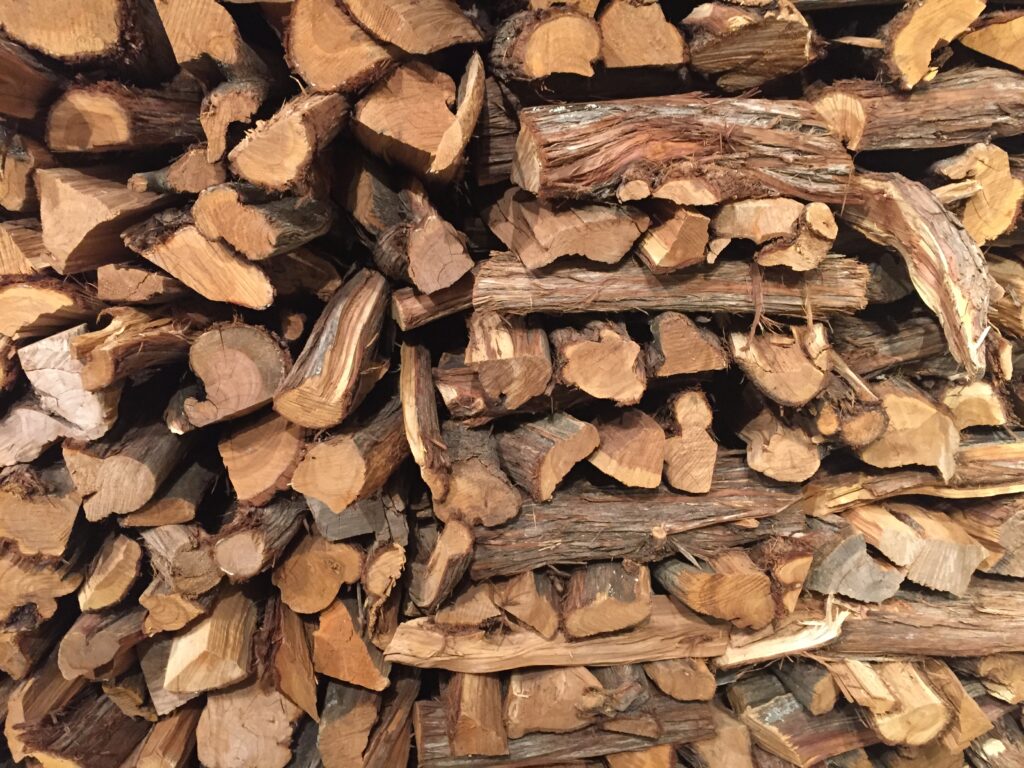
The stacked cedar wood holds itself together as if wrapping its arms around itself, holding itself snug, arms to ribs to achingly tired heart. The wood is old, old trees bent to wind and sun, seeking a drink of water and a sheltering hill. The scent is strength, cedar oil preventing rot and insect, giving a soft sheen to the shaggy splits of firewood.
The Dine` artist in New Mexico, the Navajo woman, wrote:
The first time I read your letter I cried. Everything you described is so true to me.
I am so nervous, even though I have been stacking wood all winter – for my grandmother.
And my baby is quiet and calm as long as I am busy and she can watch.
My daughter just turned one year old as well.
I have never been so in love with anyone or could I be as in love, as I am with her.
Indeed I have changed.
She talks of her grandmother. Of it being best her baby never meet the father. Of Dog, her companion and extra guardian of her baby. “Dog and Baby speak a language that I do not understand.”
To me, this is what will make the work complete. After all, who am I stacking wood for, if not my grandma and baby? And what will be our constant from outside to inside, but Dog?
The contemporary museum is a quiet place. I look at the wall of wood, stacked for grandma, for baby, imagining Dog trotting outside to inside.
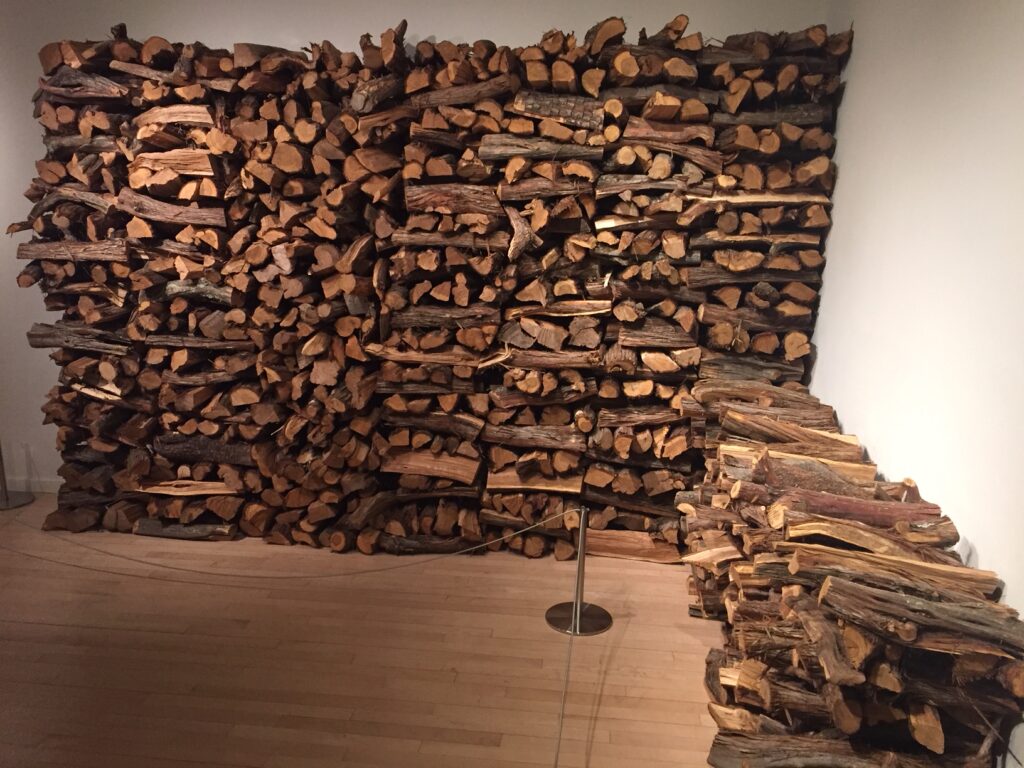
I remember latching a screen door’s hook, high enough above my three-year-old daughter’s head that she could not reach it. Firewood piled on the front porch. More in the wood shed.
I am indeed changed. It’s good to know.
I feel sometimes like I have been stacking wood all winter. As if I am back there, watching the deer silently cross the snowy pasture, my breath a fog as I bring in more firewood.
That is motherhood. Trimming dead tree limbs and cutting them to length. Splitting the lengths and stacking them under a shelter to keep them dry. Collecting kindling, always collecting kindling. Matches near the fireplace. Ashpit shoveled clean.
Laying the wood on the andirons, a lean-to construction of sticks to get started. Breathing life into the fire in the hearth. Adding more, a little at a time, until it is fully aflame.
It all needs air. The trees as they grow, the woodpile to stay dry, the flames we kindle. The sleepy babies we raise to the scent of wood smoke and crisp snow. The exhausted mothers curled up with babies in front of warm fires.
We learn by stacking a wood pile in preparation for winter, honest firewood become a work of dedication, of love – a work of art. The fuel of a life well-lived. The fuel and the life a dialogue, a conversation we have with ourselves, like our breath hanging visible before us as we step outside in winter.
January 1, 2020 / wanderinglightning / 0 Comments
What is your greatest fear?
I have two: 1) I won’t live my true life but will settle for a reasonable facsimile; and, 2) My children will make all the same mistakes I made, rendering the facsimile an exquisitely ironic exercise in crushing futility.
So actually, that’s still just one terrible, double-edged fear.
I’m re-reading my dad’s battered paperback copy of Blue Highways, the very first book William Least Heat Moon ever published. At 38, having lost his wife and his job simultaneously, he left town to see what he could learn along the small back roads of America, traveling a wobbling loop around the country in an old white van he named Ghost Dancing. By the time he had gone 10,000 miles and was looping back toward home, he started to realize he was actually running, avoiding the issues. Avoiding the feelings. Drinking beer instead.
Except he had asked a lot of people a lot of questions. He fearlessly struck up conversations everywhere he went. He asked strangers he met about their towns, about regional history and historical characters, and got unexpected answers about the character of a man’s heart and about what anonymous people living deep in nowhere deeply believed in.
As he drove along through a wooded area of Maine, windshield wipers beating against drizzle and fog, he described how his journey was affecting him:
I lost myself to the monotonous rhythm and darkness as past and present fused and dim things came and went in a staccato of moments separated by miles of darkness. On the road, where change is continuous and visible, time is not; rather it is something the rider only infers. Time is not the traveler’s fourth dimension – change is.
Hard lessons come this way, losing oneself in a monotonous rhythm of confusion and foggy avoidance, where dim images and feelings come and go, disjointed moments you notice but don’t understand separated by miles of heavy darkness.
What’s so difficult for me, now having entered my 54th year on the long and winding road, is to have some familiarity with some of the foggy parts of these old highways, but not be able to give directions or travel advice to the people I love most. Not because they don’t want it; I think they actually might, these grown children of mine. It’s because, when marking the signposts of significant change looming ahead, time is not a viable dimension for my struggling travelers. Time is not visible. Speaking to them from my experiences in the past, I’m just a voice on the wind as they speed by.
This is about men who won’t see causes and therefore can’t predict effects.
Least Heat Moon gathered a lot of pithy quotes and pearls of wisdom along the old blue highways. A good life, a harmonious life, is a prayer. Hardships are good; they prepare a man. The biggest hindrance to learning is fear of showing one’s self a fool.
But he didn’t gather those quotes from his parents. They came from his own experiences and travels. A man’s work is doing what he’s supposed to do, and that’s why he needs a catastrophe now and again to show him a bad turn isn’t the end.
This is a truth I know. Time has never been my fourth dimension. I struggle to follow its lengthy ordered flow, except as those signposts of directional change: Here is when I left home. Here is when babies were born. Here is when my father died. Just like on those blue highways, the noticeable signage is few and far between. It’s the journey itself that makes you look for the guidance and meaning.
I wish I could tell them, “Don’t ignore the mile markers.” Tiny little numbers on unassuming poles, they are easy to overlook. They are your reminders, as you stare unfocused and exhausted out the car window of your frustrating situation: life is rolling by.
Mile by mile. Year by year.
The problem of what we’re doing lies in deciding what’s the benefit of history and what’s the burden.
You learn a thing or two after all those miles. What you need, and what you don’t. Who to trust, who not. Why ignoring inconvenient, uncomfortable feelings is as pointless as shooting bullet holes in the road signs.
Those feelings ARE your road signs. Read them. Read them well. And talk about them, with people you meet along your travels. Go ahead and ask, if you’re unsure, for directions, for guidance, for the best bridge to get you over troubled waters…for any small piece of advice. For wisdom, hard-earned, that might be shared.
If your highway doesn’t lead toward wisdom, why are you on it?
To be wise is to have learned life lessons. Not to be holy or magical or special in any way. It is a part of maturity. It is a sign, often seen in conjunction with gray hair and a wrinkled smile, that you might be someone who’s been around, seen a thing or two, and could point me in the right direction.
Travel your own roads, and I will, too. May they cross in my favorite place, the middle of nowhere. On occasion, I have been known to stand smack dab in the crossroads with my arms open wide, turning and looking at the wide, unbroken sky in all directions. There’s always room for two in that crossroads. And nothing but time once you get there.
Then he was told:
remember what you have seen
because everything forgotten
returns to the circling winds.
December 13, 2018 / wanderinglightning / 0 Comments
Terms: (n) words or phrases used to describe something or to express a concept, especially in a particular language or branch of study; expressions, idioms, names, titles, labels, designations, appellations, monikers, descriptors
(n) fixed or limited periods for which something lasts or is intended to last; time, stint, spell, duration, run
(n) periods in the year, alternating with holidays or vacations, during which instruction is given in a school, college, or university, or during which a court holds sessions; semester
(n) stipulated conditions or requirements under which an action may be taken or agreement reached, as, “come to terms”
All I had to say was, “Remember when we didn’t do our words?” The first graders, still drunk on fresh air and playground mayhem, would sober up instantly. That memory would live forever in six-year-old infamy.
On that day of reckoning, they had arrived spoiling for a fight. When I collected them for Lab, I always picked them up on the playground, sometimes literally, like when Espe was chasing a boy through the climbing towers and launched herself from the final platform, crashing into me as she tried to land and turn simultaneously.
They squirmed and spun and jumped down the hall. Maybe they were late getting out to recess. That happened frequently. Or maybe this day, discord waited, inevitable; maybe the unseen stars burned in their galaxies, poorly aligned.
“I don’t want…to do…words,” Espe slowly intoned, stretching disinterestedly in her chair.
“Yeah! Can’t we just read now?” Angus asked plaintively.
“Yes, yes,” Sunny nodded eagerly.
How to read without words. I typically reviewed a few terms in their next book before handing it to them. New vocabulary can be tricky, and downright frustrating – so frustrating that some kids will just throw the book down in defeat. The program’s vocab support step was supposed to ease that aggravation.
“You want to read first, or do words first?”
“READ!” all three voices chimed.
“All right – here you go….” I passed out the tiny picture books with one line of repetitive text per page.
Then I sat back and watched.
They immediately flipped the covers open and dug in. Dug in hard. Lips didn’t just move – words were whispered, harshly, becoming louder as they tried to talk through each unexpected road block. It reminded me of people talking loudly to new English speakers, as if volume were the obstacle.
The boggy ground under our tiny Battle of See-Bull-Run was littered with discarded words. All three digressed into swampy territory until, mired and exasperated, they began calling for help.
“What’s THAT word?”
“I don’t know this one….”
“Ms. Barbara, I can’t read it!”
I helped them laboriously sound out words and fed them the beginnings of answers. Reading took twice as long as usual, and their brains were more than twice as muddy from the relentless effort. We didn’t have any time to write or color. They’d been routed from the field, and I dropped them off to their classroom exhausted.
We forget how much work children do each day at school, how much of life they have not yet experienced and for which they have no words. My grandma, home on the farm, saw her own children’s curiosity and tenacity tested and strengthened daily. She wrote sweet poetry about her days with them, noticing their engagement with the world.
“Mother, won’t you come and see?”
Says the toddler with much glee
As he tugs at my finger and I go along,
Wondering at his hurry. What could be wrong?
Then he drops to his knees at the edge of the grass
And watches with rapture as a worm crawls past.
— from “Mother Won’t You Come and See,” Florence Jensen, 1979
How much these first graders would have preferred to learn from watching that worm’s battle through long grass, instead of hacking through their underbrush of unknown vocabulary.
The next day, I’d held one copy of that same book in front of them. They all moaned.
“Yesterday, I was planning to tell you some of the tricky words in this book, before you started reading. Who can tell me: why do we look at the words before we start?”
Hands shot into the air.
“Sunny.”
“So we will know how to say them.”
“Yes. And? Espe.”
“So we can read our book easier.”
“Perfect.” I looked to my left. “Angus?”
Angus scowled. “I can’t read it.” He crossed his arms over his chest and looked away. “I can’t read.”
“You got stuck on that one word, over and over, didn’t you,” I clarified, nodding.
“It’s not fair! I don’t know that word!”
I looked at him, waited a beat, and smiled broadly. “Exactly right, Angus!”
His surprised face followed me as I turned to the other two. “You’re all right.” I held up the offending book again. “Yesterday, I was going to show you that this word – “ and I opened the book and pointed – “is ‘smooth.’ And this one – “ I turned the page – “is ‘rough.’
“And this one, Angus,” and here I turned the open book to him, so he could face his nemesis. “This is the one that wasn’t fair, huh. This one.” I tapped the horrid word. He nodded miserably. Then I showed it to the girls.
“Jill.” We all nodded solemnly together.
“A person’s name, Jill. And you’re right, Angus – you’ve never seen that name before, have you? So you wouldn’t know that word.”
I sat up taller, showing them how we steel our resolve toward mastery over all the Jills of this world. “So – since that’s not fair,” and I made sure I had eye contact with each one, “THAT’S why I show you the tricky words each day. To make it fair.”
I held up yesterday’s book. “Should I put this one away now?”
“YES!” They hated Jill for how she’d made them feel and never wanted to see her again. I unceremoniously dropped it into a book bin.
“So today, I have a new book: A Surprise. I wonder what the surprise could be? Before you start, let’s look at some of the words you will read.”
Negotiating at our tiny treaty table, three little heads bobbed and nodded, leaning forward, ready for their vocabulary review.
December 8, 2018 / wanderinglightning / 0 Comments
Gladiator: (n) in ancient Rome, a man trained to fight with weapons against other men or wild animals in an arena
Violet nibbled her goldfish crackers with long, slender fingers, trying to follow along in her book, while Javier periodically whacked Alejandro on the head. Supposedly friends, Javier struggled to allow Alejandro to read to the group, drumming on the table, drumming on Alejandro’s arm, and talking over his reading.
“Javier.” I’d tried tapping his book to divert his attention. I’d tried shaking my head, putting a finger to my lips, redirecting attention toward Alejandro, giving looks. I’d asked him to “make a different choice,” which he had ignored.
“Hands – to – yourself.”
He only escalated. He talked louder. Then he began singing – until, confused, Alejandro stopped reading, looking up at Javier dancing and singing in our tiny cubicle and wanting to smile and join in…but he wasn’t feeling it.
“Javier – if you can’t be respectful in Lab, I’ll have to talk with your teacher about whether or not you can be here with us.”
He ignored me. Alejandro looked back and forth between us, holding his open book with both hands.
“Javier, I need you to stop, or we’re done.”
Zero response.
“Okay – we’re done. Pack up, guys.”
“What? Lab is done?” Violet was incredulous.
“I can’t teach this way. Let’s go.” I stood up, waiting for them to join me. “Alejandro, I’m sorry, I wanted to hear you read. Next time.”
After reassurance, Violet hurried off to her playground mediation job with the younger kids at recess. Javier had bolted back to class, so I walked slowly with Alejandro. “You just keep focusing on what you need to do, for yourself, for your own reading. You’re doing great; keep it up.”
He looked up at me long enough to ask his deepest concern: “Will we still get stickers?”
“Of course. You remind me. We’ll put them on your treasure maps tomorrow.”
Stickers. I’d heard Alejandro liked to act the bruiser himself, posturing at lunch and recess, talking tough. I hadn’t seen it yet, and hoped he would decide to be his own man and not just follow bad behavior down a long, dark tunnel. I doubted I could bandaid this child’s fragile self-esteem with stickers for long.
Oh, Javier. How to discipline a child who refuses to recognize any authority? How to connect with a child who pretends he doesn’t care about anything?
At lunch duty, I meandered through the lunchroom nodding at kids who wanted to go get their milk, or a drink of water, or just go to the bathroom. But in my mind’s eye, I was looking in a mirror, back 45 years, to a kid who scoffed at adults in “authority” – because what had authority ever done for me? It hadn’t kept me safe, hadn’t heard my cries for help, and hadn’t been remotely smart enough to pick up what I was laying down as clearly as a kid can and still survive the horrible experiences that some kids go through.
I thought about Javier’s Lab dance, superimposing him into the movie “Gladiator” and hearing him as Russell Crowe’s character Maximus bellowing, “Are you not ENTERTAINED?!”
The lunchroom floor was sticky with trails and splashes of red juice from canned strawberries.
I let myself imagine the Roman Coliseum, the roaring, incoherent crowd, the dirt arena fouled with all manner of body fluids and gore, the hot sun beating down on fighters soaked in sweat and blood and fear – and rage.
I walked over to a little girl with her hand raised who asked if she could clean up and put away her tray now. I didn’t know her name. So many of them were still anonymous to me. I let myself remember being an unheard child. I had felt unknown. I pushed my memory to rekindle the horror and fury of hopelessness, a fury that fueled unnatural strength and fearlessness. I didn’t care what anyone said to me, did to me. I raged like a fire, and burned everyone around me. I didn’t care if I burned your world to the ground.
For the first lunch, I had devised a plan with the other para’s – divide and conquer. Three teachers’ classes, second and third graders, all ate together, piling onto the tables not taken by the ECE preschoolers. The chaotic scene was only somewhat improved since Miranda’s last lunch duty. I had talked each of the para’s into taking a class, once finished with lunch, herding them to a different corner of the lunchroom to line up and wait for their teacher.
I could see the para’s struggling to maintain focus on dividing the kids into manageable groups. Other children called for attention, whether by throwing food at each other or pushing each other or wanting to read a joke to them from the side of their small milk carton. Yet each week, a faint but strengthening core of ordered expectation was growing as the kids started to remember our new drill.
I stationed myself near the doors, calling out the class names and directing traffic toward the corners with my extended arms. “Ms. Rachel’s class,” I motioned, “Ms. Holly’s class,” the other side, “and Ms. Lauren’s class.” The final corner. “Ms, Rachel’s class, Ms. Holly’s class, and Ms. Lauren’s class.” Over and over, I moved slowly like a windmill, slowly grinding the rebellion out of the room as we split their ranks and gained control. Then one by one, the teachers appeared and led their classes from the food fight arena.
We like the kids with spunk. Spunk is rebellion made palatable to the masses. We enjoy their sweet-edged naughtiness, their self-limited pushback, the way they’re ultimately seeking a balance between autonomy and approval. We like them in the school arena because we know that these little gladiators are going to ultimately fall when pressed with the swordpoint of authority. Spunky kids are easy, pleasers in pretend armor who help us believe we aren’t destroying their spirits by teaching them to behave.
“Get in line,” I heard myself saying with no small degree of disbelief at the end of second lunch. “If you can get in line, I can dismiss you for recess.” If you will just fall into line, I can allow you to go release your frustrations and pent-up energy. But only for a very limited amount of time. And only in school-sanctioned forms of play. Which you need to accept without giving any of us any attitude.
Javier was ready to read at the end of the day when I stopped by his classroom. We walked down the hall together.
“We need to talk for a minute about how Lab went today. I want to understand how you were feeling, what you were thinking.” I looked at him and just waited.
“I didn’t want to read that easy book.”
“Yes, I got that.” I looked at him a second. “What were you feeling?”
Javier concentrated hard on this one, before saying very openly, “I don’t know. I didn’t want to read the book, but…I don’t know what I was feeling.”
Just then, a girl he knew saw us heading toward the Lab. “Javier, do you go to Literacy Lab?” she scoffed.
“No!”
“Yes you do! You go to Literacy Fellows!”
“No I don’t!”
We sat in our cozy seats for our reading time. Javier shook his hair back, as if trying to settle his mind.
“Do you think,” I asked tentatively, “that you might have been feeling…embarrassed?”
“I don’t know, maybe.” He looked around. A couple kids I didn’t recognize walked by in the hall. “No, I wasn’t embarrassed. I wasn’t anything.”
“That’s fair.” He flapped his book back and forth against the chair. “Javier, have you ever heard the term, ‘pick your battles’?”
And so at the end of the day, we talked about what you would fight and die for, and what you really would not, and how to start recognizing the difference. That there is a difference. That you don’t have to come out like a gladiator, fighting to the death, every time.
And then we read “I Survived Pompeii,” totally relaxed, reading about impending disaster side by side in our cozy reading chairs.
December 7, 2018 / wanderinglightning / 0 Comments
Collaborate: (v) the act of working together with someone to produce or create something,
band (together), concert, concur, conjoin, conspire, join, league, team (up), unite
(v) traitorously cooperate with an enemy
Harrison was in a great mood as we approached Thanksgiving break. As his group colored their drawing pages, he announced, “I’m going to be…uh,” and then a wide grin, “the first person to WANT! to go INTO A BLACK HOLE!”
Marker poised at the white board, I clarified, “So you want to be an astronaut?”
“No; a teacher.”
BA-DUM-CHING! You could almost hear the vaudevillian drum and cymbal. Speaking truth, Harrison, I thought.
“My first day of teaching, I will have long hair, and I’m going to wear a dress.” When Harrison made his most provocative comments, he switched from roaring like a crowd of one into a voice of utmost affectation, best spoken wearing an ascot and a velvet dinner jacket. Or long hair and a dress.
“Cool,” I added. Teacher, I wrote on the board.
“I know how to spell it.”
“I’m gonna have a flower shop. And I’m gonna wear a flowered shirt, and my nametag will be shaped like a flower, and it will have my name, Poppy, right on it – because my name’s a flower!” Poppy had it all figured out. She was busy drawing the details of her life.
“How did you get a name Poppy? For being a flower-seller? Is that a Mexican name?” Hailey asked, genuinely amazed that her lab pal had a name that bespoke destiny.
“I’mpuertorican,” said Poppy, as fast as a human tongue can rattle off its proud credentials. She bore Hailey no irritation or ill-will at what must have been continual correction of others’ assumptions.
“Is that by Costa Rica?” Hailey asked.
“Not really,” Poppy said, reaching for her next colored pencil.
I had made them coloring pages for this last day before the holiday. “I Can Be A _____” followed by the deliberate intention, “when I go to COLLEGE!” They had three drawing boxes: yourself now, yourself as an adult doing what you want for a career, and then an image of what you think college will look like.
This project wasn’t fully my idea. The tutoring program was quite a Fellowship of the College Ring. We were charged with promoting the idea and expectation that these students would go on to college. My job was to normalize that forward course.
The pragmatist in me knew the kids needed college if they wanted to ever leave financial desperation behind. And I knew they wouldn’t all make it.
I also knew that most American colleges offered a standard bullet list of unsurprising core curriculum designed to offer a general educational foundation – what we used to call “high school.” They’d get maybe a year’s worth of specialized courses specific to their chosen major. If they actually wanted an education, they had to shoot for that elusive fit of interest and program and school and financial aid and location and personal support – the Holy Grail of Higher Ed. I felt like a fraud, a liar, and a traitor.
When my own kids graduated from college, each hit a wall. The adrenaline rush of four years was over, the campus living was over, and after the parties came the looming, depressingly rhetorical question: that’s it?
They’d expected more. Because I’d lied to them.
I told them college was their ticket to a better life, better than the scrimping working-class poverty in which I’d raised them. I told them college would be better than high school, that they’d get to study what they actually cared about, that their education would finally be personal to their dreams and life goals. I told them it would all be worth it.
That isn’t exactly what happened.
At the expensive private college on the East Coast, my daughter was harassed by a professor who thought she was some little rich girl sleeping off a night of partying when she fell asleep in class after working her two jobs the night before. At the small state college back home, her sister struggled with her hostile major professor enough to question her choices and dread each semester. My son cycled through three different universities, looking for anyone who might actually care that he attended, that a significant other had attempted suicide before either of them was 20, that he was paying his own way and working hard and just needed someone to walk him through getting an extension on a project due to being completely freaked out and overwhelmed by that experience.
These were honor students in high school. My daughters earned merit scholarships. It should have been so easy for them all, considering they were all labeled “gifted and talented.”
So had I. I had been all those things. And it didn’t stop me from dropping out in the middle of my first semester of college, full-ride scholarship be damned. No one cared when I pulled out of the University Honors Program and my double majors. No one cared when I let go of all that scholarship money. No one questioned me or counseled me or slowed me as I broke and ran.
No one cared.
I’ve wondered if maybe someone at a smaller school, or a private school, might have cared. But my daughters’ experiences make me doubt that. My son’s experience makes me pretty sure.
If you’re smart and say what you think, especially when you disagree or want something better, you risk alienating people in power. If you are personally overwhelmed in college, you’re seen as unstable instead of being seen for what you really are: young.
All of our educational woes were due to being young. Why be part of the American educational system if you do not have understanding for or compassion for or any interest in supporting and encouraging young people? Thousands of jobs exist that pay better and need smart, cynical people to make hard-edged decisions. Please – go get one. Because our children and budding adults deserve so much more than cold comfort. I deserved better than that. My children did, too.
And now, this generation of sweet grade schoolers were supposed to be looking to college as the answer. “When I go to college, I want to be a…animal saver! What’s that word?” Hailey asked.
“A veterinarian? An animal doctor? Or do you want to save them like save endangered species?”
“Like save endangered species…do they go save rhinos and monkeys?”
“Yeah, so that would be a wildlife biologist…a zoologist….” Hailey gave me an awesome squinty face of absolute disapproval. “No?”
“No, not those.”
“Do you just want me to spell ‘animal saver’?”
“Yeah!”
So Hailey wrote, “I want to be a animal saver when I go to college.” You tell ‘em, Hailey.
________________________
Before we left for the holiday, the staff had professional development training about how to use a certain online curriculum, plus a discussion about how to refer kids for additional support services in hopes of staving off a referral to special ed. The Literacy Fellows were instructed to attend the referral portion, which meant we sat in on the ice breakers and team-building activities.
“Does anybody have a Shout Out?” the administrator asked. Teachers offered praise and appreciation to the pera’s and to teammates who had been particularly helpful. We Fellows applauded along with the rest, even though we didn’t really know most of the staff being named.
Then Commanding Teacher spoke up. “I’d like to recognize Ms. Barbara for ‘Collaboration.’ I have a student with some trust issues, and even before she began taking literacy groups, she started building a relationship with that student. It’s been working.”
Everyone applauded as the administrator brought me a long thin red pin for my ID lanyard. I didn’t know what to say, shocked that my efforts had even mattered, let alone been noticed, or, unbelievably, valued. I attached the pin and looked down: “COLLABORATION.”
A few minutes later, as I grabbed a drink from the snack table, two other teachers who sent kids to me for Lab waved me over. “We were just saying – you’re doing such a great job with our students.”
“Yeah – we’re so glad you’re here.”
It all felt so strange. I did not expect to be included. I did not expect to be welcomed into the camaraderie of those brothers and sisters in arms. Walking past watercolor turkeys on brown paper lining the halls, I felt thankful for the unexpected opportunity that had come my way, to step back into the educational system that I had railed against my entire life. I admitted to myself that I was thankful my children went to college; they’d never been unable to get a job. In fact, the East Coaster got that editorial gig in publishing, just like she’d hoped. The mountain college daughter is getting a second bachelor’s now, heading into medicine. And the son who reeled from college to college – he’s the one going to law school.
The thing about college is not just the college degree – it’s crossing that threshold. It may be a lackluster, mediocre educational system; but now by god it’s your lackluster, mediocre educational system. It’s yours to return to any time you’d like, because now you have access. That’s how you actually work the system. You learn the system.
And like we were taught in our middling, unremarkable, undistinguished American public schools, once you learn the system – work the problem.