August 4, 2020 / wanderinglightning / 0 Comments
I am Wednesday, full of woe. My brother Sunday’s all bonny and blithe, good and gay. He calls me “Emo;” I call him “Pollyanna.” I used to be Woden’s Day, honoring Odin, the Norse god seeking wisdom. Then Judas decides to betray Jesus on a Wednesday. Now my claim to fame is hump day and coupon flyers in your mailbox. Sunday, smugly home from church, eats his chicken dinner and watches college football.
Sure, crucifixion, resurrection. I mean, my namesake lost an eye, threw himself on his spear, and hung on the Tree of Life for nine days and nine nights, all to gain knowledge and understanding. He cured the sick, calmed storms, just like Jesus, I’d like to point out. Jesus was god, Odin was god. The One-Eyed All-Father, an impressive title. Jesus has a kingdom; Odin has a kingdom hall, too – ever heard of a little place called Valhalla?
Angels or Valkyries, the faithful return, whether saints or warriors. So what is the deal? Why does Sunday get EVERYTHING and I can’t catch a break? Home-cooked fried chicken every week versus $2 Whopper Wednesdays. Come on.
Woe. Oy vey. Which in fact is part of the problem here – all these “woe” words are natural exclamations of lament by humans around the world: Old English wǣ; Middle English wo, wei, wa; Dutch wee, German weh, Danish ve, Yiddish vey. Bosnian jao, said, “yow.” Portugese ai, said, “aye,” as in aye-yi-yi.
Wednesday, Kuan Yin, Avalokiteshvara. I’m tired of being “She Who Hears the Cries of the World.” I feel like I need to update my image, rebrand, quit reliving the glory days of Odin’s quest for wisdom. The serpent Jormungandr is shaking the world now; Yggdrasil is groaning heavily in the uproar. We seem to be approaching a burning, drowning, come-to-Jesus moment for the Earth.
I’m not going to bring it up, though. I don’t want to give Sunday the satisfaction.
Think I’ll go with the tagline “fee, fi, fo, fum.” That’s Shakespeare, from King Lear. True, it was said by a double-crossed royal prince framed for murdering his father the king now hiding out pretending to be a village madman. But that’s way different than “woe,” right?
Fee, fi, fo, fum. Giant’s Day. Shorten it to Ginday. Card games, chilled drinks, a PROFESSIONAL football team. The living is easy, here at the end of the world.
So much cooler than Sunday.
July 23, 2020 / wanderinglightning / 0 Comments
Here’s how I have to approach you: I have to circle back around. Like livestock that got out through a broken fence, I have to calmly gather you back in to what I’m saying. Getting mad won’t help. I tell you my latest idea, and you immediately bring up the other side of the argument. As if I’m both a curmudgeon and an idiot, now that I’m fifty-four. As if I’ve never gathered hogs. As if I need you to show me that other people have other intentions. Other approaches.
You quickly tell me about an amazing essay you read, by someone closer to your own age. I listen carefully — then get to just as carefully use your story as an example of exactly what I just told you. Now, with your peer’s frame of reference, now you can begin to hear me. Now I’m not old and bitter and judgmental. Now it becomes possible that I’m just noticing. Like the amazing essay author.
My point became lost as I tried to put it into words. Farm references don’t always translate well to urban issues. More than that, words struggle to bridge generations. They always have. How many times, I wonder now, did my dad, my grandpa and grandma, my uncle with his wry, witty reflections — how many times did they try to tell me some very simple observation about life, and I hurled their small pearl of wisdom into the hog lot like a rotten apple?
Intelligence is not wisdom. I’m on a bridge between these two shores, without a foot touching either side at the moment. It’s raining, here in midlife, a sudden downpour that tried to warn me by sprinkling little showers here and there as I attended to the tasks at hand, thunder rumbling like a scolding. This bridge stretches between the heavy smell of wet hogs fenced in their pens and the warmth of Grandma and Grandpa’s farmhouse. I’m walking the sloppy gravel drive to get there, hair plastered to my head, my chore boots a mess of wet manure and mud, but the sheltered metal porch chairs sit welcoming and familiar, a safe place to pull those boots off, peel off dirty, soggy socks, and wipe my dripping face with my wet sleeve, fingers finally slicking my hair back from my eyes. How many times did I wait on that porch in the rain, noticing, as if I alone could witness such a storm.
I remember the quicksilver brilliance of my youth, concepts and decisions flashing like a mathematician’s chalk on a blackboard, like a musician’s improvisation, like a poet’s voice, the microphone close and seductive, my lips spinning everyone into the dark room with me.
I miss a step now and then, here on the bridge. I feel it, sometimes clumsily, like I’ve stubbed a toe, or sometimes like I’ve caught myself just in time from landing on a rolled ankle gone soft right when I needed its strength. And sometimes, I still feel the foot that for whatever reason didn’t come as far forward as I meant it to, dragged itself ever so slightly, still lingering just behind my intention.
I wonder about Parkinson’s. I think of my grandma’s congestive heart failure. I make my uncle’s doubtful expression at the memory of anesthesia, surgery to save my life burning the bridge behind me, no way back to brilliant now. I have my mother’s tremor in my right hand. I have my dad’s creaky ankle that burns and aches if I drive too long, his lower back that is corkscrewed into wide, flat hips. I think I’m my own person, when even my smile is a blend of the two, her smile on top, his below. Every bit of my uniqueness is built of hand-me-down gifts.
You’re so young, so brilliant, so sure. Yet I wish again, for the hundredth, for the thousandth, for the millionth time, that I could bring you inside my heart and mind, help you see what I see. Convince you that I notice, and I care, deeply. That my words that so irritate you are the gritty, sandy seeds of your own growth. That everything you think you need to teach me to see, I taught you to see.
I wish I could tell you about life without you subtly correcting me. The ones fit for that task have long since crossed the bridge and traveled away. I am more familiar with this bridge than you are, have stumbled along more of it, have been walking in the rain so much longer than you have yet even been alive. Before I get too far along the way, let me circle back, and place these few small pearls in the palm of your hand. There aren’t many, but they’re all I have to give you.
Do with them what you will.
July 14, 2020 / wanderinglightning / 0 Comments
First, I thought they were hummingbirds. Barrel-shaped bodies flitted among yellow-dusted blossoms hanging under lacy leaves. From my desk at the window, I watched them swoop on buzzing wings through the slender locust tree growing between the sidewalk and street. I imagined hanging a red nectar-filled feeder by my back door. But it’s all adobe, my back wall; there’s nothing to hang a feeder on. And they weren’t hummingbirds.
Then I thought they were cicadas. I saw one that was a coppery-brown, another darker, and since I have only known cicadas by their heat-gnawing summer song and husks of abandoned skins left clawed into tree trunks and branches, I guessed they might fly in looping arcs if given the chance.
However, it appears they are a type of huge bee, built like a bumble bee but without the bad temper of that chubby garden tyrant. Carpenter bees, who chew a perfectly circular hole into any unpainted, untreated wood to make a nest. I read that the males can be aggressive when protecting the nests; yet even if they dive-bomb, they’ve got no stinger, so what do they do? Head butt? Body slam? The females have the stingers, but it seems they rarely use them. Females prefer to stay in their wood tunnel burrows. You have to provoke a female carpenter bee to get stung.
I keep encountering how much I don’t know. Like the last time I went running at the volcanoes. I saw a very looonnngg baby rattler stretched halfway into the trail, which, upon second look, I thought probably wasn’t actually a baby rattler. This snake’s head was shaped differently, and the body seemed to shine with a coppery stripe, though toward sunset, who can know what they’re really seeing. The thing is, this snake looked fast. I can’t explain this to you, except that upon seeing this very looonnngg baby rattler, entirely unmoving, unblinking, I just knew. This makes no sense, I realize, and I’m with you in being annoyed that I would state as fact what I clearly don’t know.
But life is like that.
Striped whipsnake. Belonging to the snake family of “racers,” colubridae, they’re incredibly fast: fast as a whip. They typically grow to four feet long, hence their nickname “coachwhip” (think stagecoach). Whipsnakes are often found draped in bushes like tiny anacondas, or heads-up on the ground, their faces little periscopes above the cactus as they glide across the desert sand, searching for something to eat.
Whipsnakes are generally nonvenomous. Also not constrictors. They are typically harmless to humans, though a bite still wouldn’t feel good. Nevertheless, their prey includes lizards, frogs and toads, ground-nesting birds and small mammals, even other snakes – including rattlesnakes. So how do they attack? They just rush their prey and eat it ALIVE. They. Eat. Rattlesnakes. Alive.
Appearances can be deceiving.
I remembered the carpenter bee and the whipsnake as I drove out of Albuquerque this weekend to escape daily temperatures of 105 degrees. I am not native fauna. A Colorado transplant, I realized the enormity of my error last summer; now, as July has unfortunately arrived again, I have forsaken my cool, dark cave of lethargic exhaustion in an attempt to escape. I am a mountain ground squirrel running frantically up the highway, hoping to find my habitat before my feet melt into the black pavement or I am crushed by the stampede of traffic behind me.
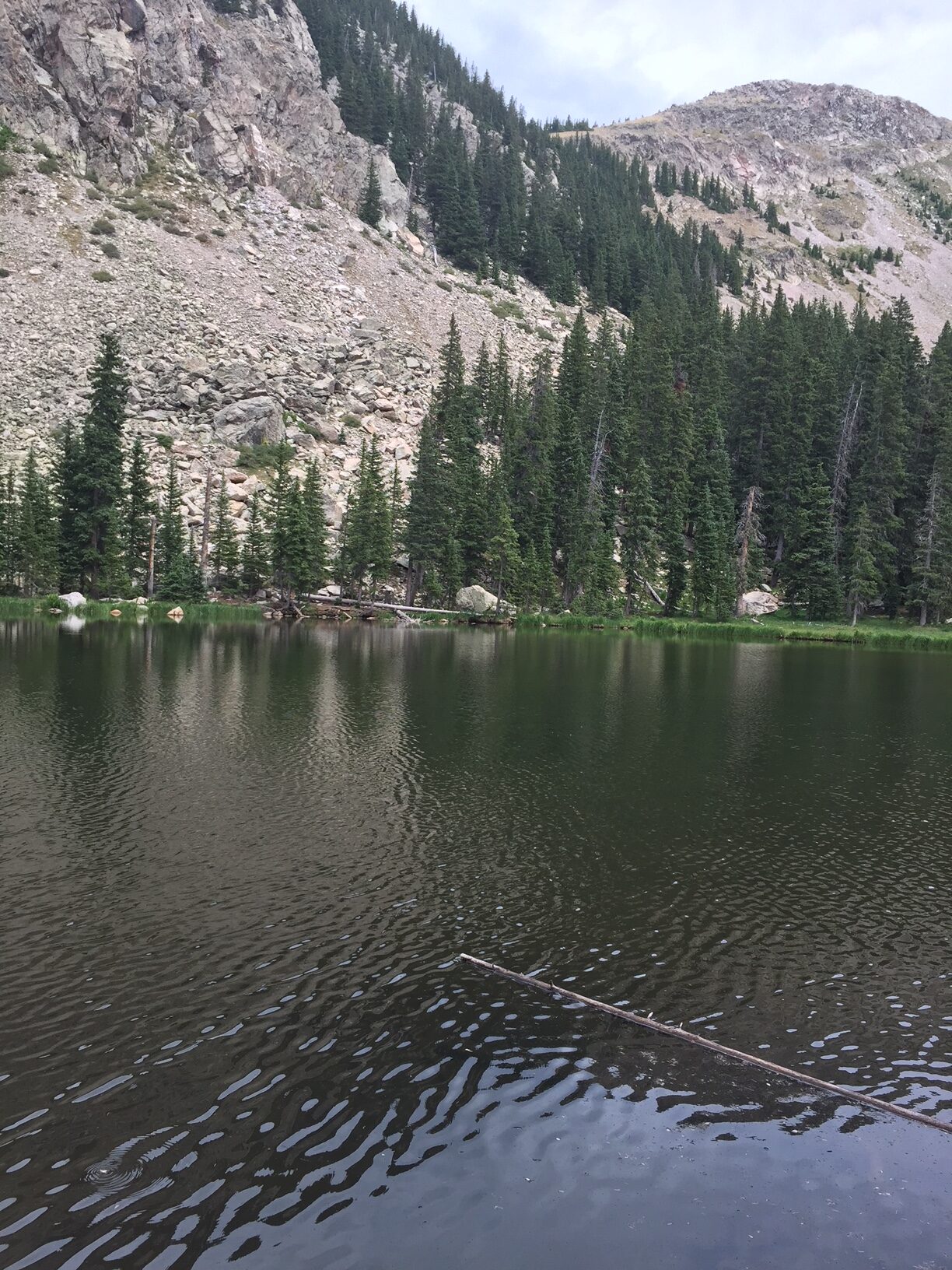
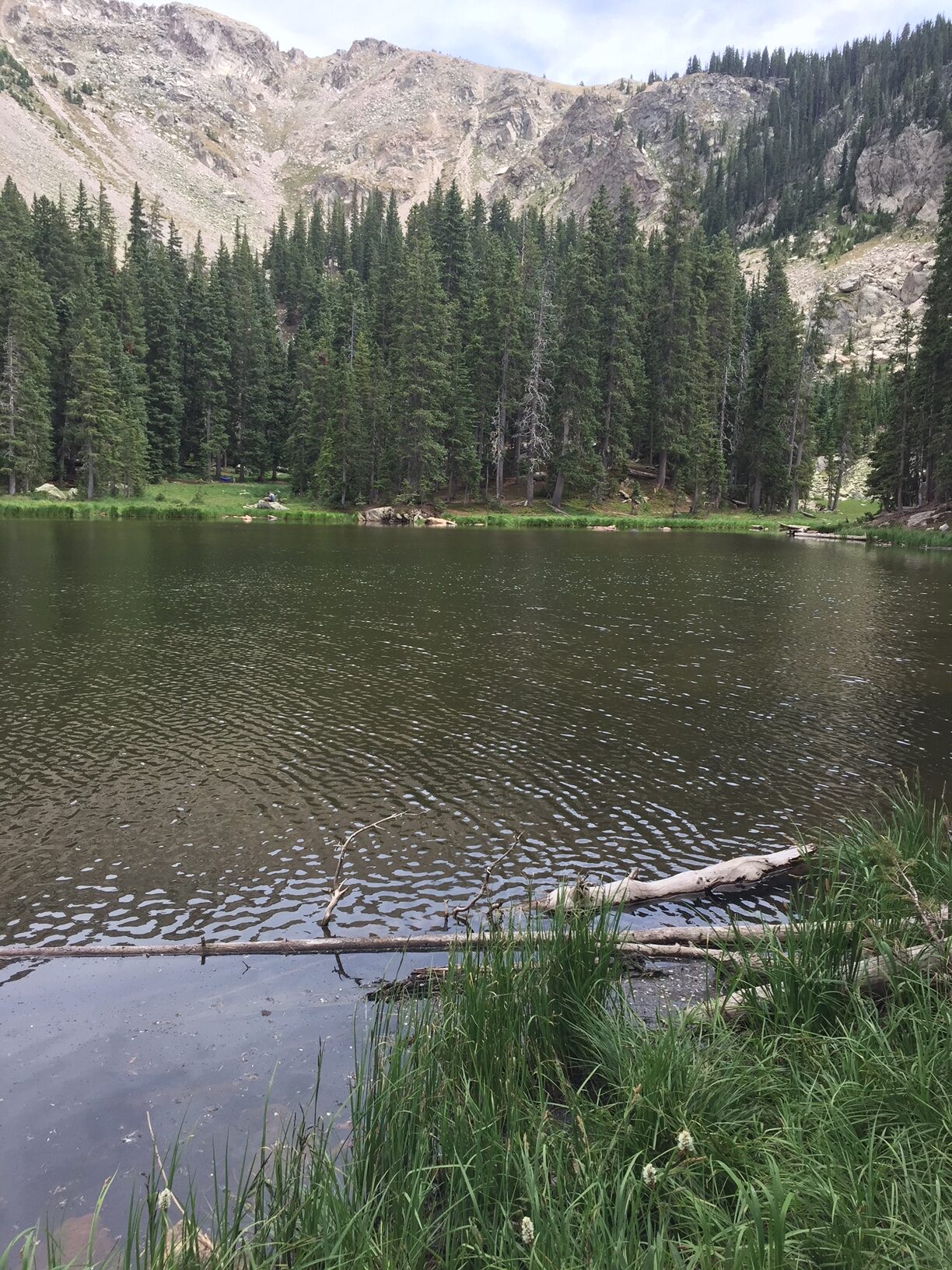
Against my usual prerogatives, I’m heading to Santa Fe. My hiking guidebook tells me I will find Nambé Lake at 12,000 feet. My flushed face and sweating body tell me I will find cool air and cold water within the high cirque holding this precious source of the Rio Nambé.
My bias against Santa Fe stems from its faux-adobe-suburban vibe, a city of seemingly over-educated, overly-thin white people who epitomize one stereotype of Santa Fe, salt-and-pepper haired arts patrons dressed in quick-dry shorts and web-strapped sandals, sunhats and sleeveless T-shirts baring old, brown arms, silver rings on several fingers.
People who look uncomfortably similar to me. I notice my hiking wear with dismay, driving in my Tevas with their red-patterned straps. My rings flash atop the steering wheel.
I haven’t explored much up around Santa Fe. I’ve been to Chimayo and Española, Taos and the Rio Grande River Gorge. I stayed at Upaya Zen Center for a weekend. I’ve driven up and over the High Road multiple times. But of Santa Fe itself, I only know the plaza. I only know the roads that leave Santa Fe. I haven’t actually tried to enter and explore the mountains that hold this city.
As its name suggests, Paseo de Peralta lifts you up into the hills. This road winds until it reaches another, and another, until you find yourself on Hyde Park Road. I associate Hyde Park with rich people back East, and as I drive past custom fauxdobe homes, my heart simultaneously sinks and rises with the road.
These hillside homes are, in fact, beautiful. The walls act as mere frames for windows that showcase the surrounding views, vistas that stretch and relax for miles and miles of high chaparral and wide sky. Hyde Park Road, and Gonzales Road that led up to it, cling to the edges and pinnacles of ridges, one of my favorite features of New Mexico roadways. The air is already ten degrees cooler. I drive past several neighborhoods of condos and realize I’m scouting locations for my life, smiling at the northern New Mexico Territorial architectural style with which I have always been taken, stucco and protruding vigas and shady porticos and little walled plazas for yards, sprouting sage and wildflowers. I like it up here.
You drive to the end of Hyde Park Road to get to the trailhead. I pass Hyde Memorial State Park, 350 acres donated by a member of the Hyde family in 1938, New Mexico’s first state park. “Hyde Park Road” takes on a different tone, after that.
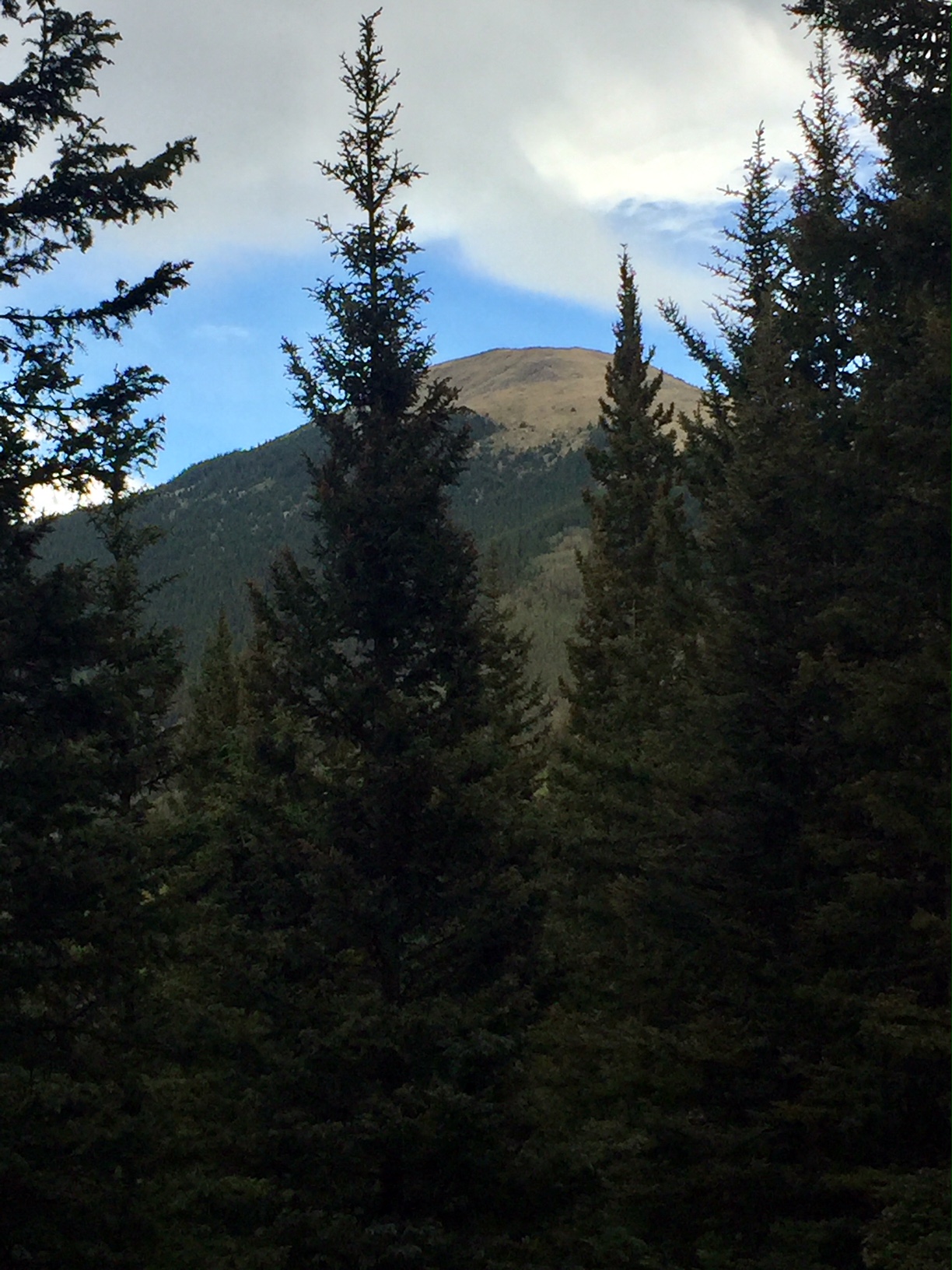
The road wraps the mountains, curving its way up and up, through tight canyons and into taller forests. Guardrails along sheer drops feel familiar. Mount Baldy to my left reminds me that New Mexico does have peaks that rise above treeline. The sight of its smooth pate refreshes my eyes and gives me hope for this hike.
I arrive at the end of the road, a large parking lot for the Santa Fe Ski Area, and find a small gap along the side to park. I can see the trailhead sign from my car – as well as dozens and dozens of cars and hikers and lounging RVers and young Instagrammers in stretchy “athleisure.” The place is swollen with hot, sweaty humanity. But I don’t care.
Because I have reached 10,000 feet above sea level. And even though the trail begins with a precipitous rise that finds me huffing and puffing, I am totally at ease being this out of shape, this high in the world. Ten thousand feet never felt so good. My legs strain against gravity and against a summer so hot it has left me sedentary and depressed until now.
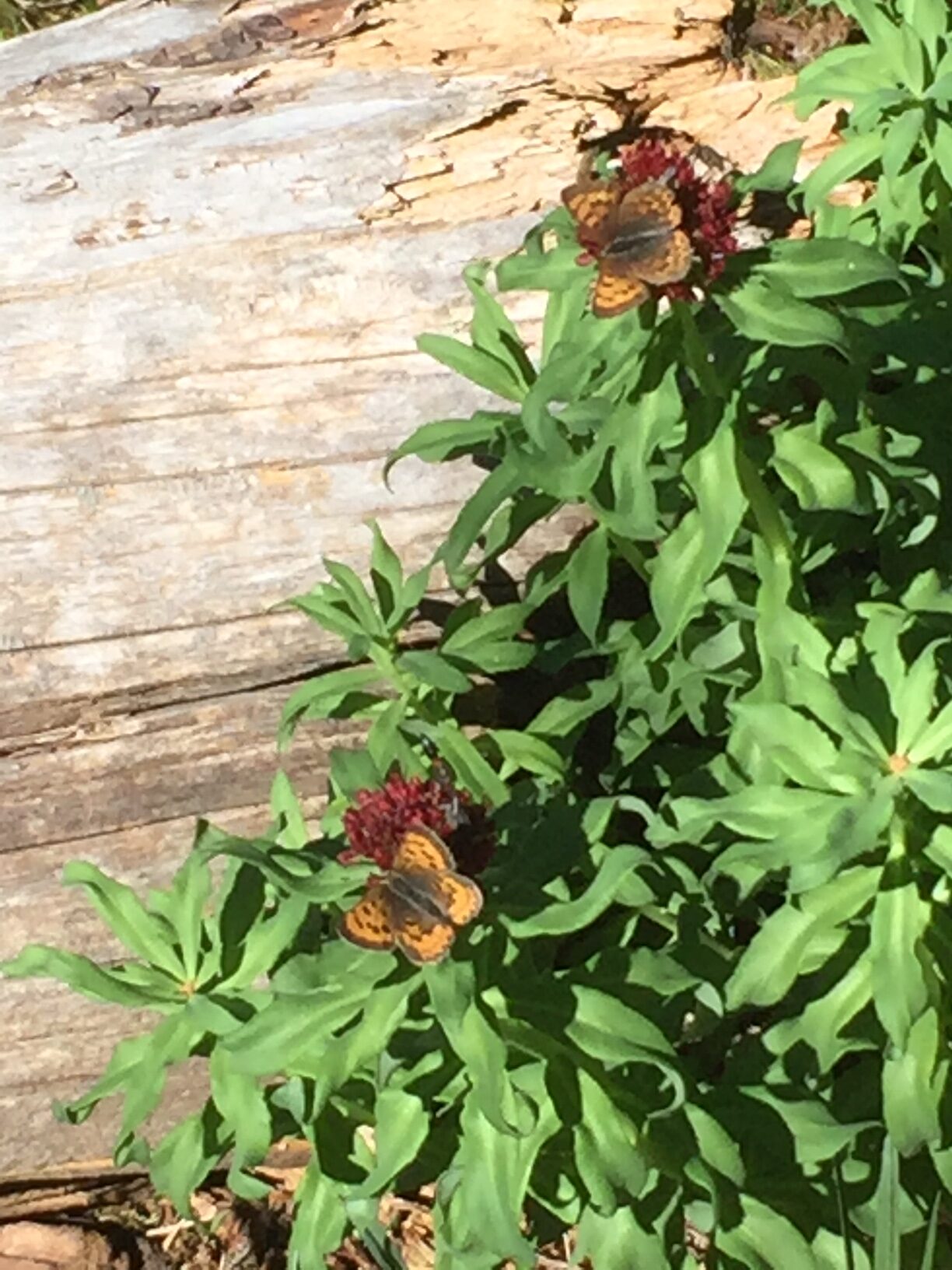
As soon as I reach the initial point of exhaustion, stopping at a switchback, feeling my blood and breath pulsing hard, my familiar comrades join me: the butterflies.
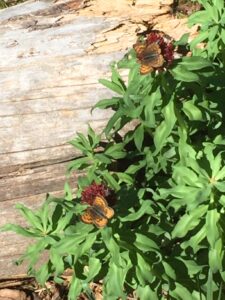
A speckled pair of bright orange, summertime energy swirl around each other and soon around me, one alighting briefly on the top of my walking stick, the other on the knot of the extra shirt tied around my waist. I feel energized with delight and relief to meet up with them, my trail guides of longstanding mutual agreement.
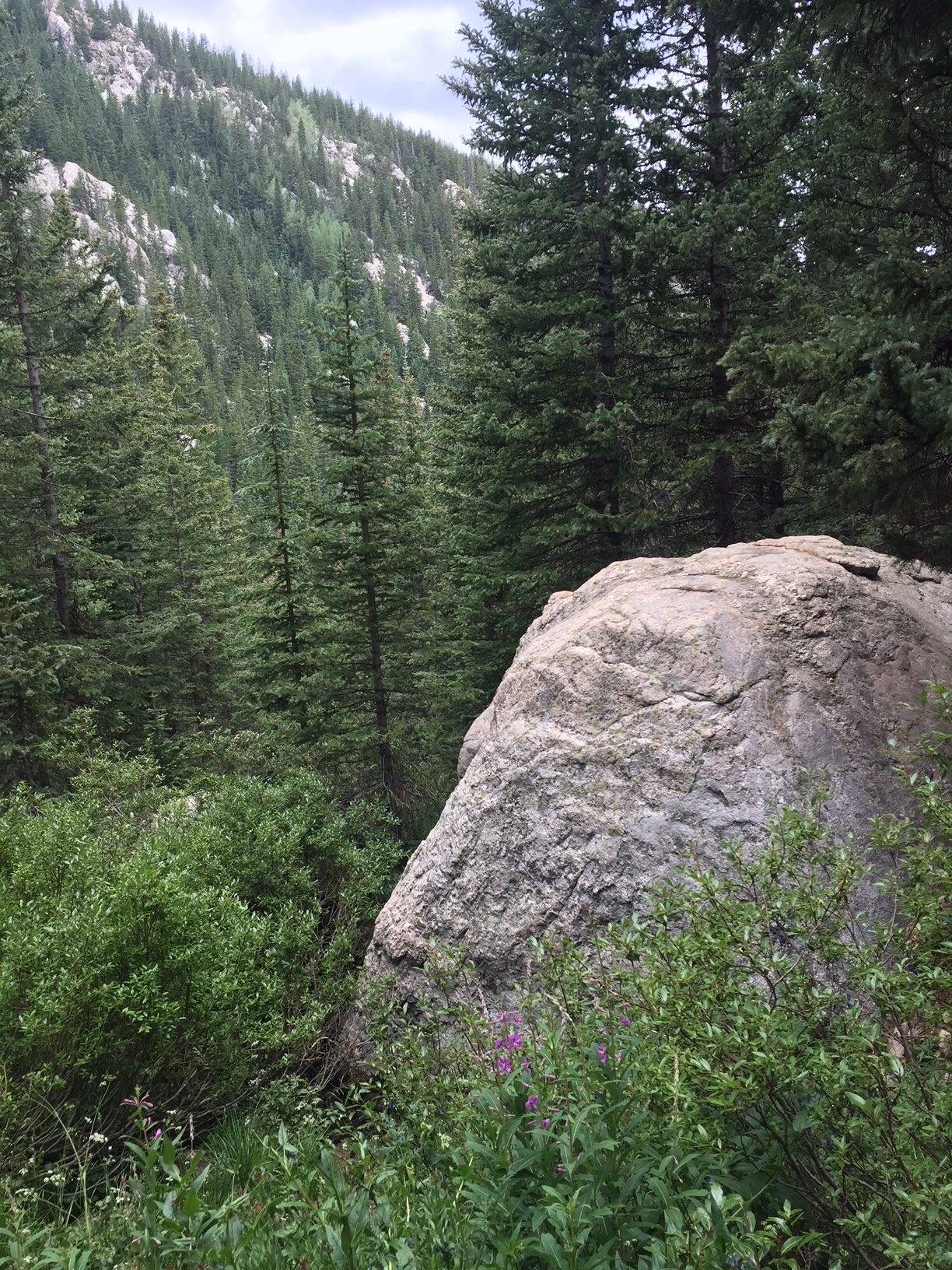
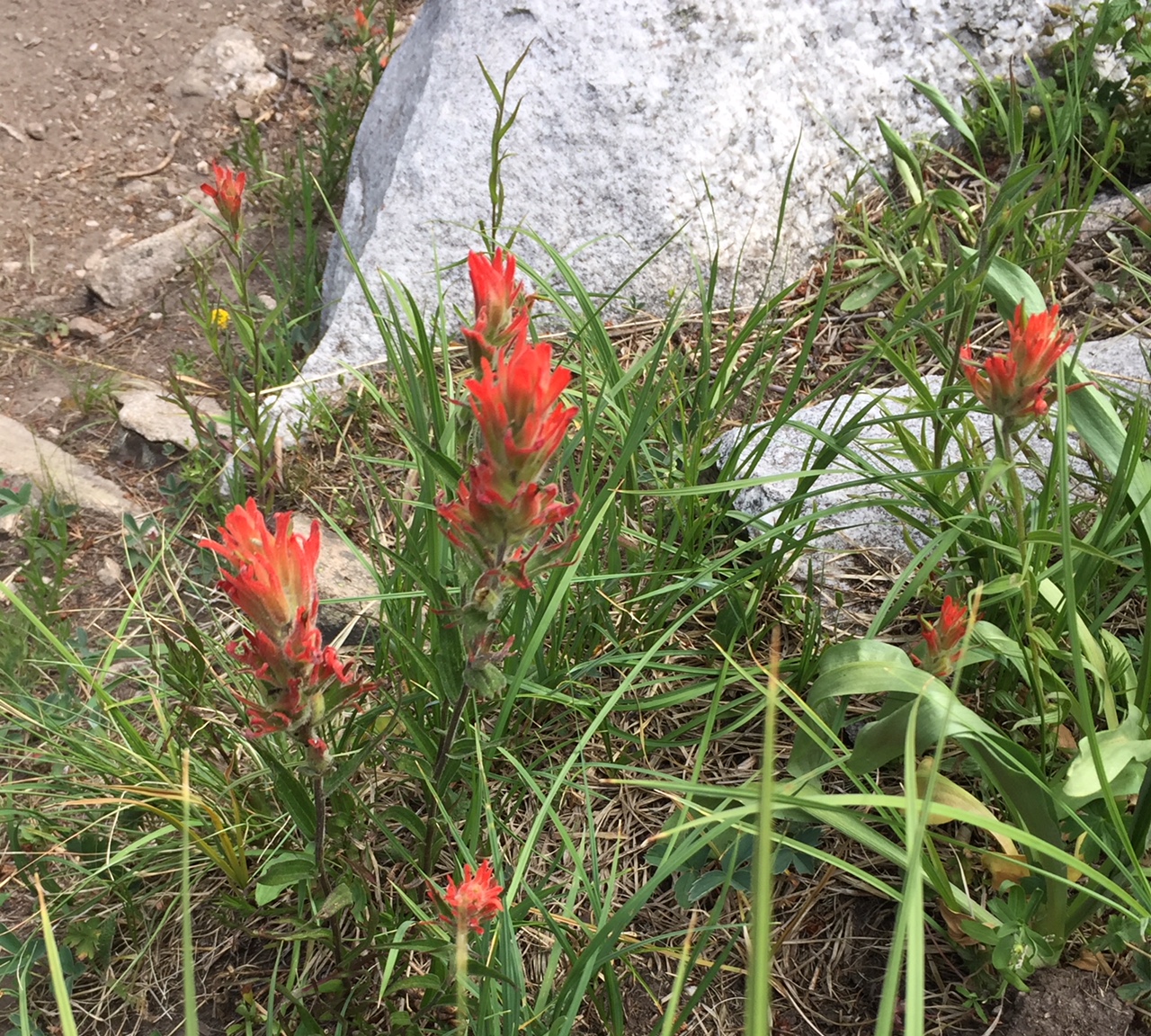
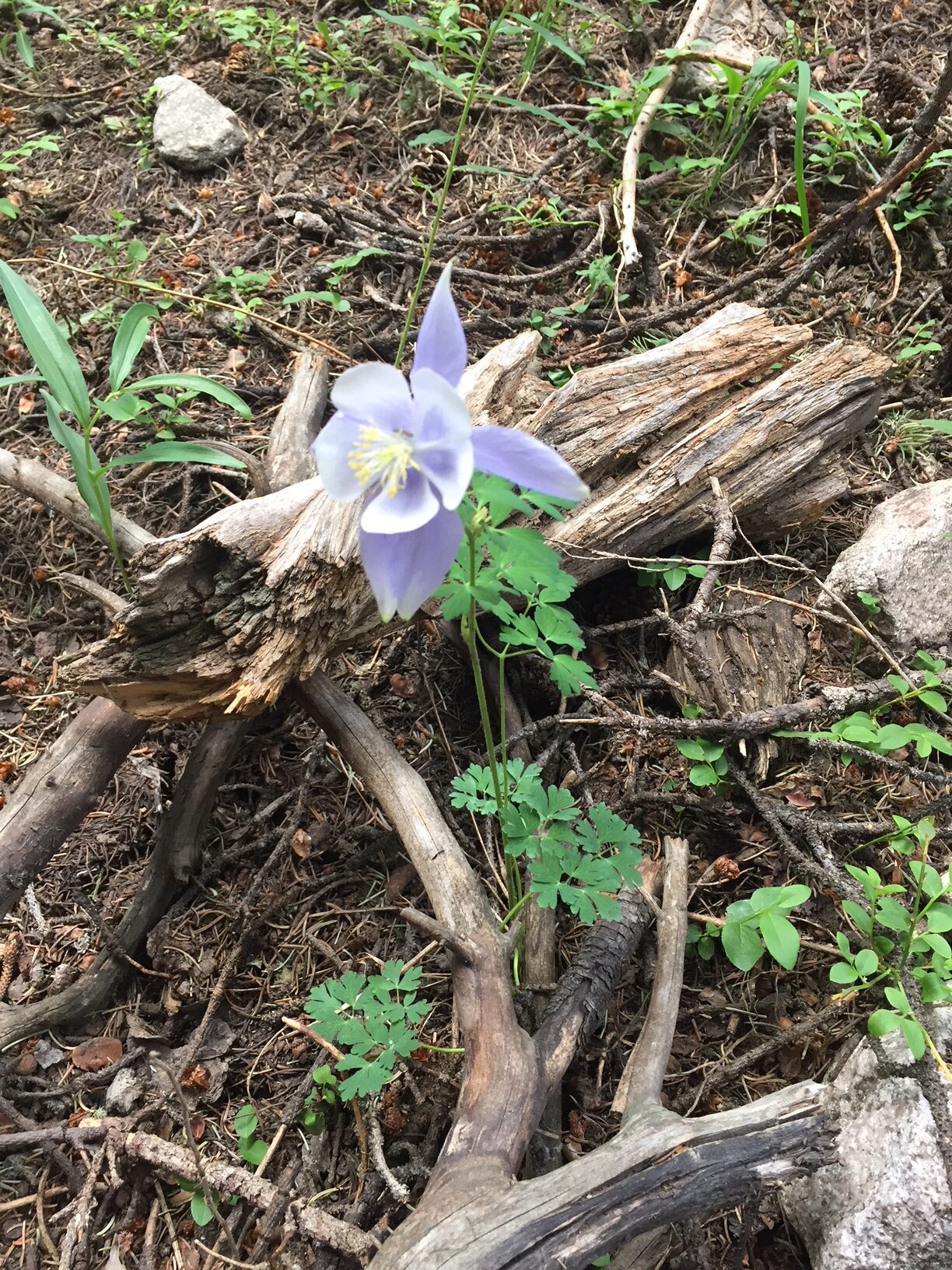
As quickly as they greet me, they lift and spiral away over the wildflowers. And just as easily, my temporary exhaustion is alleviated by joy. As I squeeze through the V-stile log gate into the Pecos Wilderness, I feel that my butterfly friends have welcomed me home. I follow their lead, wandering off on side loops, retracing my way back, crisscrossing the drainage, stopping to admire the paintbrush and columbine.
Even as I take yet another water break, for the entire six hours I am on the trail, I never once think this hike is a mistake.
Listening to the running stream and birdsong, I do think I might have been wrong about Santa Fe, though.
July 9, 2020 / wanderinglightning / 0 Comments
Turquoise. How could I know? The ocean rolls waves over the surface above me, a landlocked desert pilgrim on Camino, the path leading to sand and sea. Weightless, swaying with the water, I relinquish my brokenness to wonder. Fragments of shell, tumbled by waves against hidden stones, emerge with me upon the beach.
I have dreamed of the turquoise water again. I believe it is the water that calls to me while I turn and float in sleep. But the water is only the voice.
The unexpected color of the light, curling waves reflecting my own eyes to me – this is the soul messenger, the fantastic angel holding my wings for me, again, summoning me to put them on, again, and rejoin the larger world. Come, swim out into the ocean, says Wonder. Wings become fins, fins become feet, feet take to trails, trails take to stars.
I am dried out, parched under this sun of relentless
knowing. What I know is small, scuttles under rocks for shade, waiting for the desert air to cool. With nightfall, the Mystery closes my eyes and draws me forward, winding and finding my way by flicking my tongue, testing my thoughts for the faintest scent of life. Hungry, hunting for new experiences that can feed me. By day, I curl into my den, dulled by heat, waiting.
I don’t want to know. I want to find.
Wonder as I wander, under the sky.
June 23, 2020 / wanderinglightning / 0 Comments
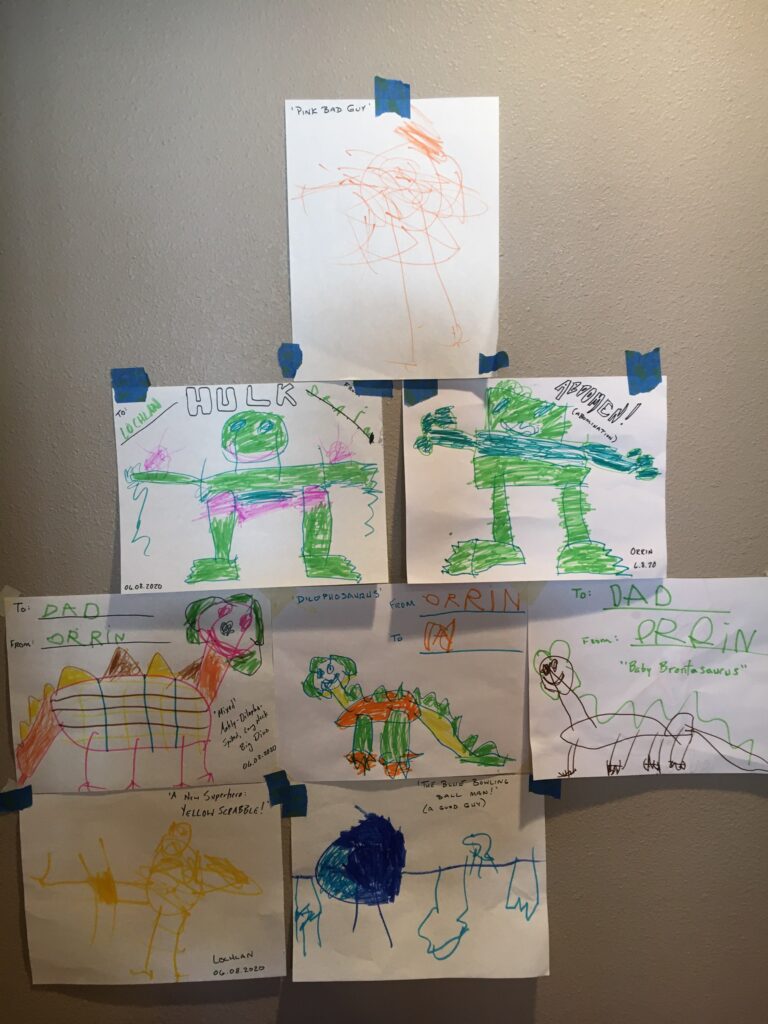
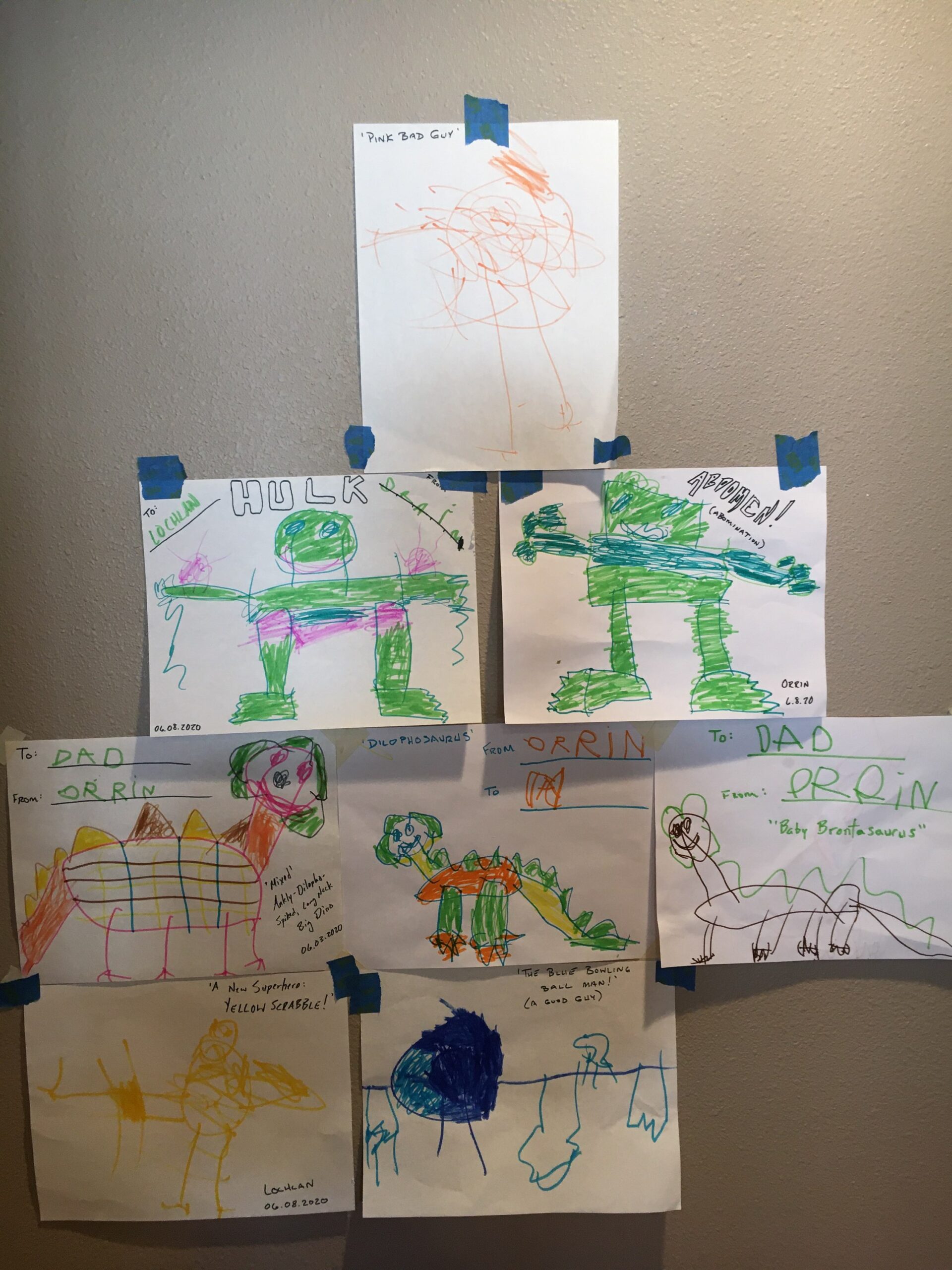
I learn so much from my grandkids. This month’s wisdom teaching comes from the three-year-old, explaining the role of superheroes.
Drawing a line of tall figures with round, staring eyes, he explained, “These are ghosts….” The ghosts are drawn in dark hues of purple, blue, and black. Their unformed faces feel vague and detached. Their bodies without limbs stretch like heavy robes to the ground, solid and imposing.
Ghosts. I think of all the images and stories we allow to haunt us, not only from fiction, but from our own histories. We can be tormented by unsettling visions from our past lives – especially our very-recent-past lives. Even from what is happening right in front of us, right now.
“These are ghosts that scare people,” my grandson said, confirming what I know to be all too true. “But they don’t scare Bruce Banner, because he saves people.”
Ah, the hero.
My grandson loves this particular superhero – not just The Hulk. He loves Bruce Banner. The ordinary guy who becomes something more than he is, on occasion. Through outrage at what he sees happening before him.
Even if your whole goal is simply to help people’s lives suck less, that’s so much more than a lot of people are offering. If the ghosts are our fears, our regrets, or what we become when we succumb to hopelessness, then Hulk might be a reminder of the double edges of being a superhero. It’s the injustices of bullying and exploiting and defeating ordinary people – the situations that create ghosts – that bring on Hulk’s roar. The price: you often feel like just smash, smash, smashing things.
The one who actually saves people is Bruce Banner. Because, using his great scientific mind and huge heart, he learns to tame and manage The Hulk. While Hulk’s superpowers are strength and endurance, Bruce Banner’s superpower is compassion. For himself, for his least nuanced and most aggravated reactions. For his primitive, irrational chest-thumping. For going green with rage and frustration.
Bruce Banner just keeps working at it.
My grandson drew some sidekicks for The Hulk. He made “Yellow Scrabble,” whose superpower I have decided is decimating wordplay, leaving a bad guy speechless with a triple-word-score comeback to his irritating remark, the superpower we all dream of. And “Blue Bowling Ball Man,” who, tiptoeing like a ballerina and then kicking that leg back with a flourish worthy of Fred Astaire, uses his weekend nonchalance in blatantly unattractive league wear to Simply. Not. Care. What. You. Think. The ultimate superpower. Blue Bowling Ball Man will play his game, his way, for the win. And have fun doing it.
May we all join forces against the fierce “Pink Bad Guy,” whose portrait looks like just a hot mess of disorganized, naked human frailty, fighting against all of us as hard as possible. Maybe Bruce Banner can tame this brute, too, in time.
Or maybe we can each tame Pink Bad Guy, using our words, like Yellow Scrabble, and our brains and self-compassion, like Bruce, and our devil-may-care individuality, channeling our inner Blue Bowling Ball Man. Wishing us all the strength and endurance to let go when what we’d really like to do is just smash, smash, smash; to keep trying to turn that split into a spare, using a little English to turn things around. Heroic indeed.
June 21, 2020 / wanderinglightning / 0 Comments
a title is a brand
is a name
not your name
gotta take it to the
bank gotta
go gotta win gotta
cheering with the crowd
out
loud
gonna give it to the sun
gonna run
someone
gonna show you what I
mean
unseen
this scene
like a name is gonna fly
that lie
who’m I
_____________________
As I think about the book, I remember skimming bindweed with an iron rake, her tossing everything over the compost fence, descending the steps into her disease and my history, her knitting in that rocking chair, shoveling snow like memories, driving the jeep like I needed four-wheel-drive to cover the terrain of dementia, always caught off-guard flat-footed and unprepared, a pilgrim being burned at the stakes, Dad pitching horseshoes, the black wall of tornado, driving for yarn and lakes and singing with Mr. Rogers and finding stepping stones to make our way through.
_____________________
The Path of a Tornado
title options
Crazy Weather
I have considered
Bindweed & Iron
and pushed off onto a side table to look at later
____________________
Basho’s haiku written in 1686:
the old pond
a frog leaps in
sound of the water
The master of wabi sabi: the ephemeral beauty and deep meaning of simple, homey objects weathering, gaining patina before utterly crumbling away; “both the passing of time and time transfixed”
Weathering: the wabi sabi of Alzheimer’s
Basho’s book written of his travels around Japan from March 27 to August 21, 1689:
The Narrow Road to the Deep North
As it begins, he writes,
The months and days are the travelers of eternity. The years that come and go are also voyagers. Those who float away their lives on ships or who grow old leading horses are forever journeying, and their homes are wherever their travels take them. Many of the men of old died on the road, and I too for years past have been stirred by the sight of a solitary cloud drifting with the wind to ceaseless thoughts of roaming.
Last year I spent wandering along the seacoast. In autumn I returned to my cottage on the river and swept away the cobwebs. Gradually the year drew to its close. When spring came and there was mist in the air, I thought of crossing the Barrier of Shirakawa into Oku. I seemed to be possessed by the spirits of wanderlust, and they all but deprived me of my senses. The guardian spirits of the road beckoned, and I could not settle down to work.
That title is taken twice already now, once by Basho, once by Richard Flanagan. Flanagan even had prisoners of war. Everything I do is already done.
_________________________
Old Thunder
seems appropriate
old movie The Big Country
Dad’s favorite scene
nice haiku, but what’s the title of your book?
Dad’s Favorite Scene
now tell me, what did we prove?
any advice? don’t do it.
_________________________
Stretching my Patience
Walking fence
stretched wire thin
_________________________
It Was a Dark and Stormy Night
Edward Bulwer-Lytton wrote that, I found out years later. The author of, “Patience is not passive, it is active…it is concentrated strength.”
He also wrote, “There are two lives to each of us, the life of our actions, and the life of our minds and hearts. History reveals men’s deeds and their outward characters, but not themselves. There is a secret self that has its own life, unpenetrated and unguessed.”
__________________________
A Pilgrimage to My Motherland was written in 1860 by Robert Campbell, he who traveled back to “the Egbas and the Yorubas of Central Africa” from America. A black man leaving America, taking his family far from these troubled shores. Poor timing to be usurping the title of his book, I think. As if it was ever anything but a poor idea.
__________________________
Mom or Mommy in English.
In Japanese: mama.
So that’s just spooky, not helpful. Still chasing a title. Still searching for the hidden meaning.
May 17, 2020 / wanderinglightning / 0 Comments
“The first step to getting what you want is to have the courage to get rid of what you don’t.” — Zig Ziglar
I’m struggling with my character development. My book character. Which also happens to be me. So, again, I’m struggling with my character development.
I’m trying to figure out (for the reader, mind you) two small ideas:
1) What’s my motivation?
2) What do I WANT
In a nutshell, I need to give you someone and something to root for, to cheer onward to the goal. And since this book is about this character (let’s call her, oh, “Barbara”) who does not have a back story of people rooting for her, this is somewhat foreign territory. Let me think out loud here for a minute.
At first, I didn’t understand the character roles. I wrote the book about one fascinating character – who, it turns out, is actually the antagonist. This character, Barbara, is the actual protagonist of the story.
Surprise twist! I did not see that coming.
I did not see that I am the primary character in any story about my life. How interesting is that? Professionals, feel free to weigh in. Meanwhile, back to character development.
This character’s stated reasons for coming to Alzapalooza are so thin they’re more like 2-D geometry than 3-D real life:
- The character decides to help simply because she can? Who believes this line? I certainly don’t.
- The character is between trips and needs a place to crash? Reeeally? At her mom’s? I think not.
- Maybe the character wants to help her sister? Ehh…weak…because why?
I think we need to examine this “Barbara” character (if that is in fact her real name) and look at what she has given us to work with in the initial 3 stories of the first chapter.
- She is armored heavily against her mother, whom she hasn’t seen/talked to in seven years – hostile relationship!
- She is going on a 600-mile hike across Spain
- She’s “a person who keeps her word”
- Her mother gets diagnosed with Alzheimer’s
- She’s concerned about “the job” that “needs to be done” related to her mother
- She seems to live in New Mexico & drives a jeep
- She’s solo, a poet-artist person, divorced, with five kids – most grown, one finishing high school
- She has a sister who’s also a divorced parent, that she is worried about because she’s taking on too much with their mother – sister is thinking of moving in with mother
- Mother has asked our protagonist to stay with her – yikes!
- She has brothers who live in Florida who show up/leave quickly, she hasn’t seen them in years either, doesn’t trust one of them (oh dear, that feels like heavy foreshadowing)
- She’s a “watcher” in social settings
- She thinks she has the least to lose in terms of emotional risk with the mother
- She’s leaving in the fall for Japan
First take on examining that list: what this character has given us to work with = NOT MUCH.
It’s almost all external. She notices landscapes, and weather patterns, and elements of place. She feels quite distant, emotionally guarded. She feels like an outsider who won’t let us in. I don’t even know what her job is, how she’s just driving around, traveling to Spain, to Japan…?
Hmmmm. Still feel stuck. Finding a character’s motivation is like having the character go to therapy: “Tell me why you’re here.” Maybe that’s exactly where to go next:
“Welcome, Character Barbara; my name is Therapist Avatar. You came from…New Mexico, is it? To be your mother’s caregiver? Tell me how that all came together, how you decided to do that in three quick little stories.”
“Uhhh…I…don’t really know. I think there was probably a lot going on in my head that I didn’t really share.”
“Say more….”
“I knew you were going to say that. Um. I dunno, that’s so long ago; I’m trying really hard to care, because I just want to get this book done.”
“You’ve been working on your book a long time.”
“Oh for the love of god – STOP THAT. You are ME.”
“Sorry. Go ahead.”
“Jesus. Okay: what my character wants is to get things done that need to be done. That’s stated, that’s in there. Character has emotional issues: check. That seems clear, this person seems a little wounded, a little broken. But they’re also a seeker, a spiritual seeker, trying to learn, grow. Is that in there?”
“No. That doesn’t come up until page 26.”
“How about if I beef it up in the New Mexico travel bit?”
“You could try that. Is that your motivation?”
“Would you just – again, ME….”
“Right, yup. Continue.”
“So – a get-er-done mindset: that’s practical? work ethic? Duty? Flawed emotionally: we can relate to that. Spiritual seeker: common for broken people.”
“These are character traits, not motivation.”
“UGH. Let. Me. Work. On. This….”
“It’s -”
“NO.”
“Just -”
“NOT. NOW. I told Emma I’m going to trust myself, back when I wrote this, that as I was creating the journal, some part of me, my subconscious, the best writer in me, was crafting the storyline without me knowing it. I’m going to trust the storyline to tell me the answers.”
“That’swhatIwasgonnasay. Yousaidthatearliertoday.”
“FINE. Thank you.” Sigh. “It’s in the beginning then. So let me look at it: I’m leaving, and without her knowing that I’m on my way to Spain, she and her counselor call me to come meet. Weird spooky blood magic. That sets us up for any Camino magic I want to introduce later. That doesn’t – that doesn’t matter here. Anyway: she apologizes for her most recent ‘worst thing’ in her long-running series to be entitled ‘Worst Thing Lately’: she apologizes, sincerely, for being horrible when Dad died. So here’s Dad. And his death. And she admits ‘I wasn’t there for you.’ When do I tell you I promised Dad to be patient with her for a year?”
“CanIgoahead….”
“Yeah, yeah….”
“Thank- all right yeah – that’s, that’s page 62. Of the pre-edit version. Mid-April, of your book that starts beginning of March basically.”
“Hmmm. The promise to Dad seems huge.”
“So significant.”
“REALLY? With the counselor amplification thing?”
“I – just – so do you maybe want to punch that up? I mean….”
“Huh; doing it for the death-bed promise to the good dad seems pretty believable. And – actually, as I think about it, I do think that is the motivation. Well yeah, of course it is, I end the book about Dad. He’s the ‘Mentor’ figure in my Hero’s Journey, here.”
“You’re on a ‘hero’s journey’?”
“I’m ALWAYS on a hero’s journey. Where have you BEEN?”
“I mean -”
“I ALWAYS have ‘Hero’ motivation.”
“Mmm, do you….”
“I know, I act like an idiot, but my motivation, definitely always Hero. Hello? I’m Aragorn. I’m Han Solo. I’m freaking William Wallace.”
“So we’re going for flawed hero.”
“Of course flawed hero. The BEST heroes are flawed heroes.”
“So now you’re the BEST hero.”
“GAH. I cannot win here. Hear me out: my character is super flawed. With a decent-to-good father/mentor/role model, who taught me to do what’s right as I understand it, no matter the cost. Stand up. Take action. Do the right thing. And then he asked me to be patient with her. And in my mind and heart, I answered: I’ll give her a year. And at the end of the book, I realize the year I have given is the Alzheimer’s year, of actual patience, not the year of gritting my teeth and letting her be awful. That was actually avoidance. This was actually taking action, doing the job I was sent – by Dad – to do. I want to honor the promise I made to Dad. And then I can be free.”
“You’re on a mission.”
“I am ALWAYS on a mission.”
“You think it’s the promise you made to your dad, then?”
“What else would it be?”
“It’s that, yes. And…do you see what else you just said?”
“‘I can…be free’?”
“Better go add some of this to those first three stories.”
“You think that’ll work?”
“You mean, do I think that’s motivation a reader might understand and root for? Promises kept to those we love, and giving everyone, including yourself, freedom?”
“Yeah. Does that work?”
“Yeah. Yeah, Barbara, I think that’s enough, that’s enough. That’s more than enough.”
May 10, 2020 / wanderinglightning / 0 Comments
Driving west from Albuquerque is infinitely better than the travel videos I’ve been watching online. Rolling across the easy hills like a tumbleweed, I pass through one entrancing vista after another, sipping ginger lemonade and humming along with the stereo from the best seat in the house. The afternoon light is more honest than video, highlighting the soft green of new growth dusting the desert in early May, growing hazy and indistinct as I look to the far off mesas, their stair-stepped horizon.
All along the highway, electric signs flash warnings that Gallup is still locked down, “no services available.” My daughter lives in Gallup with her family, at the epicenter of New Mexico’s current coronavirus outbreak. Temporarily under siege, she assured me over the phone that she planned for the long haul on her last shopping trips, stocking her pantry with non-perishables. But the kids are so small, just 5, 3, and the little one having her first birthday this weekend. They don’t have ice cream for her big day; they don’t understand why Mommy won’t give them more baby carrots and apples, rationing the fresh produce to make it last. I taste the extravagance of my lemonade as I finish it off. I have veggie chips and an apple in my daypack.
I take the Quemado exit but turn right, skirting the small, rundown town of Grants, turning right again at the storage units, following the signs toward Mount Taylor. I pass the privatized local jail facility, “CoreCivic” proclaimed on the gate; that’s the truth, I think. Between Grants and neighboring Milan, you can count three sites for incarceration, two of them on this road.
I note another sign just before I pass the larger prison complex. “Do not pick up hitchhikers in this area.” The shoulder of the road widens for inexplicable reasons, the next sign noting, “No stopping except for emergencies.” I think I would drive on a flat tire rather than stopping in front of this razorwire-bound fortress.
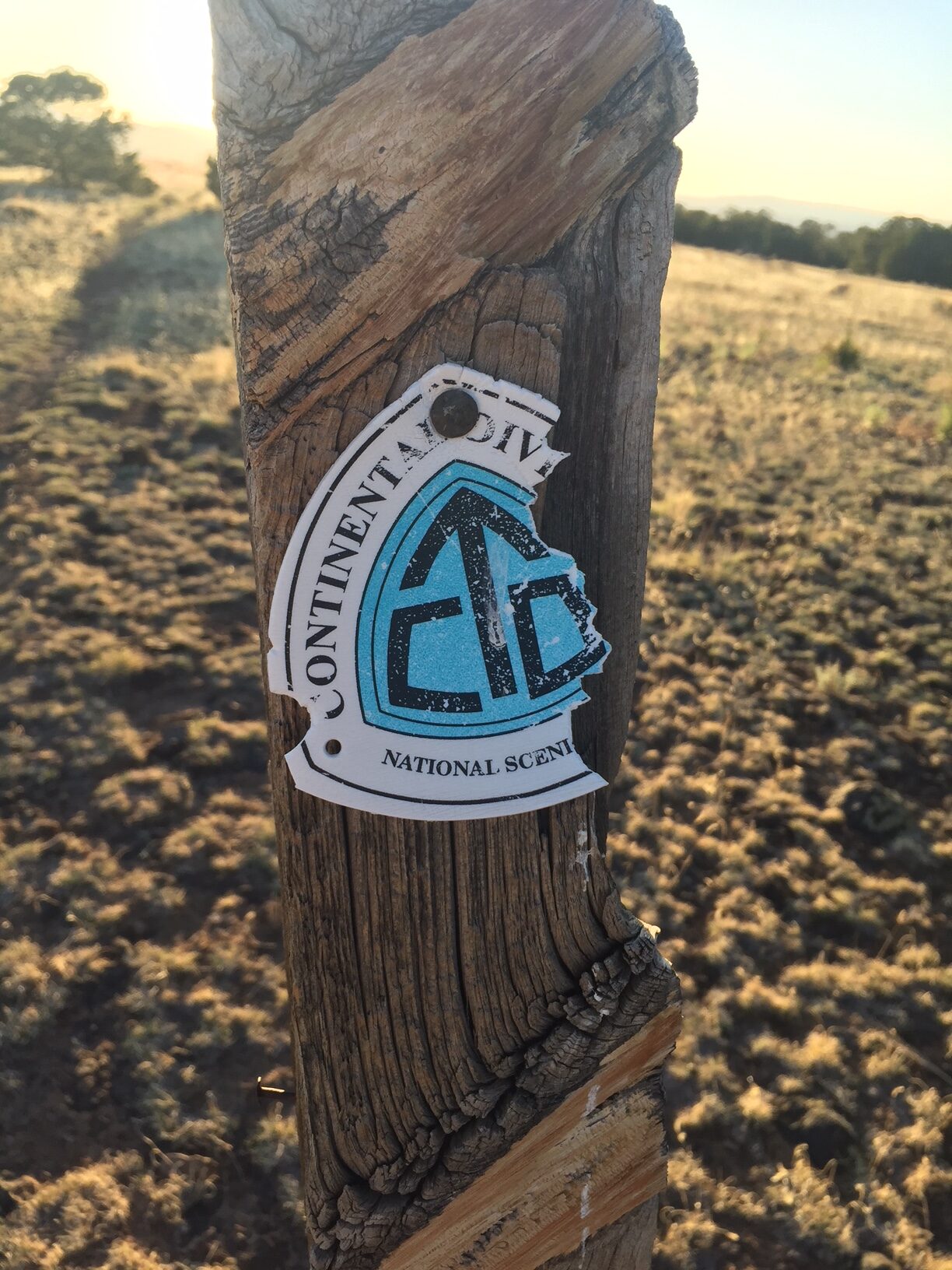
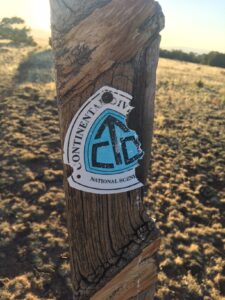
The prison is a landmark I watch for, ironically, telling me I’m almost to the gates of freedom. Around two curves of the road, I see the National Forest sign: “Continental Divide Trail.” Following the Rockies high and low, the Continental Divide marks the North American watershed, dividing waters flowing west to the Pacific and those flowing east to the Gulf of Mexico and the Atlantic. I turn right a third time, onto a short, deeply rutted dirt road into a dirt parking area that is always sparsely populated.
I’m learning to judge my trail access by the way vehicles are parked. If a couple of dependable, used SUVs are aligned faced into the boundary fence, a few hikers are on the trail. If an older pickup with a topper is backed into the farthest corner, hiding its license plate and activities, that could be anything from someone staying overnight to drug dealing to do-it-yourself shooting range, using your empties as targets. Today, a ratty compact sedan with no hubcaps is the only vehicle, parked dead center in the lot, angled for a quick escape. Sure enough, as I park at the boundary fence, three young guys immediately exit nearby brush, carrying on a forced conversation about absolutely nothing in voices tuned to be heard. Clearly up to no good, I watch them load into the car and peel out, tires throwing rocks, straining the buzzy engine of the sun-bleached little Mazda as they hightail it down the highway. I strap on my pack, click the beeping lock button on my car key, and stride through the gate and up the steep trail, moving fast, wanting to remain unseen just in case they decide to come back.
 It’s 3:30 on a mellow Friday afternoon, perfect, sunny, a cool breeze keeping the temperature in the mid-70’s. Having put in extra hours at the beginning of the week, I’d let my boss know I’d be leaving early today, and he’d encouraged me to go.
It’s weird having a steady job during this second Great Depression. Over 33 million Americans have filed for unemployment in the last seven weeks. I’ve been reading the New York Times: one in six Americans has lost their job in the pandemic, and the number will only grow.
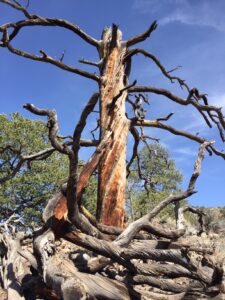
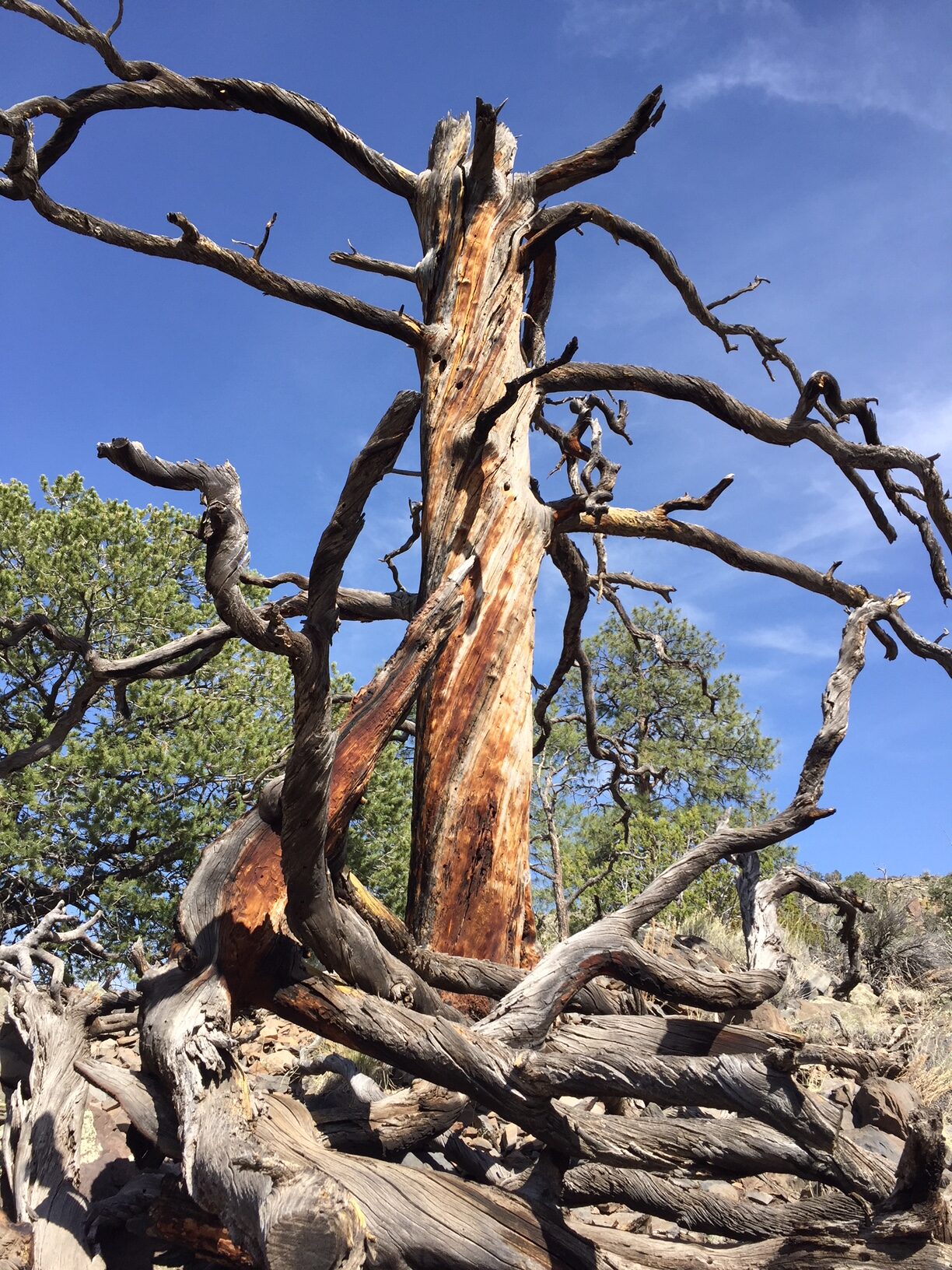
lightning-struck tree
Millions of people have filed for public assistance benefits in the past two months, in some states double the total applications for all of 2019. Cars fill stadium parking lots across our country and stretch two and three miles as people wait hours for food boxes. “Mortgage loan servicers,” the new name for predatory lenders, prowl like wolves. The working poor continue to rack up debt as they wait, hoping to be recalled to their hourly jobs.
My hiking trail winds around the edge of an incredibly steep hillside. Shrubs I do not recognize, with tiny green slivers of leaves, pink buds, and small four-petal crosses of white flowers, cling just below the narrow path amidst the rocks and cactus, offering a hint of fragrance. They are cliff fendlerbush, awkwardly named for Augustus Fendler, “the first academically trained botanist to collect plants in and around Santa Fe, New Mexico,” in 1846, according to the Forest Service. The prettier name is Navajo orange, K’iishzhiní, listed on New Mexico State University’s website “Selected Plants of Navajo Rangelands.” I like the Navajo word best, the soft sound capturing the sweet enchantment of this unexpected garden along such a treacherously narrow margin. I find this bush’s tenacious optimism encouraging.
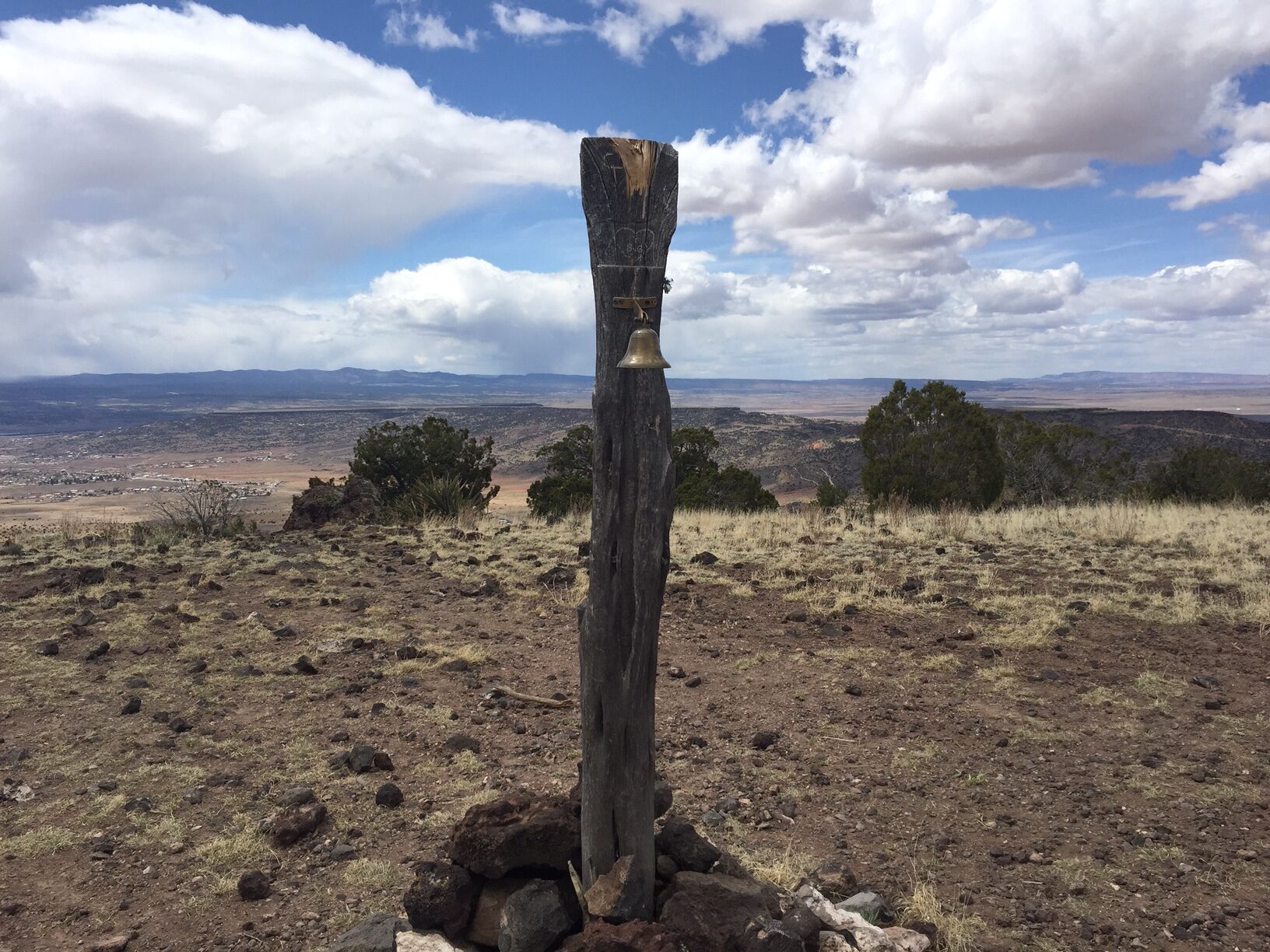
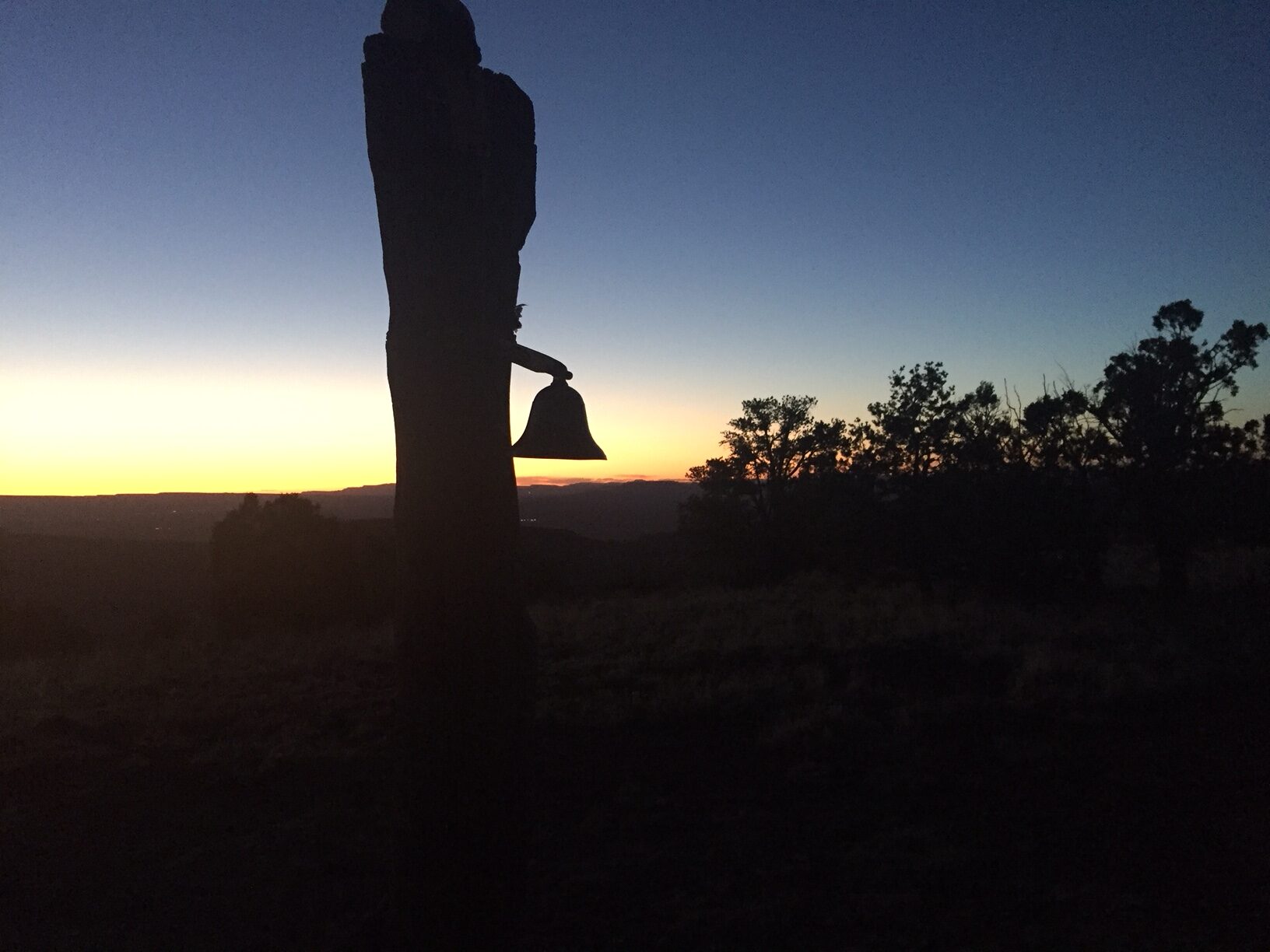
Less than an hour on the trail, I step beyond the scraggly junipers to reach the mesa summit. Here you can take in a panoramic view to the south, layers of hills slowly fading into the distance. Foothills of Mount Taylor block my view to the east, toward Gallup. However, mere steps to the west, on a tall post held steady in the center of a rock pile, someone has attached an old brass bell. It hangs at about face height, patiently waiting over the course of years for the dusty human beings who’ve made it this far to ring out the sound of their existence over the valley below.
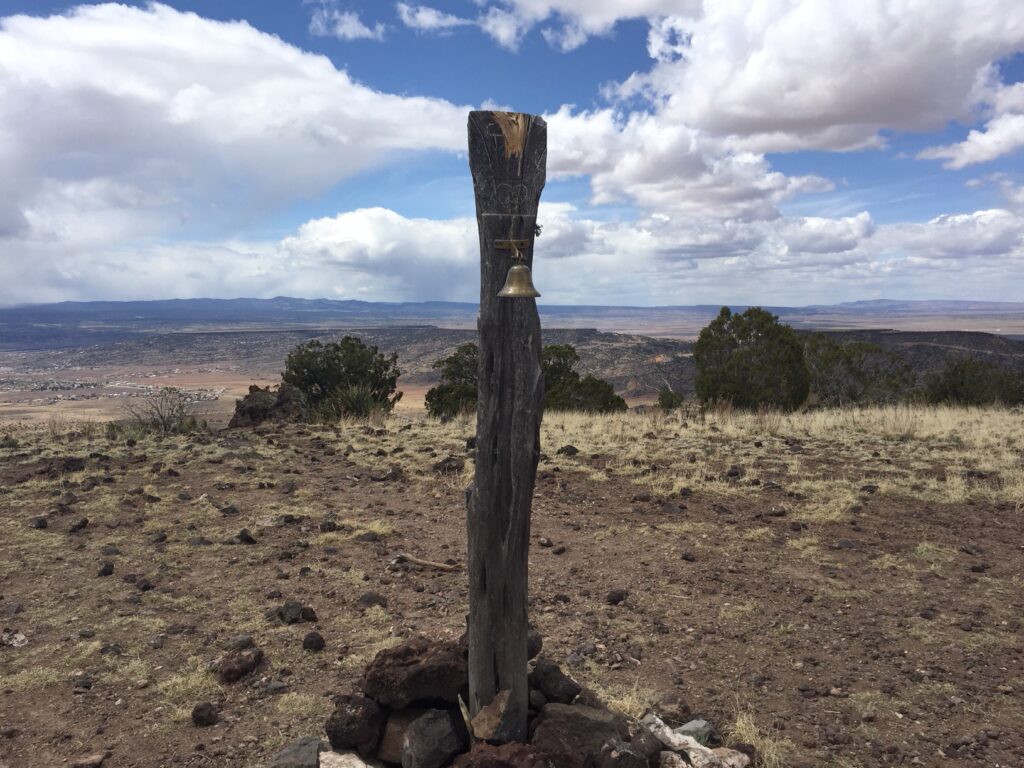
Every bell is a bell of mindfulness, asking me to pay attention, like the Vietnamese Buddhist monk Thich Nhat Han has tried to teach me through his books. I pick up a rock and tap the bell, and a soft, sweet note rings gently, a fragile voice that whispers away on the wind: K’iishzhiní.
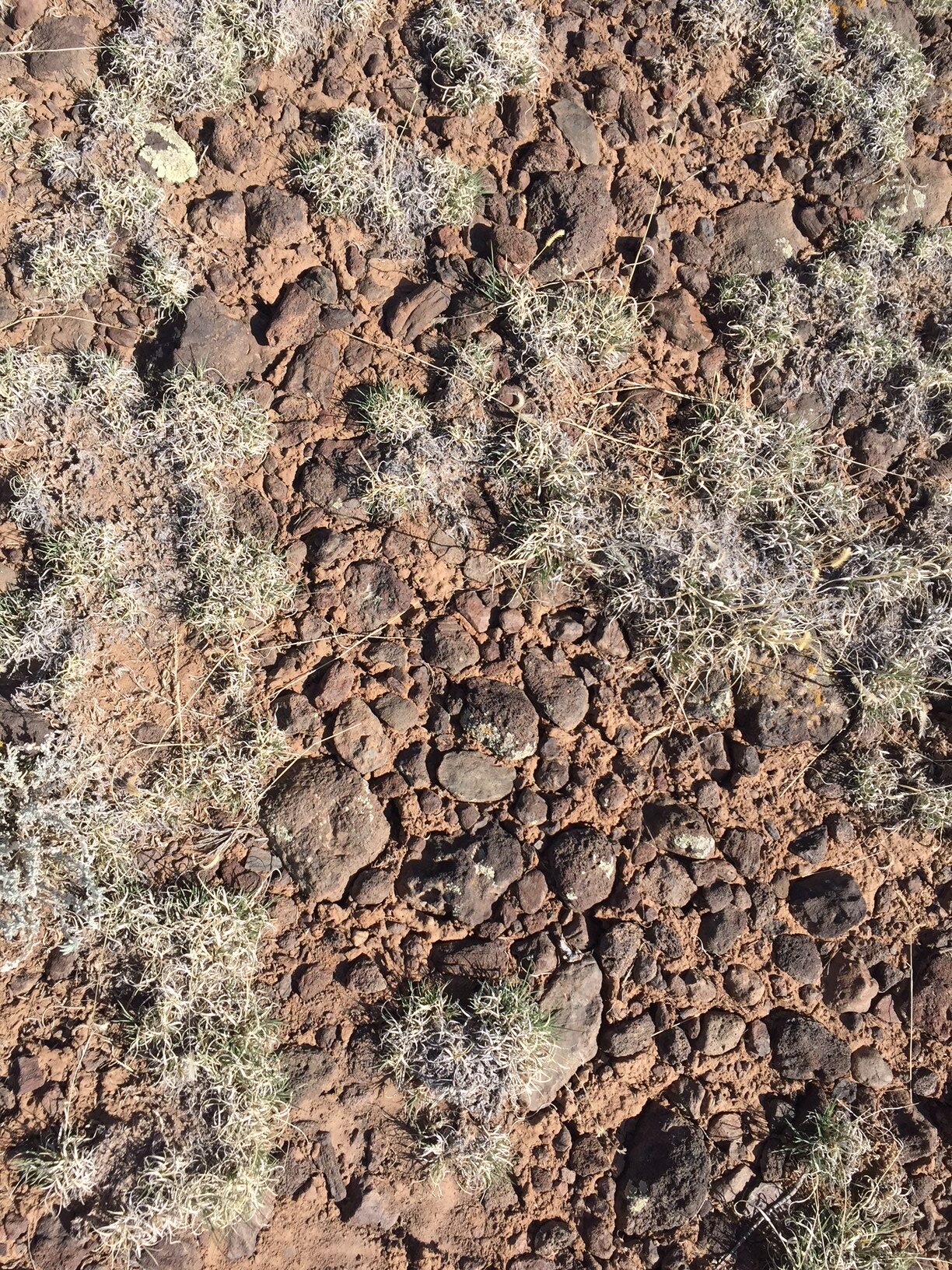
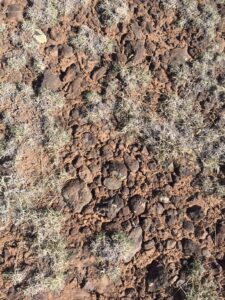 After a drink of water, the trail leads me north across the open tableland, evergreen scrub circling the edges of the mesa. Here, grass grows in dry tufts scattered among a vast cobble of volcanic rocks. The trail gently sways to the left and right, like a cow path through pasture. Nearby lies evidence that this may indeed be the origins of this stretch of trail: dessicated cow dung bleached nearly white, their cloven hoofprints hardened in the dry orange clay by the ever-present wind and sun.
Out of habit, I scan the treeline, watchful for wildlife, friend or foe. I’ve picked up a walking stick along the way, weathered grey, worm-trailed, but solid at its core. On my last hike up here, I’d found what looked like bobcat or coyote scat, full of rodent fur and tiny bones. But today, my only companions are birds, ravens overhead, warblers and sparrows singing from their distant branches. I pass through the first line of trees and across the next lower mesa. I wend my way through more juniper and split cedar.
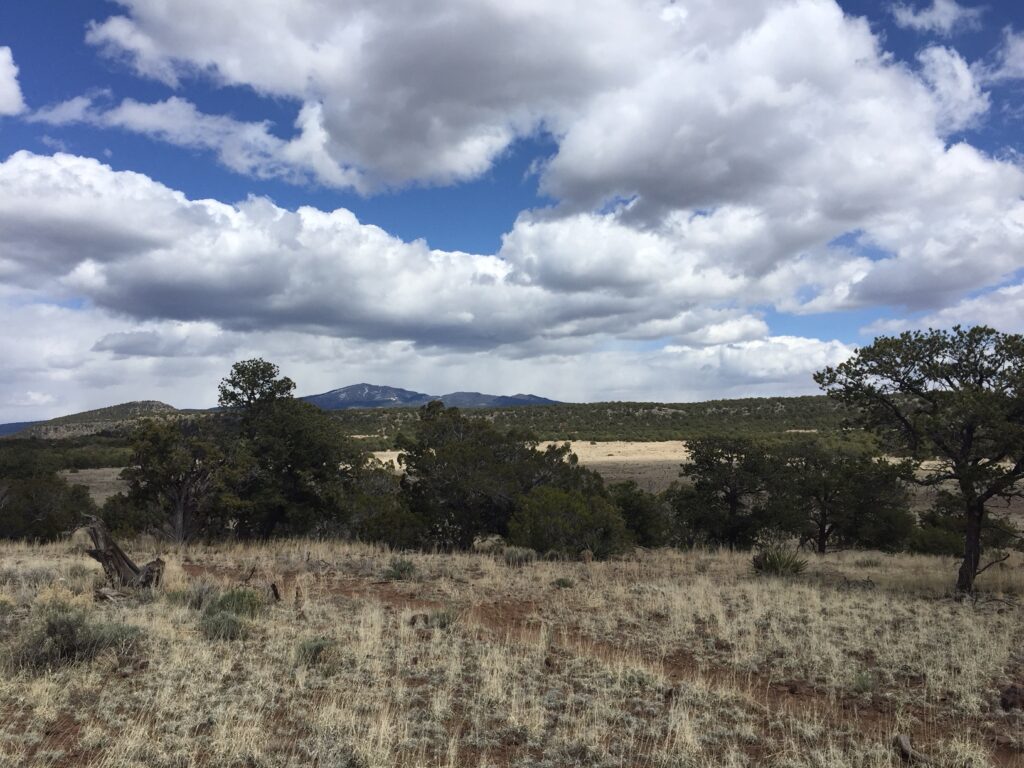
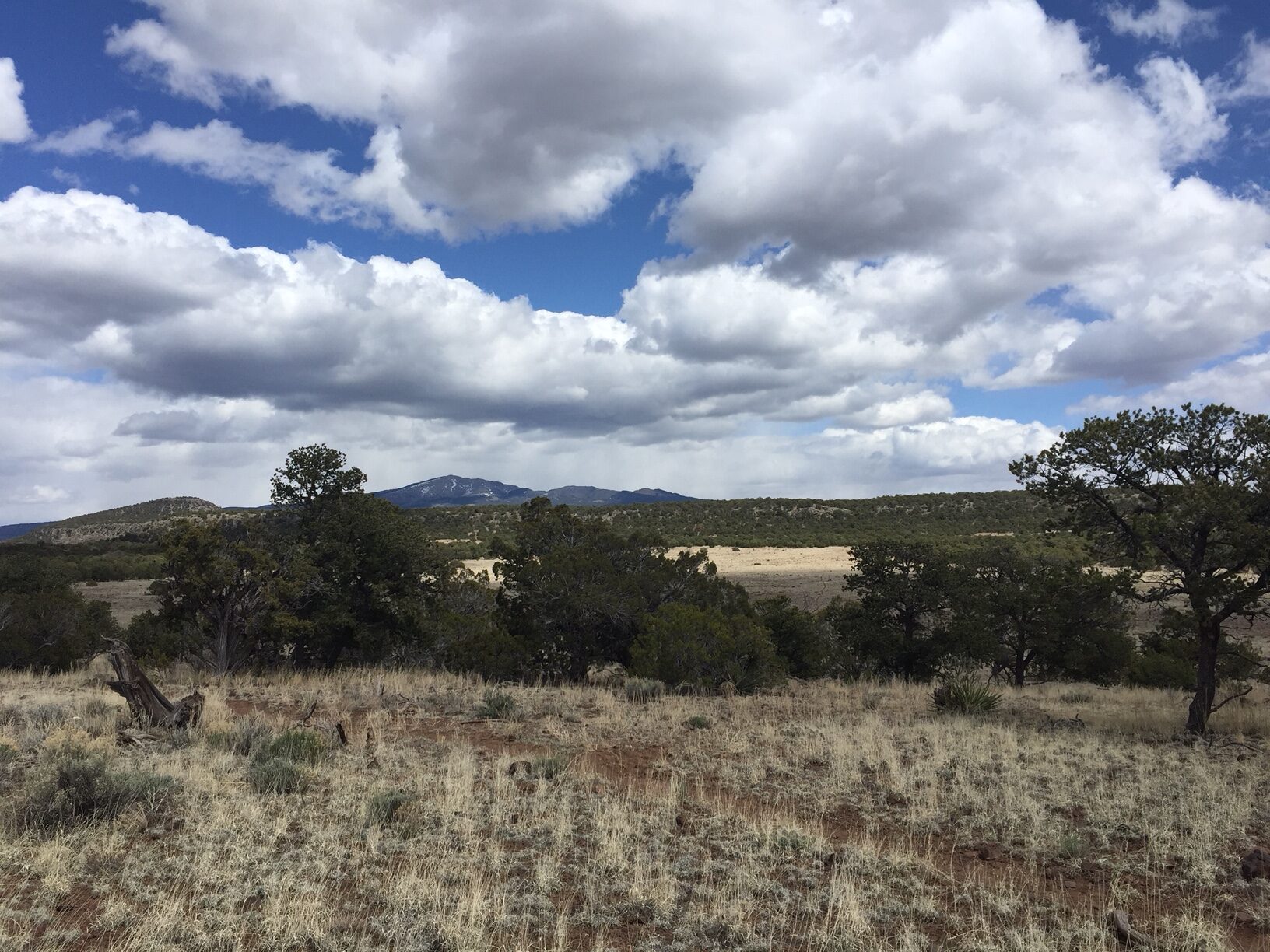
Now coming over a rise, I see a pristine valley opening to my right. No roads, no fencelines, the kind of high meadow within tree-covered hills favored by elk. This is as far as I’ve been on the trail to-date, and I happily continue around the next hillside.
The landscape becomes more of a low forest, and the farther I hike, the taller the trees grow, short-needled fir, spruce, and white pine, until I’m suddenly surprised to find myself on the top of yet another rounded mesa in a spreading grove of nothing but fat piñon. Just as I think it, I see it: elk droppings beside the path. I venture on, tall trees rising once again, white pines stretching higher, wondering if those are ponderosa I see, the harbingers of mountain trails.
As I reach a small gap in the forest, I notice two things nearly simultaneously: a view of Mount Taylor, looking closer and more attainable than ever, and another Continental Divide Trail marker nailed to a tree. This one’s a tiny little pine, with two angled branches of thickness similar to the central leader, all splitting from the same location. The effect is of a hand holding up three fingers, like a reminder of something, something I’ve lost count of. I look at Mount Taylor, pondering the little tree while perched on a low limb of a particularly spectacular piñon, the ground under my daypack littered with its wasted abundance. I nibble my veggie chips and chomp into my apple.
It’s 6:00. I have to turn around if I want to get down before dark. But how I wish I could just keep going, for days. I imagine hoisting my larger backpack, tent and sleeping bag secured, and wandering away, away from the day job I am lucky to have, away from cars and video screens and politics and reactionary people fearful of the unknown that lies ahead of us all.
At least I have walked beyond my worries today. Zipping my daypack, I feel wistful as I turn back, 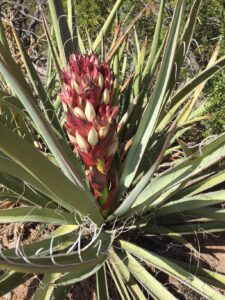 and something else, something stirring within.
Tapping along with the walking stick for an hour or so, I meet a young woman on the open mesa. From a distance I note the big pack, rain jacket, and quick-dry shorts. As she approaches, I see a carton of what I presume are hard-boiled eggs lashed to the top of her backpack. I step aside, giving her safe distance to pass.
“Have you seen anybody else on the trail?” she asks me by way of a greeting. A familiar style of greeting. And as she says it, I feel joy, as if I have come home.
“No, nobody,” I smile at this stranger. “How far you going?”
“Just to Cuba.”
“How far is that?”
“Mmm, maybe 90 miles.” She cocks her head back and forth between empty hands like scales, the gesture of the we’ll-see-guesstimate: “I’ve got food for five days.”
“You’ve done the Continental Divide Trail before, the whole way?”
“Oh yeah. I’ve done all of them.” She grins, the pink streak in her blond hair shining in the afternoon sun. “I’m one of those people.”
I smile broadly. You’re one of my people. Before we part, she tells me that since she’s now unemployed, she’s heading back onto the trails, reconnecting to that part of herself she loves 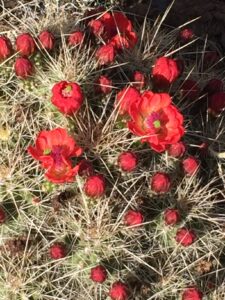 most and has neglected in the city.
And there it is.
It’s been three years since I went trekking across Spain. Signs and messages come in threes. As do prisons.
So many things cancelled, locked down. It’s hard to feel free. Yet my first book still goes to the editor in July. Ring the bell: I’ve made it this far.
Maybe I could follow that familiar stranger, joy, hike over Mount Taylor, all the way to Cuba, or beyond. Use some paid time while I have it. While I’m well. While I wait to hear what comes next.
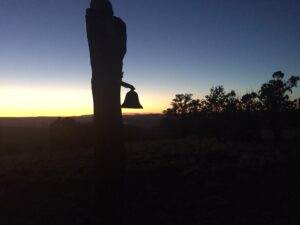 As I reach the overlook, I turn right, to face the setting sun. Standing in the warm rosy glow, chewing on a twig of sweet-tasting Navajo orange, I contemplate the unexpected abundance of my life, spent constantly walking the Great Divide.
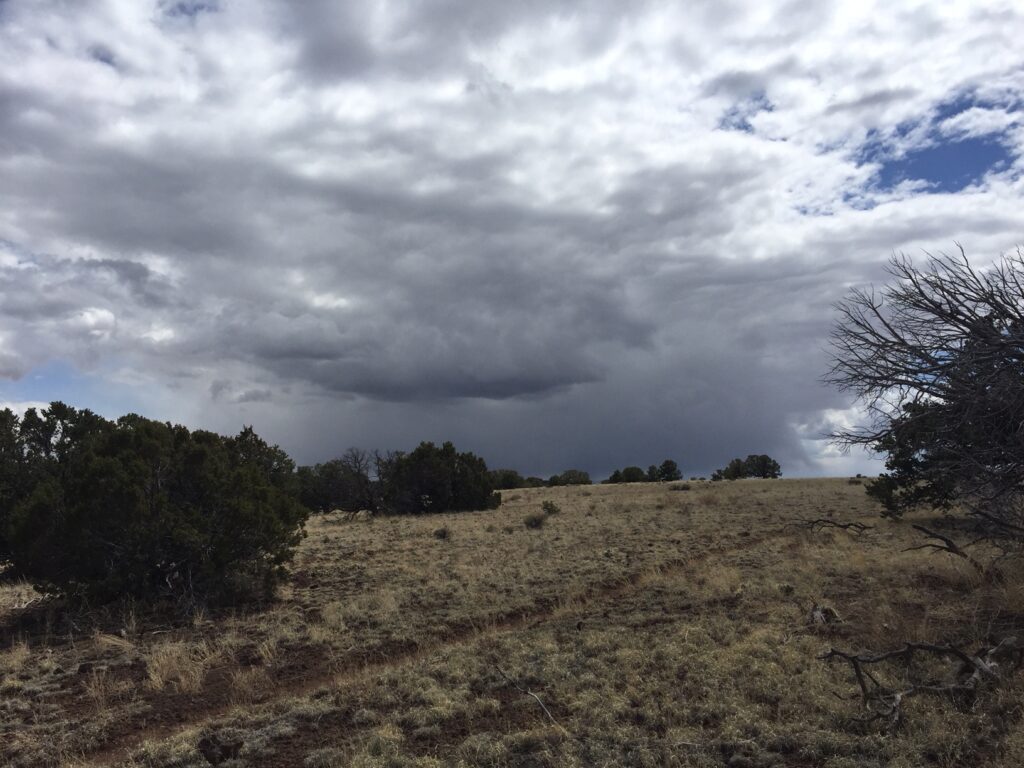
Water only flows to one sea or the other. But first, it comes to us as rain. In this way, somehow even the desert blooms.
K’iishzhiní, whispers the evening breeze.
February 29, 2020 / wanderinglightning / 0 Comments
After I lost my shoe, I definitely thought a lot about my next steps. One foot walked the same old walk, carrying on as usual, though my sole was worn nearly through; one foot placed itself more knowingly, swaddled in extra socks as if swollen by injury, as if I was doing the best I could – despite my own carelessness that dropped the lost shoe behind my gym locker, never to be retrieved.
But isn’t this the usual price of carelessness? Self-injury? Even when my thoughtless, heedless, mindless actions hurt others, they double back and bite me in the heel, too, like a snake in the grass. Or in the dust of the desert.
The way I know I’m taking a misstep is that I feel as if I’m off my stride, out of balance. If I continue, I feel an ache. But it’s not in my foot or ankle – it’s a heartache, low but insistent, the regular pulsing of regret.
Some people say they will never regret. All well and good; maybe these people never had responsibilities to someone they love, someone small or someone old, someone depending on them in very real ways that tied them to frustrating realities. I have experienced regret. I have limped through mediocre choices, too tired to believe I could be more than what I saw reflected in the bathroom mirror each night. Turn out the light, ignore that image, sleep until tomorrow.
“No regrets” is a shallow motto. It is the battle cry of immaturity. Everyone regrets, if they wise up, grow up. Regret is the key to repentance, which is the turning point for resolve.
Religions have co-opted the word “repentance,” but I want it back – it’s a damn fine word. One definition is “sorrow, shame.” But another is “pangs of conscience.” The Greek root of the word repentance can be translated as metanoia: a change of mind. Some call it a change of heart.
“It implies making a decision to turn around, to face a new direction. To turn toward the light.”
— metanoia.org
For each of us, a way of living beckons like a light in the darkness. We call it by many names: the dream, destiny, “someday,” or most usually, “You know what I’d really like to do….” The truth comes out over beers, or while changing diapers or pushing swings, or talking about frustrations at the office or the shop. We get down into the dirt, and we get real. We acknowledge those pangs, like a hunger for something we’ve heard of but never really tasted. Or maybe we have tasted it. Maybe the sweet taste of victory has turned to ashes in our mouths.
Such was my feeling stepping into Ash Wednesday. Like I was still walking with one shoe on, one shoe lost. Because despite my best reframing efforts, trying to convince myself this full-time job is a sweet opportunity to stash some cash and get ready for my next travel opportunity is wearing thin. I have tasted the life I want, and I struggle to convince myself that I’m still on my path. I’m noticing a bitter taste as I work to keep my impatience down. It’s a spiritual heartburn, which feels just as stupid as it sounds. I feel like I know better, and I’m kicking myself.
Therefore I despise myself, and repent in dust and ashes. – Job 42:6
Job was a pawn. In the Bible story, God bragged to Satan that Job was “blameless and upright,” to which Satan replied that God had “put a hedge about him and his house and all that he has, on every side.” Satan said that if God took away Job’s sweet life, Job would curse Him to His face. So God said fine, give it a go, just don’t kill him; don’t worry, he won’t turn on me. And Satan promptly proceeded to torture and torment Job.
What the hell kind of god is that? While God watched (or didn’t), Job’s blameless uprightness was shredded – his farm destroyed, his family annihilated, his body diseased and inflamed. What doesn’t kill us…makes us stronger? Makes us question if anything we do even matters?
Being ripped out of the hedge flings us far from the familiar, dropping us hard in the dirt of a crossroads of the soul. It can make us so bitter that resentment is all we can taste. We give up and give in, to our worst beliefs and our worst selves.
Or, looking down the other road, it can remind us that this one life is all we have, and we need to quit taking it for granted, so certain that there will be more days, that we can waste any of them. I had touched on this viewpoint when I was traveling, and found it invigorating. Then I ran short on funds, so I snuck back behind the hedge. I’ve been struggling to break free of the more-than-full-time salaried job ever since, especially over the past year. Hence the heartburn, acid frustration eating me alive.
Choice is power. Sometimes, the only choice we can find is how we focus our minds. Which road to look down. Making the decision to turn around, again, face the direction we know we want, again. Turn toward the light. Again.
Ash Wednesday is a holy reminder that we are mortal. It doesn’t matter what religion we follow, if any. Christians take the palm branches used by multitudes to celebrate Jesus’ arrival into Jerusalem as the King and burn them to ash to remember how a week later, the same crowds chose to save a thief and crucify their King. We are those multitudes. We choose to follow our best and highest callings, the truth of who we are; and then, a week later, we turn on ourselves and choose the thief, Fear, also known by the names Maybe Later, When Life Settles Down, and That Was Just A Crazy Idea I Had.
Ash Wednesday reminds me of the Upanishads, too. In the Hindu faith, holy ash is applied in particular ways to particular areas of the body, including across the forehead. The sacred ash is bhasma; it is ash from a sacrificial fire. The roots of the word bhasma mean “to destroy” joined with “to remember.” It is generally described as burning away evil to remember the divine.
By applying the sacred ash to their bodies, devotees of Lord Shiva embody both the transience of this life and transformation: a state “beyond perturbance,” with nothing left to burn away.
I was still perturbed. How to get to the point where I’ve burned away fear, with nothing left between me and the life I want to wear across my forehead like a rite of passage? What are the ingredients of my sacrificial fire?
My ridiculous, crazy idea is that I can walk the world in a continuous pilgrimage, learning and writing. Remembering I’m just a guest wherever I go, a stranger just passing through. I’ve started. I completed one route, across Spain. I determined my next route: Japan. I made arrangements, had a trip scheduled – and was typhooned out, airport ransacked, mudslides destroying the paths I planned to take. I looked again this year: a raffle for free plane tickets to Japan was rigged against me by limiting itineraries to just 10 days. I needed weeks. Japan would have to wait while I saved my yen.
Without a destination, I was walking in circles, down the hill and past the train tracks to work, then back, past the homeless people setting up their blue tarp tents under the setting sun, up the hill as the train bells clanged and left me behind, rolling away down the line. I have been regretting my decision around work, knowing I am not doing what I’m supposed to be doing. I just don’t know how to do it without money. And I don’t know any other way to get the money to do it.
Like all the best crossroads, I cannot see far down the path I need to take. But I can see where it starts. And I’ve learned that the only way to see farther down the road is to start walking it.
Again.
So in April, I’ll walk a local pilgrimage route – to El Santuario de Chimayo, almost 100 miles northeast as the crow (or in New Mexico, the raven) flies. Peregrinos get themselves to Santa Fe by whatever route they can. Mine will be along the Turquoise Trail, a high road between the Sandias and the San Pedro Mountains I have driven enough times for it to be somewhat familiar. From Santa Fe to Chimayo, we join and walk together – highway lanes are closed to let thousands of seekers make their pilgrimage during Holy Week, that time between waving palm branches at our ideals and carrying our cross up the hill.
At the Santuario, el pocito (“little well”) is a sanctified hole in the ground, offering holy dirt famed for healing. The faithful rub it across their bodies, turning their Job-like afflictions into miracles. Canes and crutches are left behind as testament to transformation.
You’re not supposed to consume the holy dirt at el Santuario de Chimayo, but apparently some people do. While no one has determined scientifically the healing components of this soil, it was found to contain high levels of calcium carbonate – the main ingredient in heartburn remedies.
Up the path a few steps farther sits the Santo Niño chapel. I read that here, shelves are lined with rows and rows of pairs of little shoes – all gifts offered to the Holy Child, to make sure his small feet are protected as he journeys to offer comfort to all who suffer. Even Tiny Jesus walks his own Camino.
I need new shoes, as does Santo Niño. I will bring him a small pair. I resolve to burn this old, worn-out shoe that has walked my old, worn-out path. That ought to be a delicious smell.
To destroy, to remember: can’t be one foot in, one foot out. Sacred ash, holy dirt.
“If you are a stranger, if you are weary from the struggles of life, whether you have a handicap, whether you have a broken heart, follow the long mountain road, find a home in Chimayo.”
— newmexicoexplorer.com
February 22, 2020 / wanderinglightning / 0 Comments
How do you know when it’s time to run?
I’ve been running on a treadmill. Literally. Instead of trailrunning across mountain foothills, I’ve been walking down city sidewalks to a downtown gym. There’s nothing wrong with working out in a gym – it’s just that I’m not a gym rat by nature. I’m a nature rat, in fact, when it comes to running.
It’s so hard to realize what you’ve gotten yourself into until you get yourself out. Start getting yourself out, at least: start looking over your own shoulder, seeing where you are, where you’ve been. Get some perspective.
In the locker room, I finished changing from my work clothes into my workout clothes. I sat on the wooden bench just like in the old days, getting ready for basketball practice, softball practice, soccer practice, track practice. Leaning over, I pulled my laces snug and tied a double knot for the twenty-thousandth time.
Twenty-thousand days is just over fifty-four years. Even accounting for babyhood and barefoot days as a child, that shoelace figure is bound to be low.
I know the squeak of my soles on the wooden basketball court intimately, the feel of a cinder track from a rubber track under thin running shoes, the softness of the grass on the soccer field, or digging that back toe into the dirt of the batter’s box, ready, watching for the pitch.
I stood and locked my adult life into the narrow locker, giving the dial on the combination lock a half spin with the practiced flick of my thumb and fingers. As if I didn’t care about ever opening it again, ever retrieving my badge and work keys and the circling weeks of dissatisfying responsibilities moving ever closer to a year. To year after year. I filled my water bottle, then turned and walked to the treadmill.
I start here, I end here, each workout at the gym. Step onto the black rubber loop, hit the Start button, and the machine begins moving under my feet. It always starts too slow; I always find myself annoyed and kick up the speed to my pilgrimage walking pace, arms moving, chest forward, head high.
But it’s not a pilgrimage; my backpack is at home, unused on a shelf in my closet. My walking stick stands idle in a corner. My back is unnaturally light at this pace, and I always feel off-balance.
This day was no exception. And like each day on the treadmill, I brushed off my unease by turning up the pace again. Twelve-minute mile…eleven-minute mile…ten. As the speed increased, I took a deeper breath, adjusting.
The point where my eyes usually landed when I ran outside was inhabited by the red digital readout showing my mileage, pace, calories burned, heart rate. I lifted my eyes; I read the brand name of the treadmill.
I lifted my eyes further. The gym was walled with mirrors. In them I could see my running shorts, moving smoothly like flowing water. I settled my gaze and watched my legs run, and run, and run, these legs that had taken me so many places, that had traveled so far. I watched the muscles pulse and contract, over and over. I felt my heart beating.
I reached forward and adjusted the settings: nine-and-a-half. I looked up over the top of the digital screen and straight ahead. An old, familiar face watched me from the mirror, breathing methodically. Still running, I straightened the angle of my head, as if greeting myself. I noticed how my shoulders remained at different heights, one more forward than the other. I tried to adjust, but it was as if the arms were attached by different mechanisms at different points on each side. My hips do not match either, I know this; my yoga teacher years back helped me to see my imbalance. It’s become interesting to me now, the ways my body has been twisted and reformed by my living. One shoulder dropped from all the years carrying my work bag to the office. Hips distorted by childbirth. Pelvis torqued by the internal scar tissue of surgeries.
Nine. I watched with detached satisfaction as the strong muscles between my shoulders and neck flexed as I moved into a full run. My hamstrings began to remind me of my age. My quads said we could do a little more.
Eight-and-a-half. I like to push myself as I finish my warm-up runs, even if only for a few minutes. Without cues from the natural world, every quarter mile feels like forever on a treadmill, instead of marking a distance so short I’d hardly notice, if outside.
When my stride became a bit uneven, I felt I was probably nearing the end. I looked at the mileage: .84. Unbelievable, how far I had not come. How could I possibly be under one mile? I snorted like a tiny bull and kicked back into gear, frustrated and confined, by my age, by my life, by my job, by this gym, by this treadmill I was running. I pushed myself back into a rhythm and willed myself not to count the minutes. I counted the tenths and hundredths of a mile instead, until .99 kicked over to 1.00. I hit the Stop button. The machine read my heart rate. 179 quickly dropped to 169, to 159, to 135. I huffed, irritatedly shaking my head, then hopped down and took a drink from my water bottle.
It wasn’t the mile or the pace that was hard. It was the treadmill.
The feeling of running on a treadmill is heavy-footed, no matter the pace. Unnatural. It’s the feeling of forcing yourself to do something because you think you should. For me, it feels awkward and frustrating.
Running has always been a way for me to leave my life behind, whether running away from home as a kid, running as part of a team as a lonely adolescent, or trailrunning after work to shake the dead weight of professional restraint. But my running always circled back to where I’d started.
Twenty-thousand days, and I was still running in circles. Twisting my shoulder to wipe my sweaty face on my T-shirt sleeve, I decided I was training for my next journey, my next adventure. Or maybe I remembered; I feel like I keep having to remind myself who I am, why I’m here, what it is I want to do with my life. I keep running the same loop, over and over, working a day job until it works me into the ground, finding the strength and the stamina to keep on running, finally hopping off the treadmill in a leap of faith mixed with huffy frustration at myself – for continuing to expend so much energy going nowhere, when I could have been out in the world all along.
I needed to use running to prepare me to walk away. Which is what I have been saying for six months now. Which I was saying for six years before that. I keep leaving the world of full-time work and then coming back, circling back to where I was before. I keep walking away and then running back to security.
I was thinking all these things after my workout, after weight lifting to build bone mass and balanced support, after resistance training for core strength and quick response, after a cooldown run, hoping to cool my agitation. I sat on the bench in the locker room and took a long drink from my water bottle. I leaned over and untied the double knots, slipping off my old shoes. The tread was virtually gone, the soles nearly worn through, the pavement and the treadmill taking their toll. I stood and stretched in front of my locker, then holding my shoes in one hand, I tried to turn the dial on the lock with the other. The lock swayed and the dial balked. I reached up to set my shoes on top of the locker so I could use both hands – when suddenly, I felt one of my shoes slip from my fingers. I heard a muffled flump.
It didn’t make sense. I looked up and saw only one shoe on top of the locker. I looked at the floor around me, but of course it was empty; I hadn’t seen anything fall.
Taking off my socks, I climbed barefooted onto the bench and stood on tiptoe, peering up onto the top of the lockers.
What seems solid, bound and sealed, often is not. I keep forgetting this ancient truth, and Life keeps reminding me with recurring lessons. How far I have not come.
As the row of lockers met the corners of the locker room, they didn’t fit exactly. So the gym owners had simply angled a couple lockers to cut each corner, and braced them with thin slats screwed across the backs. Leaving triangular gaps just the right size for a shoe to drop, all the way to the floor behind, impossible to recover.
I stood on the locker room bench, looking at my one shoe atop the locker. I imagined climbing onto the lockers – but to what end? I had no tool to hook my fallen shoe. And suddenly, I noticed that it was 8:00pm on a Friday night. The gym was only staffed until 7:00; after that, 24-hour access was maintained by security cameras and by scanning your electronic fob at the locked doors. I realized the man who had been lifting free weights had already left. Everyone had gone out or gone home. I was completely alone.
Up on my toes on the locker room bench, I straightened my cocked head, then hopped down. I started laughing. Spinning the dial on the padlock, I swung the locker open wide and took out my towel, heading to the showers. I found myself humming, steam surrounding me like mountain mist as I took time to loosen and roll my neck and shoulders under the soothing hot water. I turned off the shower, and still the gym was silent except for the sounds of the turning fans. I dried off and got dressed, then scrubbed at my hair with the towel before tossing it into the basket across the room.
Two points. I put on my socks, and my old right shoe, chuckling as I saw myself tie the lace in a double knot out of habit. Then I put both of my workout socks on over my regular sock on my left foot. I looked like I’d just gotten a cast put on, or maybe just gotten one removed. It felt like that – like getting to learn to walk after a healed injury, a little uneven, a little awkward.
But then, tossing on my hoodie and my rain jacket, I picked up my bag and marched resolutely across the empty gym and out those locked doors. One shoe on, one shoe gone. Forever. One foot in this world, one foot striding into the one I want.