October 25, 2017 / wanderinglightning / 0 Comments
three graces
to illuminate my mind
to burn my words into a sword
to break our hearts
with the beauty of it all
The cab driver was confused. After shaking his head and trying to dissuade me from hiking the coastal route of the Camino (“montañas”), I gave him 40 euros for a 28 euro ride. “For luck,” I told him: for being kind, and helpful, and forgiving my useless Spanish. For this odyssey upon which I was embarking. He let me shake his hand, offering me, “Buen Camino.” I smiled, not realizing it was the first of a thousand such blessings I would receive, then walked toward the wrong hotel door. He honked and pointed, and once more steered me right.
Up the narrow stairs, at the front desk I was greeted by Begoña; she said most women in Bilbao have this name, which makes it easy to address people on the street – “Try it! You’ll see!” – and we both laughed. My room at the end of the hall looked exactly like the online photos, meaning aging, rundown, and absolutely charming, with a view out the long floor-to-ceiling windows of the Teatro Arriaga across the street. Cool air flowed through the long unscreened windows and gently fluttered the gauzy curtains. I stood my backpack next to the writing table in the corner, and hauled off my hiking boots and socks. Several pots exploding with flowers filled the balcony to the left of my window, including begonias. I could see the river past the plaza de teatro.
I ran a hot bath, knowing I would not have another for months. As I soaked in the steaming water, I thought about the many begonias in Bilbao: the cathedral, the flowers growing around lampposts and on balconies, the women like exuberant flowers gracing the city. I found out the Basilica de Begoña is the cathedral of the patron saint of Bizkaia/Biscay, named Nuestra Senora Begoña. Our Lady of Begoña. I had arrived in the Basque region, fiercely independent people with a long tradition as sailors and navigators. Sailors who were immensely grateful for returning from the fierce Atlantic Ocean into the Cantabrian Sea, known in the west as the Bay of Biscay; they navigated up the Nervión river and offered thanks to Our Lady as soon as they could see the high steeple on the hill. I later learned the begonia flower symbolizes many communications, including this gratitude, giving thanks for a favor or assistance. It can also mean a warning of upcoming misfortunes or challenges, including those dark thoughts that can distract you from your joy.
For now, nothing could distract me from it. I set out into the neighborhood and found a small cafe with an excellent soup: sopa pescada con mar. In the delicious, rich, rusty-brown broth floated scallops and mussels in the shell, and an entire, enormous prawn, the giant shrimp found here. Who knew shrimp legs are delicious? I still couldn’t bring myself to eat the head of another being, however. The waitress, mixing Spanish with a few English words for my benefit, asked if I wanted wine, and I said no, water please. I thought she asked “single, or cold glass,” and was regretting that I’d answered “cold glass,” thinking I had foolishly asked for local tap water. Instead, I received a sweating bottle of sparkling water with my soup – “con gas” means carbonated. It was the perfect drink. I sat at my outdoor table with its white tablecloth in the wide, lively alley behind the hotel, where several restaurants’ late night customers held court over bottles of wine, or laughed softly and intimately, as neighbors walked through on their way home. I could feel the moisture in the breeze, and would have dozed in my chair, looking up at more flowers, geraniums on balconies, soft lamps glowing behind flowing drapes in apartments above, the restaurant lights warm and inviting. In Bilbao, I felt like I’d stepped into a romantic fairytale. Every scene was richly textured. The very air wove itself through the story, as I smelled the sea, faintly, now and then.
I wished Begoña buenos noches and fell asleep in my bed to the sounds of laughter and footsteps, trains and motorbikes, and one lone saxophone playing Spanish melodies somewhere, all below me in the street.
* * * * * * * * * * * * * * * * *
In the morning, I set off to find coffee and a bus to Irun. As I wandered the streets of last night, here marched Begoña, who called, “Hola!” like a hug and asked what I was looking for. When I said coffee, she took me back to the bar next to the hotel even as I protested that it was closed. Her answer: “Oh, he’s nice, you’ll see,” and she knocked on the door. Raul opened the door to her rapidfire explanation that I was una peregrina searching for the holy café con leche and he let me in, making a lovely thick latte. Lovely as in I am in love with the Spanish idea of a cup of coffee; it is a deep and intense moment of desire, a lingering kiss each morning, and I felt spoiled all day because of it.
I walked across Bilbao afterward to find the bus station. The river curves through the history, the theater district, the churches and government buildings, and I cross over all on cobblestone plazas rising onto bridges and streets leading into the hills. Once, lost in map study on a corner, a very dear older man with musical English explained the route and wished me “good way” offered with his cheery smile. I waved goodbye, and thought about what it would be like to live in Bilbao. The entire city was fitted onto the foothills of mountains, so people walked up or down to get where they were going, and always with a view of the mountains between the buildings, a framed landscape wherever I looked. Bilbao was like no mountain town I had ever known, a mountain city near the coast, gone European and self-confident. The old city by the river was especially energetic, edgy and delicious. Posters offered museums and art exhibits large and small, and always a street musician played with an open case sprinkled with coins.
I waited only 20 minutes at the station for the air-conditioned bus in the July heat. There I met the Three Musketeers, who were actually the Three Graces in disguise – Charm, Joy, and Beauty, better known as Vicki, Pat, and Bernie, respectively. These three women were all teachers from Britain, two retired, one on summer holiday. “You Australian?” they had asked. Americana. They immediately absorbed me into their group as we tried to figure out why this bus to Irun was in fact not now the bus to Irun…it all worked out, and we found our way to Irun and so to the start of our journey.
I feasted on irony, pinxchos, and beer with the Graces at a pub next to the albergue, the word for pilgrim hostels along the Camino de Santiago. Vicki was annoyed by the bar owner who didn’t seem too anxious to take the order of four women backpackers, and she kept up a steady stream of abuses about his pace and the quality of the service. Bernie offered witty asides and quips and was so helpful with her fluent Spanish they called her The Linguist, and it was easy to agree. Pat was the experienced through-hiker, and a runner, fit and easy to like – and 69 years old. Her pack was small and tight, her step solid and balanced. While Bernie was exploring the possibility of a new love, and Vicki was impatiently waiting for a paycheck to hit her account, Pat was the glue holding the trio together.
As we waited for the albergue to open, we walked a path through a nearby natural area park, and as we imagined walking the Camino, talk came to the subject of past health issues. Pat’s husband had malignant melanoma, but was going on five years “clear,” approaching that mark where he might breathe again after such a long fight. She talked about going to college again after her children had grown, and not being identified as their mother or Jim’s wife, but just as herself, and she reveled in it. I told her I was following the dream from when I was 17, so I decided to bring that girl along – just me, and me. She nodded approvingly.
What I didn’t elaborate on was my own brush with cancer several years back. More than five. But my cancer could return whenever it wanted: I had a nasty and, in my case, particularly persistent virus that could cause cancer cells to develop at any time. It had already cost me two surgeries and three organs, an ugly tally. I had taken it as a warning shot fired across my bow, that life can end at any time. My life, ready or not.
What I also didn’t share was my supplication to any angel that could hear me, that this trip would heal something more lethal than cancer for me. I was making an entreaty for wholeness. My body was strong enough to make this long hike, at least for now. But I had other issues weighing me down. What I wanted to let go of was my fear of giving up on my life. Of drowning in dissatisfaction before I was finally the poet, writer, singer, artist I had always wanted to be. The “me” I had been, but hadn’t seen through to completion. I needed to go on this pilgrimage and arrive to see a steeple on a high hill, and thank Our Lady for my safe journey, and safe return…to myself.
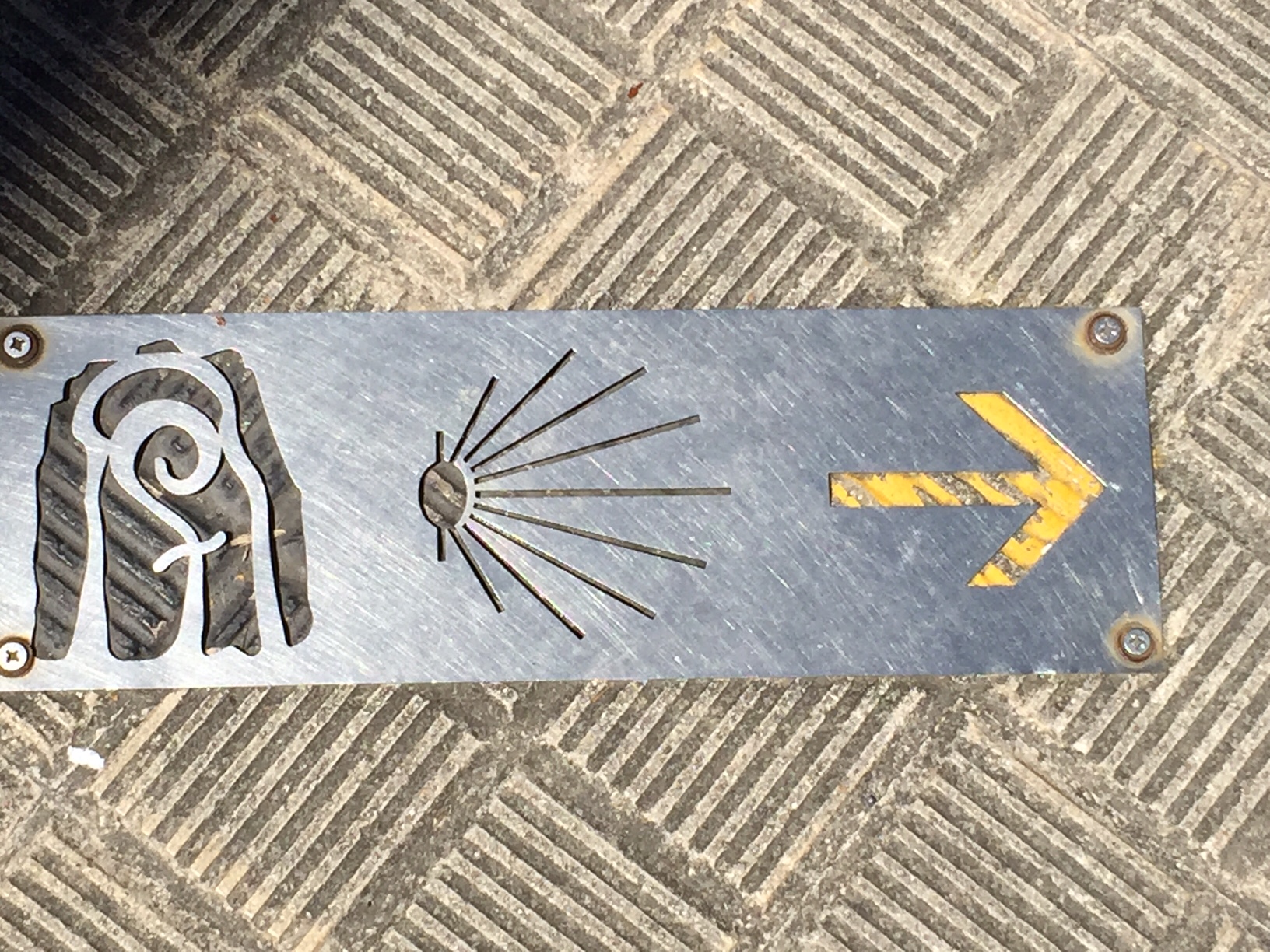
At the albergue, I received my credencial, and its first sello – the first stamp on my passport for the Camino. I tied a white scallop shell to my backpack, the sign of Santiago, Saint James, and the mark of the spiritual traveler. I had found the starting signpost, been given blessings by strangers, guidance by Santa Begoña, and nourishment by the Three Graces. In the morning, I would set off for Santiago de Compostela, over 800km away. And beyond.
October 24, 2017 / wanderinglightning / 0 Comments
la mar
Mother of Life
la madre
oh Mary where
among the saints
does the sea
have her name
engraved
Having slept on three planes so far, after 20 hours of travel I arrived rumpled and excited in Lisbon at 6:00am local time. The sound of my passport being stamped for the first time echoed in my ears as I exited the airport – and found myself officially in Europe.
I got a real coffee. Thick foam, lovely brown, hearty and satisfying like a crusty loaf of homemade bread. The tiny white cup and delicate silver spoon let me savor my first moment away, relaxing at my cafe table like a movie extra, anonymous behind the story.
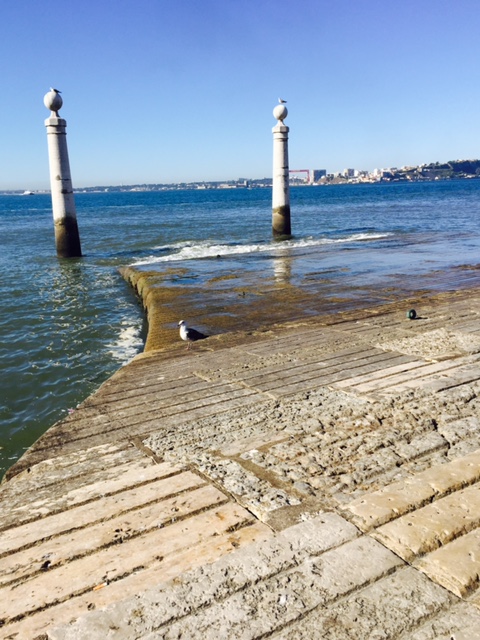
I caught the aerobus, which looped from the airport past hotels and restaurants and into the center of the old city. The streets were cobbled, the plazas actually mosaic, as were some of the walkways. I turned in circles occasionally, wondering at the world beneath my feet. Stone steps led from the main square surrounded on three sides by the palatial buildings of the kings of Portugal, down to the harbor – literally, down into the harbor, with iron rings pinned into the stone steps that disappeared into a blue-green bay. Gulls landed nearby, as pigeons hunted for crumbs. Out beyond the last steps, two stone pillars rose from the water. Sitting with my bare feet just touching the lapping water, I realized that this was the original entrance to Lisbon – by boat, of course. What a spectacular front gate. A man played Fado-style guitar as tourists took pictures, summer skirts and sun hats ruffling in a cool summer breeze. People sat reading on the seats built into the low stone balustrade winding away along the harbor shore. With hours before I needed to catch the bus back to the airport, I let myself be lulled by the music, the sun, the breeze through palm trees, couples walking past holding hands, boats in the harbor.
Fado is the richly blended music of Portugal: sad, filled with longing, wistful maybe’s and what if’s and the melancholy regret of a passionate love forever lost. I could feel it deeply, this waiting for a boat that never came back, a voice that never called my name again, a burning heart grown cold for reasons never known. But instead of some other, the lost beloved was me.
I wondered if I was too late. This fear, more than any other, I had carried across the Atlantic like the burden stone in my backpack. The stone I would give up on the Camino; but this burden of fear, of time forever lost, weighed heavy. I listened to the seagulls crying to each other, their voices blending with the Fado guitar, the creaking of a nearby dock accompanying them. I could hear the beginning of a song to it all, and just sat on the steps of Lisbon’s harbor, listening to the aching harmonies that can hardly bear what we ask. Steps that lead down deeper than we know.
* * * * * * * * * * * * * * * * *
“Your ticket – where is the other part?”
“There was no other part – only this.”
“Where?”
“From the machine. At the airport.”
The aerobus driver shook his head. A passenger with stronger English explained tickets come in two parts. The second missing part had a code I needed. When he understood I had only come from the airport, seen the water, and now returned to the airport, the driver waved me back to a seat.
The passenger told me, “Always get both pieces,” and smiled, and for a moment I imagined that I became a local in Lisbon, using the airport bus to go to the old city, the Praca do Comercio and the beautiful fountains with green figures on four sides, the colorfully painted plaster buildings of yellow, pink, blue, and the tiled buildings at their sides – entire facades covered in intricately designed four-by-four tiles. Color and tiles, and red clay tile roofs, and ornate iron balconies, all gleaming under the midday sun.
The narrow streets of Lisbon flow down and around its hills, intersecting at random, organic, no right angles. It is easy to lose your way. If you fight to find a direct path, you wind up going in circles. So I had finally let go and just wandered, slowly, in gentle arcs. A young mother sat a moment at her open upstairs window, her baby craning his neck to see me, laundry fluttering on the wall between us. The Santa Maria Maior Cathedral rose like a fortress of belief in the midst of wonder. Shopkeepers smiled in their doorways and chatted across the streets to each other. Workers hung colored streamers and set up tables for the next fiesta, called a festa here.
Drifting between being a local and a tourist, I was already remembering as I saw through the bus window the Avenida da Liberdade and the Marques de Pombal, shady promenades under huge trees I’ve never known before, something like a cross of maple and catalpa leaves, with trunks seemingly blown smooth by the winds off the sea. They look like the tallest giraffes, smooth and pale with patches of khaki and brown, grown to trees instead of animals. Utterly foreign to me.
Eucalyptus, I found out. Their shade cooled the sidewalks, and the road, and the bus back to the airport as I returned for the flight to Spain, soothed and welcomed regrets-and-all through the Fado gates into coracao de Lisboa, the heart of Lisbon. Having washed my pilgrim feet by stepping into the ocean to which I would return.
October 23, 2017 / wanderinglightning / 0 Comments
Once, not so long ago, in a place far away over the ocean, Gorma took a long journey to find her joy, and what was in her heart among the hearts of people everywhere.
Gorma walked and walked for many days along the Camino of the Heart, and so it was good that in the first days she met a guardian angel – and all because of the trouble with her broken toe. It was the tiniest pinky toe, on her right foot, that caused all the problems.
As she hobbled up a great, green hill with her aching toe, she was sad and all alone. Suddenly, Hernani appeared at the top of the hill, above the sea. Hernani’s black hair curled wildly atop his head, and his bushy, black beard wrapped a kind smile. His warm, dark eyes in his warm, brown face knew Gorma in an instant.
“Gorma, Gorma, why do you walk so slow? Why are you ‘La Tortuga,’ little Gorma?”
She recognized him on sight as well, as often happens when we walk in the Land of the Heart. “Hernani Angel, my toe is broken and will not let me walk.”
Hernani smiled, and said, “Here is a friend to help you on your way.” And an old dry branch from an ironwood tree broke itself free and slid into Gorma’s hand.
“Hernani, friend – I do not use the walking sticks the trekkers tap, tip-tap, tip-tap. I use my feet, my good strong feet, to walk up any hill I want to climb.”
“It is true,” Hernani agreed. “But I see: your broken toe won’t let you walk.” And with that, he turned up the path and was gone by the next bend of the camino. Vanished!
Gorma set off with the walking stick, and it was true, it helped to carry the load, so Gorma was glad. She arrived at the albergue just in time for a bed, for which she was very grateful, and she slept deeply.
The next day, Gorma set off to walk again. The walking stick helped quite a lot, and Gorma named it Saint Thomas, in honor of her doubts, for she had to feel the pain and suffering herself to believe. Gorma walked many miles, but her broken toe would not stop aching with every step.
Suddenly, Hernani appeared from among the trees of the forest. “Gorma, Gorma, why do you walk so slow? Why are you ‘La Tortuga,’ little Gorma?”
“Hernani Angel, I lean on Saint Thomas when I have doubt, and need, but my broken toe, it will not let me walk.”
Hernani smiled and said, “Here is a gift from the land of Portugal, home of humble loving kindness on the shore. I will cradle your tiny toe in a bubble filled with the sea. This gift will help you on your way.”
“Hernani, friend – I do not know of the sea, the waves that curl and wrap the shore, laugh and roar. I use my feet, my good strong feet, to walk up any hill I want to climb.”
“It is true,” Hernani agreed. But I see: your broken toe won’t let you walk.” And with that, he turned the path and was gone by the next bend of the camino. Poof!
Gorma walked with the bubble of the sea surrounding her little broken toe, and it was true, she felt comfort from the sea, as is so often the case. She arrived at the next albergue just in time for a bed, for which she was very grateful, and she slept deeply.
The third day dawned cool and gray as the sea. Gorma walked along, leaning on Saint Thomas, and feeling the sea cradling her tiny toe. But by that afternoon, the sea had grown stormy, and so around her broken toe. It grew and grew until she thought her toe would become the sea itself.
Suddenly, Hernani appeared out of the mist on the mountainside. “Gorma, Gorma, why do you walk so slow? Why are you ‘La Tortuga,’ little Gorma?”
“Hernani Angel, the sea has swollen my toe into a tempest! The sea, it will never stop growing in the bubble around my broken toe! And so, I cannot walk on the sea.”
Hernani smiled and said, “You cannot stay in this bubble of the sea forever, little toe. You must walk the earth.” And with these words, he handed Gorma a little knife, just the size to match her tiny toe. And with that, he turned up the path and was gone by the next bend of the camino. Into the mist!
Gorma looked warily at the little knife until at last she sat down on mountain and repeated Hernani’s words: “You cannot stay in this bubble of the sea forever, little toe. You must walk the earth.” Then quick as you can say “Hernani,” she cut the bubble, just the bubble, and out poured the sea onto the path like a wave upon the shore. Gorma saw inside that the poor little toe, all pink and soft like a sweet new baby, could not yet walk the earth. So she gently cushioned it with gauze and wrapped it with bandages like a blanket. And leaning on Saint Thomas, she walked carefully so as not to wake the baby toe, and arrived at the next albergue just in time for a bed, for which she was very grateful, and she slept deeply.
The next day, Gorma set off with soft socks and more gauze wrapping the tiny toe like it was precious to her, which it was now. She walked carefully, letting Saint Thomas help her with the many, many steps of the path.
As it became evening, Hernani appeared on a wooden bench by an old stone wall, all mossy and comforting. “Gorma, Gorma, why do you walk so slow? Why are you ‘La Tortuga,’ little Gorma?”
“Hernani Angel, shhh, so softly speak. My baby toe is sleeping. It is healing,” Gorma smiled.
“It is true,” Hernani agreed. “We all must leave the soft bubble of the sea to walk upon this earth. This is how we heal when we are broken.” And with that, Hernani turned up the path and was gone by the next bend of the camino. Just like magic!
Just like love. For the love of true friends watches over us like a guardian angel, supports us with a strength like iron, surrounds us with loving kindness, and encourages us to be brave when we feel small and weak. So Gorma learned that love is healing.
Gorma walked on, quiet and smiling. She arrived at the next albergue just in time for a bed, for which she was very grateful, and she slept deeply. Outside, it rained and rained, cooling and cleansing the air.
Buen Camino, Hernani.
October 23, 2017 / wanderinglightning / 0 Comments
It was the best of times, it was the worst of times – it was my life, and now I was 50. It took me another year to realize, or more accurately, to make up my mind, that it was time to walk the Camino de Santiago. And I needed to bring someone with me.
“I wish you to know that you have been the last dream of my soul.”
― Charles Dickens, A Tale of Two Cities
My daughter lassoed me on my 51st birthday. “You need to buy your ticket.” I bought a one-way ticket to Bilbao, on the northern coast, the closest airport to the border with France, where the northern Camino route begins in Irun, Spain. “Did you get your passport?” I’d never had one.
So everything began with me wanting desperately to go, but stalling. And then deciding. And then never looking back. Because the someone I needed to bring with me…was 17-year-old me. The kid who was going to escape all the crazy of my younger life by going to college, getting that journalism degree, writing for National Geographic, traveling the world, meeting the world’s people. Falling in love with all of them, writing their stories. Over and over, year after year, becoming a citizen of the whole, wide world.
When I quit college, and then when I got married at 19, and then when I started having kids at 20, and 22, and 23, and 27 – that kid just had to sit and wait, reading book after book, writing angry poems, listening to the Rolling Stones, especially, “You can’t always get what you want….” That kid just had to watch while I worked like a grown-up every day, typing up reports instead of stories, interviewing homeless alcoholics instead of Amazonian tribal chieftans or Sami herding reindeer in the Far North or the great-great-great-great’s of Genghis Khan.
At first, I tried to half-listen to that kid. I read those angry words into microphones in small, dark theaters filled with smoke and poets. I sang sorrow to open art exhibits and crooned bluesy warnings in front of velvet drapes and mixed drinks. I breathed sultry innuendo into the erotic poetry night. I was good. I was married. It was terrible. I got divorced. I got a job.
That kid didn’t know I was trying to offer a consolation prize. The other kids needed a home, regular meals, a ride to school so they wouldn’t drop their science project, a cheering parent on the sidelines of their games. If I couldn’t go to meet the world’s people, maybe I could have the world’s people come to me – give me your tired, your poor, your huddled masses yearning to breathe free…send these, the homeless, tempest-tossed to me…. And Life did.
Don’t get me wrong – their stories were rich, rich with lost hopes and survival, disillusionment and yet perseverance. But I didn’t write those. I entered their basic demographic information into databases. For all their stories of childhood abuse, foster homes, learning disabilities, drug use, prostitution, jail time, gang crimes, mental illness – I ticked boxes. Type an X. Type an X. Another X. Another.
“Sadly, sadly, the sun rose; it rose upon no sadder sight than the man of good abilities and good emotions, incapable of their directed exercise, incapable of his own help and his own happiness, sensible of the blight on him, and resigning himself to let it eat him away.”
If you’re looking for it, Life offers real consolation. Not bestowed as a prize, but earned by hard work, like that paycheck. Real connection in those moments when I listened, cared, said so. I learned to be quiet and let people tell their stories themselves. I developed a radar for danger, alert to people’s state of urgency and desperation, aware of my safety while ensuring theirs as well. I was an emergency responder without a badge or a siren, only my voice, and my eyes, which both needed to communicate at the highest levels. And amazingly to me, I rose to that challenge. I became someone who could evaluate a developing situation and set a boundary with a six-foot-four, 250-pound man who was coming unraveled and needed to leave for the day. I became someone who could empathize with the anger and fear but could keep it together. I became someone people could trust.
So that 17-year-old’s life passed again, and we were 34. And then it passed again. And we were 51.
Somewhere between 34 and 51, something shifted for me. Originally, when I met with homeless people and they told me their stories, they’d inevitably thank me. I shrugged this off, reminding them they were the ones who had been brave, who’d opened up, who’d risked. They’d ask, “So, you have a master’s degree or something? Are you a doctor?” To which I would answer, “No, man – I’m just a poet with a sweet day job.” I’d thank them for talking to me.
But somewhere in my 40s, I stopped saying it. I stopped saying I was a poet with a sweet day job. What had been so honest, so true, for so long, became a memory. Became my history. I had quit going to poetry readings long ago. Now I wasn’t even writing, just a thought here, a Christmas card poem there. I hadn’t written a song in years. I started to believe I was a social worker. But I didn’t have the education; social work requires credentials, a trail of letters following your name. I had lots of experience, many skills, but needed a couple of college degrees to work anywhere but in the one job I had. And then I left that job.
Life intervened. This is what I know now. The Universe turned my world upside down. Ownership of the homeless resource center where I worked changed. A private group created their own agency, thought they could run the center through good intentions and quickly ran it into the ground. I tried to work with them, and then I fought them, and then I left them. I did it very intentionally, to attract community attention. It worked. The center was investigated. Ownership changed hands again. The center was saved.
But all of that took over a year. In the meantime, I needed a job. I found work an hour away. I sold my house and found a closer apartment. However, because I didn’t have the degrees, I couldn’t do the work I knew how to do. I could only approach the depth I’d had, but it was out of reach now. I thought about college, but at my age, I didn’t really want to spend the money from selling my house on a social work degree, which would earn me not much more than a non-degree job. I saw burn-out on the horizon, but it didn’t look like anger. It looked like boredom. Leading to apathy.
That’s when I realized I had quit saying I was the poet with the sweet day job. I hadn’t seen it disappear; it had just faded away.
“I have been troubled by a remorse that I thought would never reproach me again, and have heard whispers from old voices impelling me upward, that I thought were silent for ever. I have had unformed ideas of striving afresh, beginning anew….”
I was a fraud in both worlds. I was a social worker with no credentials, and a poet with no poems. I couldn’t do the real social work I knew, and I hadn’t become the journalist I’d originally intended. What to do? I did what has always saved me: I wrote. I wrote what I was experiencing, began searching, exploring the unformed ideas that were rising. For three years, I was more honest than I’d been in a really long time. I had learned how to interview in all those years talking with homeless people. So I interviewed a really fascinating character I had never thought to talk to about all this: 17-year-old me.
Ah, that kid. There she sat in her metaphoric basement bedroom, headphones on, cross-legged on top of her bed, grounded seemingly for eternity. I sat down next to her, and she took off her headphones. And I just listened.
As I was writing, I gave her the respect I hadn’t been able to give her before. She was a wild-child, hair on fire, eyes blazing, heart broken, brilliant, fantastic. Yet she wasn’t only defined by what she’d gone through. She knew who she was, what she wanted, where she wanted to go. We don’t believe teenagers, that they know what they’re talking about, that they could possibly know who they are. But she was solid. She knew. She wanted to go see the world. For herself. With her own eyes.
“And yet I have had the weakness, and have still the weakness, to wish you to know with what a sudden mastery you kindled me, heap of ashes that I am, into fire.”
I realized she was right. I knew people would say I’d had a great career, was a good social worker no matter what, had done so much good for my community, helped so many people. That’s true, there’s truth in that. But I knew, and young me knew, that I’d been treading water. I have a talent for making those lemons into lemonade, so I’d made a humongous, industrial vat of lemonade, decades’ worth, and that’s where I was resignedly kicking and swaying my arms, floating confined. And getting tired.
Social work wasn’t my calling – it was my foundation. It was my training ground.
I had to go. Whether the time was right or not, whether anyone understood or not, I had to go. And I had to take 17-year-old me along, before I lost her forever. I couldn’t bear that thought. I – finally – loved that kid. Ferociously.
The Camino de Santiago was an easy choice. Since I was 15 I’ve been an amateur religious studies aficionado, reading on my own about Buddhism and Sufism and mystical traditions in Catholicism, Shinto beliefs that everything has a spirit, Hindu beliefs in keeping multiple virtues in balance with the help of multiple deities. If I couldn’t go on the Muslim hajj, I could hike the great camino across Spain, some of it traipsed by the weary faithful since before the year 800. I was seeking kindred spirits to walk and talk with for a time. I was seeking seekers.
As I got off the plane that had carried me across the wild Atlantic, I turned inside to 17-year-old me, smiled, and said, “You ready? C’mon – let’s go.”
“It was remembered afterwards that when he bent down and touched her face with his lips, he murmured some words. The child, who was nearest to him, told them afterwards, and told her grandchildren when she was a handsome old lady, that she heard him say, ‘A life you love.’”
October 22, 2017 / wanderinglightning / 0 Comments
This is how I know I’m back from the Camino de Santiago: I burned my tongue on gas station coffee, driving the interstate north from New Mexico to Colorado. The hot, sharp sting from that plastic cup felt like a snake bite, the risk you take when you walk too close to the sheltering shade of sagebrush or cool clefts in the rock under the relentless desert sun.
I started to realize I was back when I noticed airports and train stations felt more comfortable than familiar cities and towns. The tickertape of news from Washington is everywhere, and so unnerving now, I can’t even look at it, though it does its best to suck me in. Relentless. The manic pace of this place is so intense, so constant, for me it’s relieved by driving 80 miles an hour down a gray highway, looking at pronghorn antelope, an eagle slowly circling overhead. In my mind, I’m driving at the level of those clouds building on the horizon. This actually feels slower. The highway feels slower than the mindset of this country I’ve returned to. I don’t know how to be here, but I don’t know how to not be here – my whole family is here, and I love them, and I couldn’t wait to see them; but I’m not sure how workable this is going to be in the long run.
It’s sort of like this: I left with a crewcut, and a backpack, and all the time I would need. And I returned with a backpack that’s far too big, doesn’t fit me any more, and a mop of hair that is neither attractive nor controlled. This is probably my attitude toward this society right now: so uncomfortable. I have no interest in being attractive, or controlled, or fitting here. And now I wonder how much time I’m going to need.
Time can bring you down, time can bend your knees; Time can break your heart, have you begging please…begging please…
— Eric Clapton, “Tears in Heaven,” Unplugged
In a strange way, the quietness of the Camino was matched by the busy pace of New York, where I arrived from Spain. Floating equally anonymous and unimportant along my way, I was able to observe small moments on the streets, stop to hear music in a jazz club, search for a book on sidewalk tables. I stayed in a hostel, slept in a bunk, lived out of my backpack, just as before. Yet once I got to the quiet of New Mexico, I realized I was overwhelmed by the roaring pace of ordinary American life.
But even that’s not as accurate as I’d like to be. That’s just one piece. If I don’t want to hear the noise, I can just turn it off. It would be easy in my own space. But I don’t have my own space, just this jeep, and walking. Everywhere else is through the kindness of people who love me – a grand generosity, but subject to their relationship with the world, with information, with speed, with technology, … with noise.
So I’m also trying to figure out how to not leap back into the rat race as if I was an alternate on a relay team and now they need me – hurry, lace up your shoes, start running. I’m not interested in that any more, either, and I think the options that will come my way first will be more of the same. Instead of taking those baton hand-offs for the endless racing around in circles, I have to deflect them. I’m not sure even if I get a job and tell them, “Look, every year I go on pilgrimage, it’s what I do, it’s the reason I work, so if that’s not gonna work for you, this isn’t gonna work for me” – even if I tell them that, will I still maintain what I brought back? Or will I slowly melt into the madness again, slowly put back on my racing shoes, slowly just go back to the way it was before? I can’t lose this, and I’m not sure how to keep it.
Woke up this mornin’, feel ’round for my shoes, you know ’bout that babe, had them old walkin’ blues….
— Robert Johnson, “Walkin’ Blues,” Eric Clapton Unplugged
What is “it,” anyway, this invisible Hero’s Journey elixir. I feel like I’ve brought back a pocket of mountain mist…the sound of the sea…the texture of Roman stone roads imprinted on the soles of my feet…arms of comrades still draped lovingly across my shoulders. I keep searching as I drive past New Mexico arroyos hinting they’ve recently held rain.
I’ve been gone three months. A season in the Spanish sun. Which is how I measured my days – by the sun. My phone was reduced to a humble camera – no international phone service, no text messaging, no email, no GPS. No internet. Nada.
It forced me to quit forcing life. Our iPhones actually use two standard “commands” to keep our messages and appointments and frantic anxiety and relentless noise up-to-the-obscene-minute: PUSH and FETCH. Good god. Push it through, push it through, like forcing new prisoners into cattle cars before the horrified eyes of those already captured. Or fetch it for me, a lordly order using the intonation of a dog command, as if we ourselves are not the slaves ordered to fetch more news, more appointments, more crazy news, more assignments, more insane news, more useless meetings, more possible world war news, more messages we dread to open because it’s just one more impossible thing we are expected to manage or accomplish with a sickly smile.
As if we ourselves, the prisoners and slaves, haven’t created this culture of force. We have, by participating in it, by accepting it. We are many. We could be mighty. But we’re afraid to lose what we believe we have: security. So we push and fetch.
The highway passes out of one reservation boundary and into the next. So many reservations in the American West. I am sadly familiar with these road signs of despair: Navajo, Hopi, Zuni, Ohkay Owingeh, Acoma, Cochiti, Laguna. Over 20 exist just in New Mexico, sometimes lumped together to make it seem like the individual tribes have more space and more power than they actually do. Many that could be mighty. I realize they have the security that so distresses me: maximum security. The terrible security of imprisonment and slavery. Oh, they are free to walk off the reservation any time they want – but where can they go if they are still wearing spiritual and emotional chains of fear and defeat?
Must be invisible; no one knows me. I have crawled down dead-end streets on my hands and knees. I was born with a ragin’ thirst, a hunger to be free, but I’ve learned through the years, don’t encourage me.
— Eric Clapton, “Lonely Stranger,” Unplugged
I’m feeling like I’ve returned to the rez. Seeing the people I love searching for the water of hope in a desert of anxiety. Handcuffed by earbuds and remote controls forcefeeding them despair disguised as news. Trying to find electronic comraderie and escape from the battle fatigue of the day in games of more battle, like bailing a brother out of detox and then coming home to drink cheap vodka on the porch together. Everyone’s strung out on screens, fingers twitching keyboards like they’ve got the shakes.
And now as I’m driving north, I just want to put on my shoes and walk. Hike. Run. I’m looking for the Camino on every walking path and running trail. At 80 mph on this interstate highway.
I watch cloud shadow cross the silent red mesas. I feel similar shadows crossing my brow. Looking south, out across limitless miles of sage and yucca and rabbitbrush, my mind is eased. It quiets. Opens again. Calms my heart, as I feel myself once again standing on the shore of the endless sea, watching the waves crash forever against the rocks, watching the day drift into night.
This is the magic elixir. I understand what I’ve brought back in my pack: freedom. Anti-venom for the snake bite. My pack isn’t too big; it’s big enough to hold freedom for myself and for anyone else who wants some. How I found it and brought it back is another story.
I am free. Sounds pretentious, or idealistic. Actually it’s somewhat disorienting, after all these years. You’ll feel a little lightheaded as the poison leaves your system. Take it slow.
Then we’d go running on faith, all of our dreams would come true, and our world will be right, when love comes over me and you….
— Eric Clapton, “Running on Faith,” Unplugged
June 30, 2017 / wanderinglightning / 0 Comments
When the path ignites a soul,
there’s no remaining in place.
The foot touches ground,
but not for long.
— Hakim Sanai
Beginning in the middle circles the heart of the story, it’s true. But that is just the shape of the spiral, the yellow brick road unwinding at my feet here in the middle of my life. I leave this country for Spain in two days’ time, swinging from plane to plane like swinging across the monkey bars as a child, trusting the rhythm of letting go and reaching out, grabbing hold with one hand as momentum carries me beyond myself.
I think it’s easier to pinpoint the center of the spiral once it has gone ’round the bend a few times. Quite possibly literally. I think of my life as a series of tangents that were wrenched and contorted into orbit around my divided heart, that yin-yang binary star of my dreams and demons. When binary stars are the same size, they can destroy each other, creating a black hole, an endless void. But if one is larger, it can absorb and use the energy of the other. So for all these years, I have been trying to absorb the lessons of my pain by changing its manifestations in my daily life – studying, counseling, practicing taking tea with my demons like Milarepa, transforming them from wounds into scars, into street smart life lessons, dedication, duty.
But I neglected to grow my dreams. Without making my dreams larger, they will never have more weight in my life than my sufferings. They will always orbit each other in my heart until I am destroyed by them both. Neglected dreams do not wither on the vine – they rot, and turn poisonous.
There are two paths of which one may choose in the walk of life;
one we are born with, and the one we consciously blaze.
— T.F. Hodge
When I am asked what I value most, I have long answered, “Freedom.” But what is freedom if not the opportunity to follow your dreams? So finally, at long last, I have created my opportunity. By prioritizing it. After three years of transition, I have left the job, given up the apartment, and am saying my goodbyes. I am blazing my own trail.
I don’t know whether you can look at your past and find, woven like the hidden symbols on a treasure map, the path that will point to your final destination.
— Jodi Picoult
I don’t know either. I don’t know how to prepare for a journey I’ve never taken. But I believe everything up to now somehow has been the preparation I needed, and it doesn’t really matter what I pack, or if I’m fluent in the language, or loose with my itinerary. I’m mulling all of this. Hoping that my history contains a hidden map to my future. Hoping it’s a star chart, where what once burned deeply will now burn brightly, lighting my way. Because I’m going.
Do not go where the path may lead; go instead where there is no path, and leave a trail.
— Ralph Waldo Emerson
June 27, 2017 / wanderinglightning / 0 Comments
Gallup, New Mexico: in this small world of 22,000 people, you can hear the sacred heartbeat of the Southwest. All summer, the drums of the nightly Indian dances on the plaza pulse the thin desert air as it cools from the setting sun. Chanting voices give the songs and stories of the dances a deeply human rhythm and tone, so that Navajo, Zuni, and Hopi legends and prayers infuse the night sky like stars. Eagle Dance, Buffalo Dance, Deer, Butterfly, … Grass. Corn. Moon and Star. Everything has its dance and its story. History moves in circles here, stepping in toward each other, stepping back for perspective.
Perspective is needed in the daylight hours. After 9:00am, the morning chill has burned away, and the pulse you hear is the blood in your temples seeking relief from the sun as you walk these hilly streets. Tiny New Mexico whiptail lizards rustle beneath junipers in small yards and under alfalfa springing from cracks in the crumbly sidewalks. A warm breeze is welcome, blowing through my straw hat, because biting gnats have risen with the temperature. My sandaled feet are always dusty with the red dirt of the looming mesas. As I walk downtown, I am greeted by various homeless Indians sitting on a wall on a small plaza near Silver Stallion Coffee and Bread. Several have begun drinking already, which I accept readily; I remember all the homeless people I have talked with in Colorado, many drinking or using at all hours. Here, however, the stereotype is all about being drunk Indians, not about being homeless.
Loneliness and the feeling of being unwanted is the most terrible poverty. — Mother Teresa of Calcutta
I see the reservations that ring Gallup as desolate homeless shelters for tribes who long ago lost their way of living. Homeless people often self-medicate to numb the burning reality of their situation, and a homeless People will do this in the same way a homeless individual will. Generational poverty is the thistly root of homelessness, and it can be found growing in every ditch and trash dump and wasteland across America. Escaping that kind of poverty is not a simple matter of a strong work ethic or setting your mind to success. Success in our society – even just getting to the step above survival – requires not only talent and hard work, it requires opportunity, and ongoing support. It’s hard to seize your opportunity when reaching for it feels as impossible as reaching for those far away stars. The sacred heartbeat is hard to hear as you watch men and women, in baggy T-shirts and sagged jeans, hitchhiking down the highways, back to the rez, in the heat of a workday, their long black ponytails gleaming with the sweat of a legacy lost. Billboards along these highways advertise domestic violence call-lines, suicide prevention, and smashed pickups punctuating drunk driving warnings. You can pull thistles all you want, but they stubbornly grow back. You have to get the roots.
Blessed is the man who bears with his neighbor according to the frailty of his nature as much as he would wish to be borne with by him, if he should be in a like case. — Saint Francis of Assisi
Into the midst of all this comes the Sacred Heart Spanish Market. New Mexico has a complicated history of repeated invasions and conquests, made no easier by its Spanish Colonial period. The influence of Spanish Catholic mysticism is everywhere here, and for one weekend, it is on proud-but-humble display at Gallup’s Sacred Heart Cathedral on East Green Avenue, near Cliff, and Mesa, and Hill. Outside, the landscape is steep, dry and rocky; but Sacred Heart is an oasis of air-conditioned faith in human beings who have risen above their suffering to become a part of the divine. Santos, the likenesses of saints, are painted and carved into retablos (that hang on the wall) and bultos (freestanding). Saint Francis holds a bird or stands with a coyote. Guadalupe glows within her traditional golden scalloped rays of holiness, blue robe of stars draped above her roses. Dolores, Our Lady of Sorrows, implores with large sad eyes. Teresa of Avila of Spain is here too, once richly painted by Rubens and now also brought to life by Gallup artists. The saints’ images and moments from their stories are framed with elaborately pierced and stamped tinwork, ornamented with turquoise and coral, beads and glass, and intricately laid mosaic patterns made of straw.
One such straw work artist is Jimmy Trujillo, a thin older man with the weathered face and leather hands of a New Mexico native. Jimmy is a master of this folk art, known formally as “encrusted straw,” and was pleased to explain his craft. He studied under a master before him, and carries photos of the centuries-old black cross that first brought him to his life’s work. He begins by finding the right piece of wood – pine works well, or juniper, or even cedar, but not fir. He splits the wood by hand with an axe, and lets the split follow the grain of the wood. His crosses have a distinct ripple, the fluidity of the trees themselves. Both the upright and the crossbar are made from splits of the same piece of wood, pegged together on the back with a tiny handcarved pin, also from the same wood. He described one cross in which the natural ripples created a clear image of Christ on the Cross; that piece is now in the museum gallery of Regis University in Denver. Other pieces are at the Denver Art Museum, and museums throughout New Mexico. His work is collected and sells for thousands of dollars. Because he approaches it with a holy seriousness of purpose. He puts his heart and his faith into each piece, as all true santeros do. Holy artists.
Accustom yourself continually to make many acts of love, for they enkindle and melt the soul. — Saint Teresa of Avila
Jimmy collects dried sap from pinon pines. He melts it, not with heat, but with high-proof grain alcohol, watching the dissolving mixture after a few months to catch it at just the right consistency: a fluidity between maple syrup and corn syrup is just right for varnish, a thicker molasses-like consistency for adhesive. He strains it through cheesecloth, over and over, to remove the natural dirt, bark, bugs, and other debris caught in the oozing sap of the low-growing trees. He uses the natural straw stems of grains like oats, barley, or wheat to create designs on the crosses. No dyed straw for Jimmy, though other artists like the colors. He is a traditionalist, and works with only natural materials. With each straw, he must deknuckle it, which is removing the knotlike rings where the layers of grass joined. The straw is split lengthwise, again following natural splits in the fibers. Once split, each length is flipped over, and the white pith is scraped from the outer layer using a fine blade. The result is a grass ribbon of satin, which he then cuts into tinier and tinier lengths, triangles, diamonds. Grass. Butterflies. Using a dental tool, these tiny bits of straw are then applied one by one to the cross that is coated in pinon glue, in fantastically intricate but pleasingly simple designs. The results are stunning: at once uplifting and and quieting, as you move beyond the cross structure and begin to follow the meditative straw patterns.
It is love alone that gives worth to all things. — Saint Teresa of Avila
It’s so hard to reconcile his soulful work with the history of New Mexico. At an artists’ discussion the day before, an older man in the audience was called on to speak. He began slowly and thoughtfully, saying, “I am Din`e, Navajo. To me, you are all invaders.” As he continued describing his military service to a nation that marched his ancestors from Arizona to New Mexico and left the survivors of The Long Walk to die slowly, over generations, on the reservation, I watched the artists’ reactions. The graying descendant of Spaniards who had only minutes earlier noted with pride that he could trace generations of his family back across the sea, stated matter-of-factly, “Conquest is our history here.” Easy to say, if you are the conquerors, I thought. The middle aged white woman wearing turquoise jewelry of course thanked him for his service, which has become such a hollow act patronizing our veterans that I was embarrassed for her. The young Indian man at the table said of his heritage, “I’m part the conquerors, and part the conquered – that’s what my work is about.” And the complications of the Navajo displacing local Hopi and Zuni Puebloan people was never even touched on.
This feels like what Gallup’s work is about, now: reconciling the energies of the conquerors and the conquered. Maybe it can begin with young artists stepping in intricate patterns with veterans of lost wars, saints under halos chanting with drunk Indians sleeping under rabbitbrush and sage, all dancers under these same stars.
May 4, 2017 / wanderinglightning / 0 Comments
Hiking these hills, I think I’m being smart and experienced. It snowed yesterday, so I avoid the high mountains and go to the well-maintained foothills trails. This first weekend of April, only snowshoers and fools would venture high. So I carry my small pack and tromp through small mud puddles and soon travel past the families with small children and dogs taking a small Sunday stroll.
The problem with thinking small is forgetting the unexpected, the element of surprise. It will find you anywhere, any time. You believe that because you have chosen caution, you have chosen a controlled experience. There is no controlled experience. Yet how we want to believe that story, act out that script.
The first flag was a tree fallen across the trail. With the onslaught of so much snow following weeks of early warm temperatures, the old pine’s roots simply let go of the quickly thawed and saturated hillside soil. It just let go – it’s crown must have quietly drifted for a few seconds, a silent shadow crossing over the trail, before crashing heavily between standing trees on the other side. A tree falls in the state forest with no one to hear it, but here is the evidence afterward. I have often wondered what it would be like to see such a fall happen, even though I know the danger of being present at such a moment.
As I’m looking at the roots ripped loose and still covered in wet earth, she arrives with her small dog. The woman is in her late 60’s, dressed in a blouse and sweater, flowered stretch pants that end just below her knees, ruffly-lace-edged ankle socks adorning her Mary Janes. The white lace of the socks sticks out like her white hair, a fluffy shock of incongruity between old age and childlike sweetness. “Oh dear, look at this,” she says. I start to respond, but she continues speaking, and I wonder if she’s talking to the dog…or to anyone…or to no one. “This is, oh my, look at this, what shall we, oh dear,” and she looks at the dog, then down at the ground, then back at the tree trunk. I am closer, so I grab hold of branches and clamber over the trunk to the other side, thinking I am showing her how to continue her trek. I say uselessly, “It must have fallen from all the snow,” but she completely ignores me, continuing to tell her dog, and the forest, and the day, “Oh my, this is…oh dear, look look, look here, oh my goodness,” standing at the obstacle with her fluffy-eared, tiny-footed dog prancing and panting beside her. I watch her for a second, then turn as if to continue on, taking a few steps. Looking back, I see she has turned as well, returning down the trail, her commentary unabated. I hike on, mulling the mirror of our walking away.
How often do we do that: stop moving forward at an obstacle that appears overwhelming. We feel small. Without experience, we don’t know where to start, let alone have any confidence that we can overcome what is before us. I think about her lacy socks and flowery stretch pants and tiny fluffy dog, none of which I have ever owned, embarking on the muddy trail. Yet I wonder how many ventures I have set out on, my natural tendencies and preferences making me equally unprepared to face the fallen trees on those paths – marriage, finance, hierarchies, a list begins unspooling far too easily, given my headstrong and outspoken nature. Or is that description just a costume I wear, habitual choices like clothing from my closet, so that how I do what I do has become why I don’t do what I think I cannot do. Who I believe I am … or cannot be. Trying to control my life by deciding who I am. Packaging.
Feels confining, I think as I continue on. The morning warms, and yet I start to feel wet snow falling on me. It is snowing under the trees. Startled from thought, for a moment I am utterly perplexed, and look up the hillside, then straight above me. I laugh at myself. Yesterday’s snow is still settled, wet and think, in the branches of the evergreens along the trail, but the sun is smiling down and a light breeze dances through now and then. I keep my jacket hood pulled up as I walk from the sunny open path into light snow showers under the branches, grinning as it happens over and over along the way.
I reach a high point on the trail where I like to take a snack break. As I slip off my pack, my phone rings in the front pocket. I answer a call from my oldest son. He has news, he says, as I sip from my water bottle. They are expecting their first baby. We talk and laugh and I offer such wisdom as I have collected haphazardly along my life’s trail, and then we laugh at that, as well. I tell him about the funny events of the day, the woman and her dog, snow falling under the trees. We weave a lesson together of the unexpected delightful surprises of life.
By Earth Day, late in April, I am hiking the high mountains, fool that I am. The trail starts dry and warm at 8500 feet, but the gray overcast skies do not disappoint my hope to test my raingear. As I climb, rain begins to drum my hat and pack, quickly turning to silent, fluffy snow. I stop under a large tree to chain up, as I call it in my dorky way, adding Yaktrax and gaiters for traction and dryness. I munch trail mix as I stand leaning against the trunk, looking out at a sheet of snow continuously falling between me and the far side of the river gorge, between me and the high peaks, between me and the rest of the world.
I hoist my pack and step out from my moment of shelter, believing my gear will take me where I want to go. Packaging. I hike higher and higher, past the tracks of snowshoers who turned around, up where angels fear to tread, many feet of snow between me and the dirt trail far beneath my feet. The snow is warm, wet and sticky, and my feet only break through – the dreaded exhausting “postholing” – a couple times. Mostly I slip and slide, the edge of the snow trail almost constantly giving way under my outside step like a tiny one-foot avalanche, so that I am dancing a ridiculous disco step like John Travolta, stayin’ alive, stayin’ alive up the mountain.
The snow falls more gently now, softly and slowly. Enchanted, I step out to a wide place on the trail and stop, pull back my hood, and look straight up, into the swirl. I just stop, finally. I just stand still, in the quiet. The fat flakes show themselves to be many tiny snowflakes joined, just barely touching, holding each other as if holding hands. I remember watching the snow fall like this many years ago, a far away little me next to my father under pale gray skies. I feel kissed by the thousands of tiny snowflakes landing on my forehead, my nose, my cheeks, my lips, my hat and jacket and pack.
I think of my son’s baby yet to be. I wonder how overwhelmed they must feel in the face of such a tiny but mighty life-changing surprise. He will give this tiny person a costume for outdoors, just like his, just like mine. Someday I will bring this child out into the warm spring snow. Maybe we will dance like fools up a mountain, raise our faces to see the snowflakes holding hands as they give us kisses upon kisses.
It’s just a daydream at this point: a story I hope will come true. I would like to hear that small voice laughing with me as it snows under the trees on a sunny day.
April 15, 2017 / wanderinglightning / 0 Comments
Such a very small world is familiar, and so much of the map is foreign, personally uncharted – especially when you grow up on a farm in 1970’s Iowa. I remember, as a child, my coloring book with a very simple, colorful picture of a farm on the cover – classic red barn, cyan blue sky, kelly green leaves of a tree, and – orange-brown dirt? I couldn’t understand how such a gaffe would be allowed to pass unedited through whatever publishing process coloring books pass through. Because, as everyone knew, dirt was black. Pitch black. Black as the night of a new moon. Black as the void. The void from which all life springs, all colors grow. Black is the source, the secrets of seeds revealed only there, under it’s protective sheltering wing of soil.
It wasn’t until we moved to Colorado when I was a teenager that I saw farms with coloring book fields. Sun-bleached wheat grew from the water-parched orange-brown rows. I marveled that anything could grow without the rich blackness. I watched the distant blue horizon dream hazy clouds into the reality of blue mountain ranges. I was staggered that this fascinating, foreign land lay only one day’s drive from the 300 acres of the familiar.
The wildlife was similar, but changed, bigger. White-tailed deer were supplanted by larger mule deer, and even larger elk. Fewer foxes, more coyote. I saw my first jackrabbits, so much bolder than the tiny cottontails I knew. And, I saw my first ravens.
I had grown up with crows – gathering in the tops of our elm and maple trees, cawing incessantly, rising as one from the harvested corn fields. I had no stories for crows except as garden and field pests, or nibblers of roadkill skunk and raccoon. Noisy as bluejays and less beautiful to see, I had no love of common crows.
But ravens – ravens startled me with their unexpectedly impressive presence. The first time I saw a raven, I knew it was not a crow. I knew from its size, I knew from its face, and I knew from its voice. While I had expected elk to be more than I had imagined, more majestic than deer, awesome and thrilling as they slowly stepped between tall pines in the high forests…well, I hadn’t thought about ravens being in Colorado. Edgar Allen Poe wasn’t from Colorado, and he was my only reading on ravens. I had no frame of reference. And since I had no frame of reference, I was wide open to my experience. So seeing my first raven surprised me, and expanded my mind. Because it was more than I knew. It was beyond my familiar.
I have since found out that this is the mythology of the raven. Smart and strong, Raven is a character of metamorphosis. To the Hopi, Navajo, and Zuni of the Southwest, Raven has trickster energy, a bearer of magic and messages from beyond time. Raven flew out of the great darkness carrying the stolen sun and so brought the light, transforming the world. In Norse myths, Odin had two ravens named Thought and Memory who flew over the earth and brought information back to him. Like Aquarius of the zodiac, Raven shares knowledge that comes from elsewhere, that pours like water and illuminates like lightning in the night.
I hadn’t seen a raven in years. But the birth of my second grandbaby brought a fortuitous mistake of too many helpers converging on my daughter’s home on the same weekend. What to do? In Gallup, New Mexico? The answer came to me immediately: take off for the Grand Canyon, of course. I had never been, and it was only a few hours away.
We helpers were like crows, grandparents and aunts and uncles gathering, cawing and restlessly ruffling our feathers as we spied for tasks like dishes and laundry and taking out the trash. We feasted on the sweetness of mama and baby and tiniest big brother on the couch together, then rose like a heavy wave of family helpfulness into the rooms of their home. At times we sat quiet and watchful, contentedly perched together, roosting. But crows know the cultivated fields, and soon we’d be back in the kitchen, cawing out questions of favorite meals and freezer space and Tupperware.
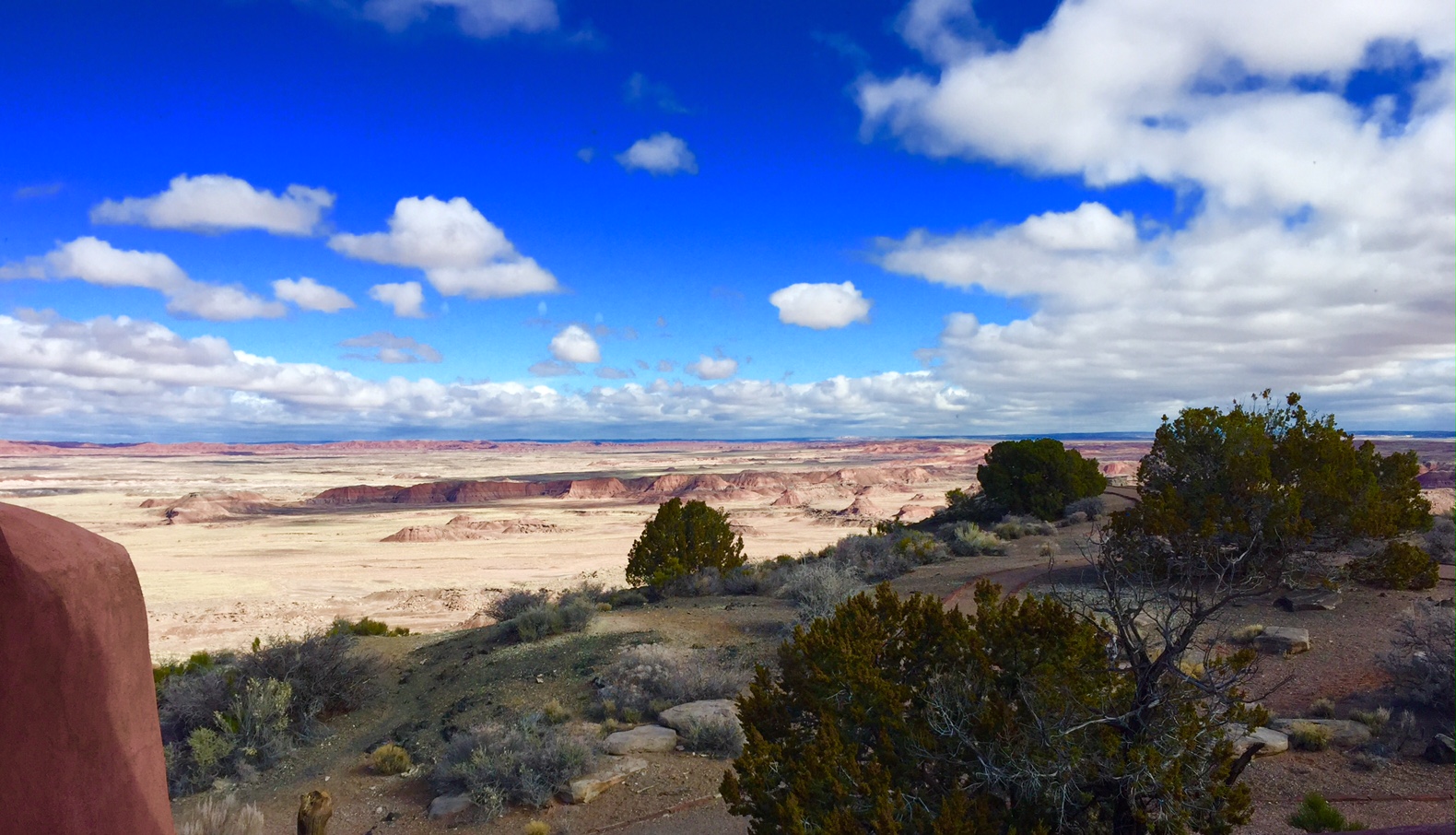
I was sad to go. But as soon as I was headed for the Grand Canyon, I let it go, easily. New Mexico softens its vistas with sage hills and low mesas and rounded mountains; but Arizona is wide, wide open, pushing your vision to the horizon and then up into the endless sky. I flew along in my jeep, rambling through the Painted Desert, discovering forests petrified into jasper and crystal before humans had written words, their hopes and fears and baby’s handprints carved into red stone.
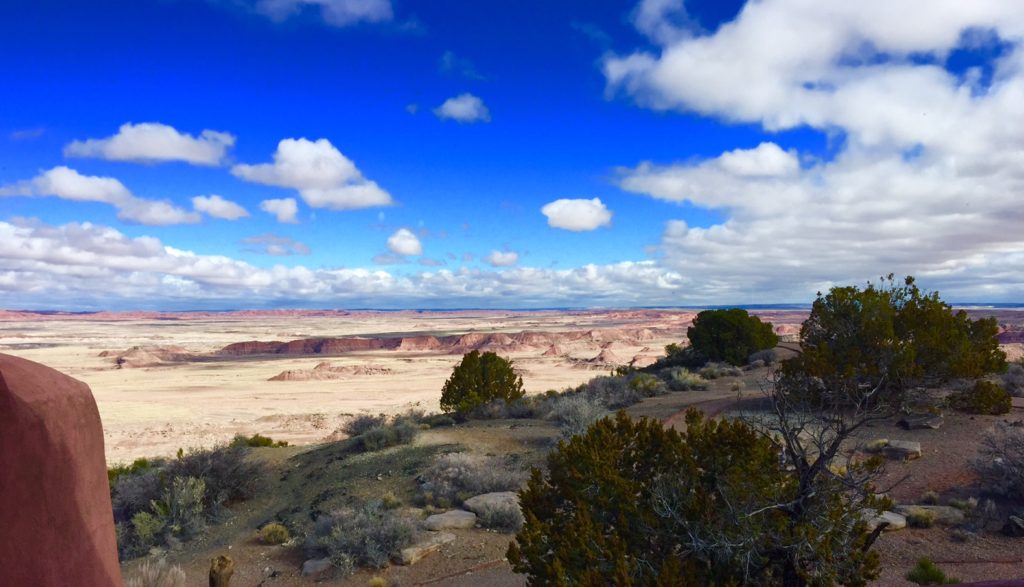
I passed Fort Courage, wasted bottomland filled with old trailers covered in painted aluminum, vinyl siding, plywood, and treaties. Old pickups bleached like bones in this desert sat parked on mismatched tires, tread, no tread, bald like bald-faced lies, American flag snapping in the wind over a yellow dog trotting in dust.
 I got a room at the Cameron Trading Post, circa 1916, where you can still walk into the deep Southwest, buy a bag of Bluebird flour, some jerky, coffee, and a blanket woven by an Indian, sold by an Indian. The trading post still holds the south bank of the Little Colorado River, and I watched it wind its muddy way west under the deepening sky to join the canyon I would see tomorrow.
I woke in the darkness, black sky sharing the tiniest stars like secrets over an unseen desert. I drove up scrubby foothills where, at the top, elk and deer wander through pine forests standing in dark pools of melted snow, cold February evergreen swamps on mesas of rocky clay and limestone that cannot soak it all in, and neither can I.
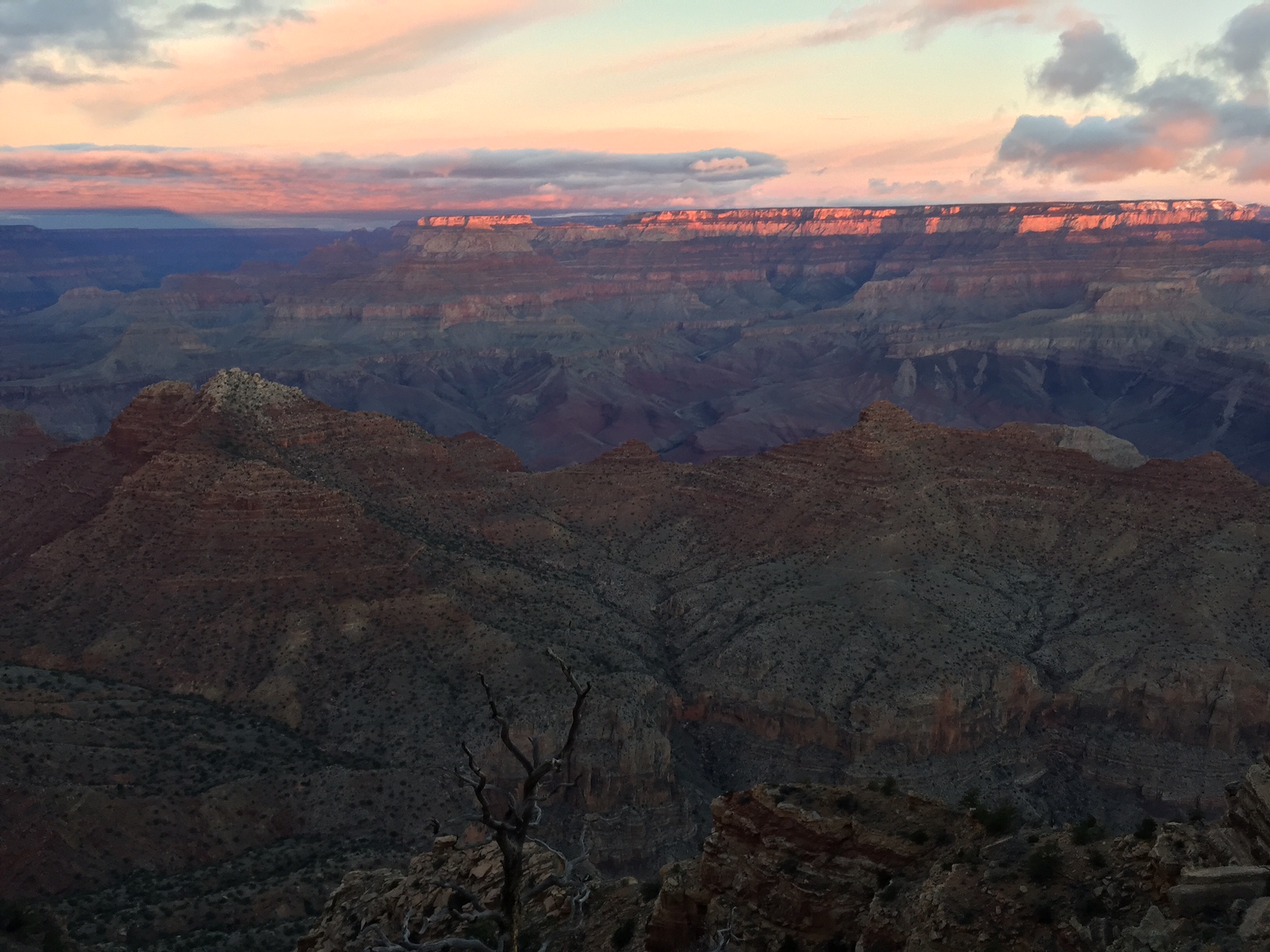
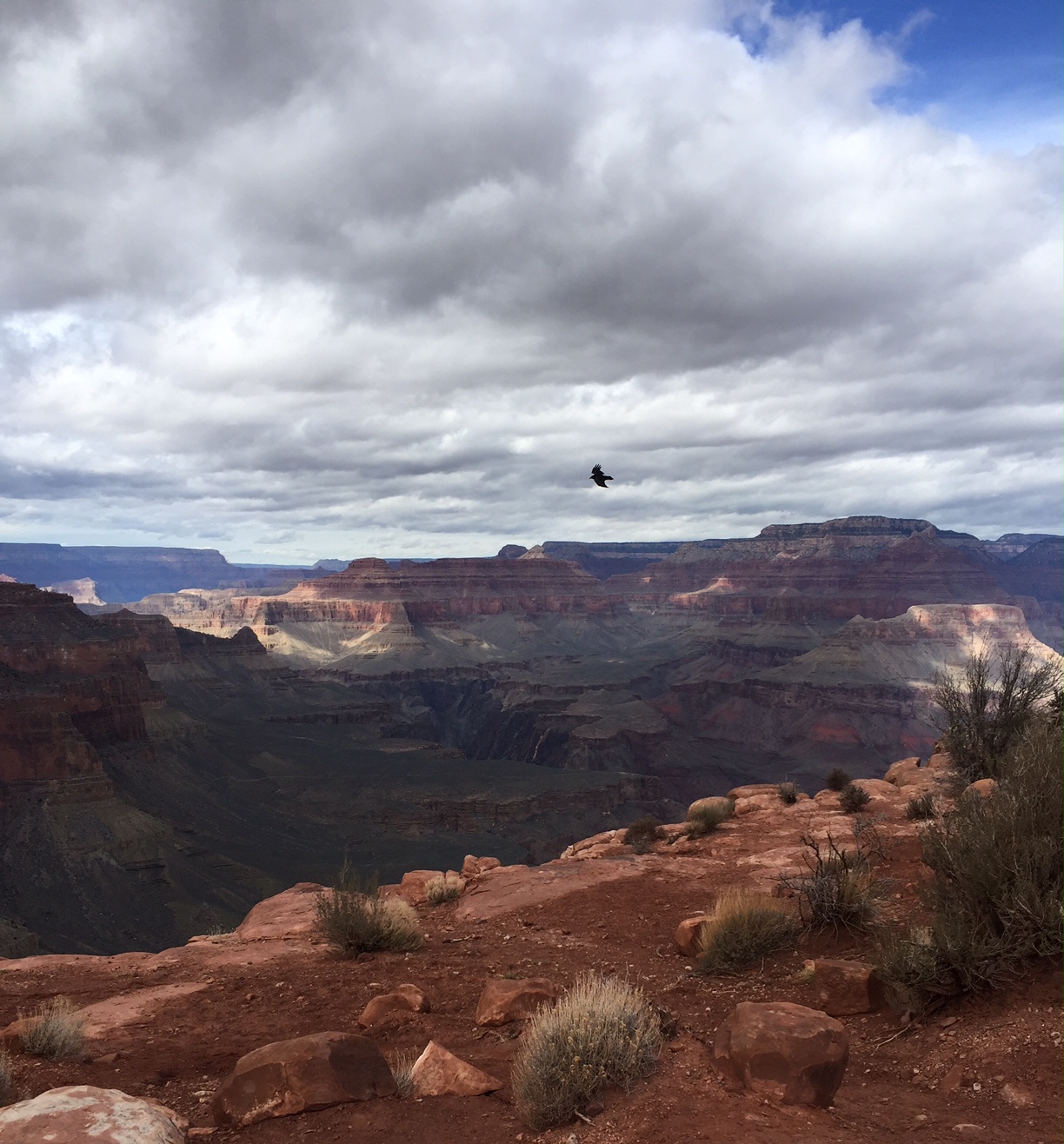
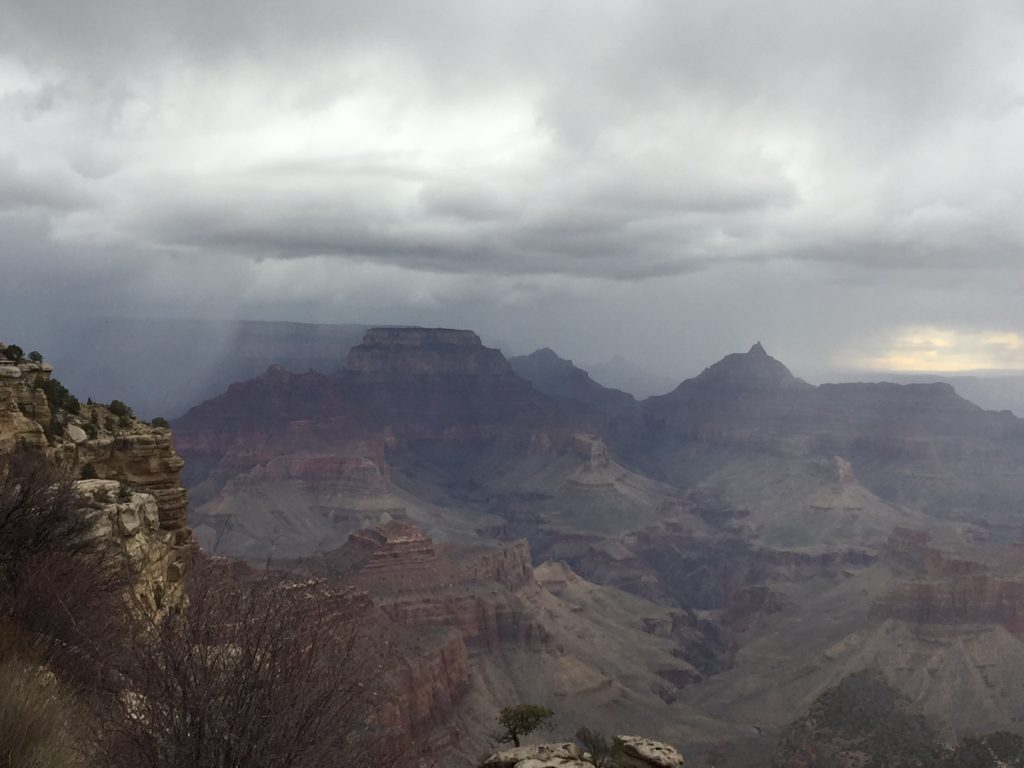
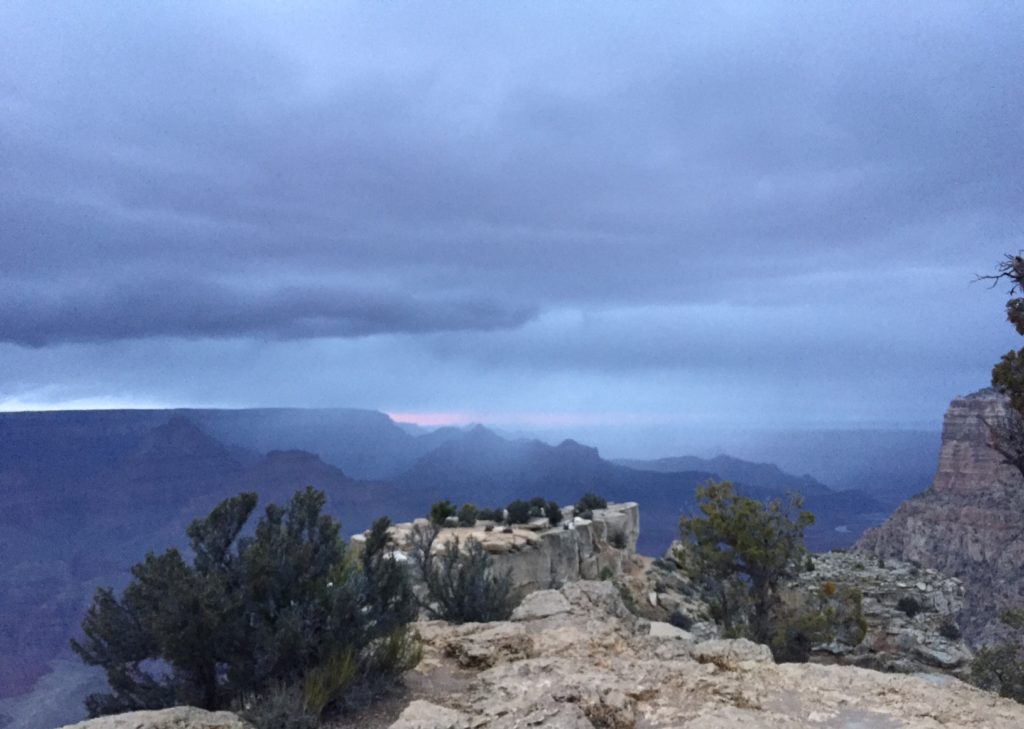
When I rose over a hill and saw my first pre-dawn view of the Grand Canyon, I laughed out loud, goofy raw croaks of surprise, delight, and recognition of something beyond time, all vying to be expressed first, immediately, forever. I parked at the overlook and walked out to the edge to watch the sun rise. A few other people stood nearby, facing east, waiting for the sun. I faced west – waiting for the effect of the sun on the vast canyon itself. As I stood alone, sensing the shifting light before dawn, I had the most unexpected feeling: contentment. I felt as open and quiet as the distances before me, while I stood in the chill morning breeze and watched pink tinge the clouds and then the highest ridges of stone, followed by golden orange, and finally the yellow light of sunrise. Silently, two ravens rose with the sun, up from the darkness of the cliffs and canyons below, their feathers like fingers lifting the light into the sky.
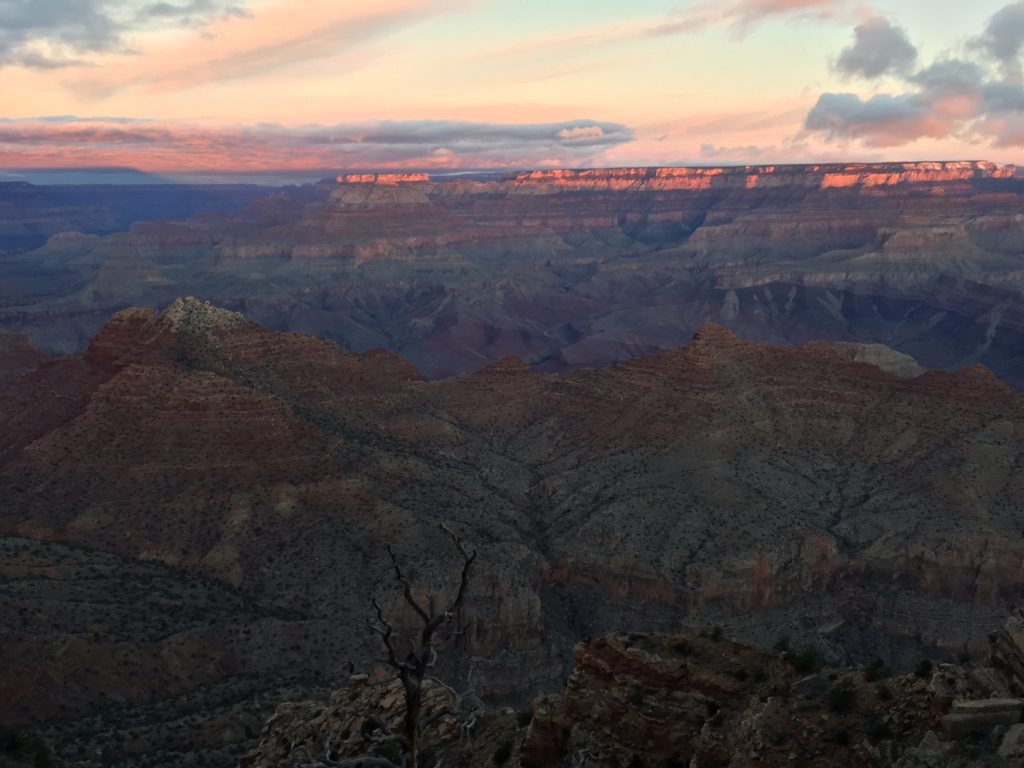
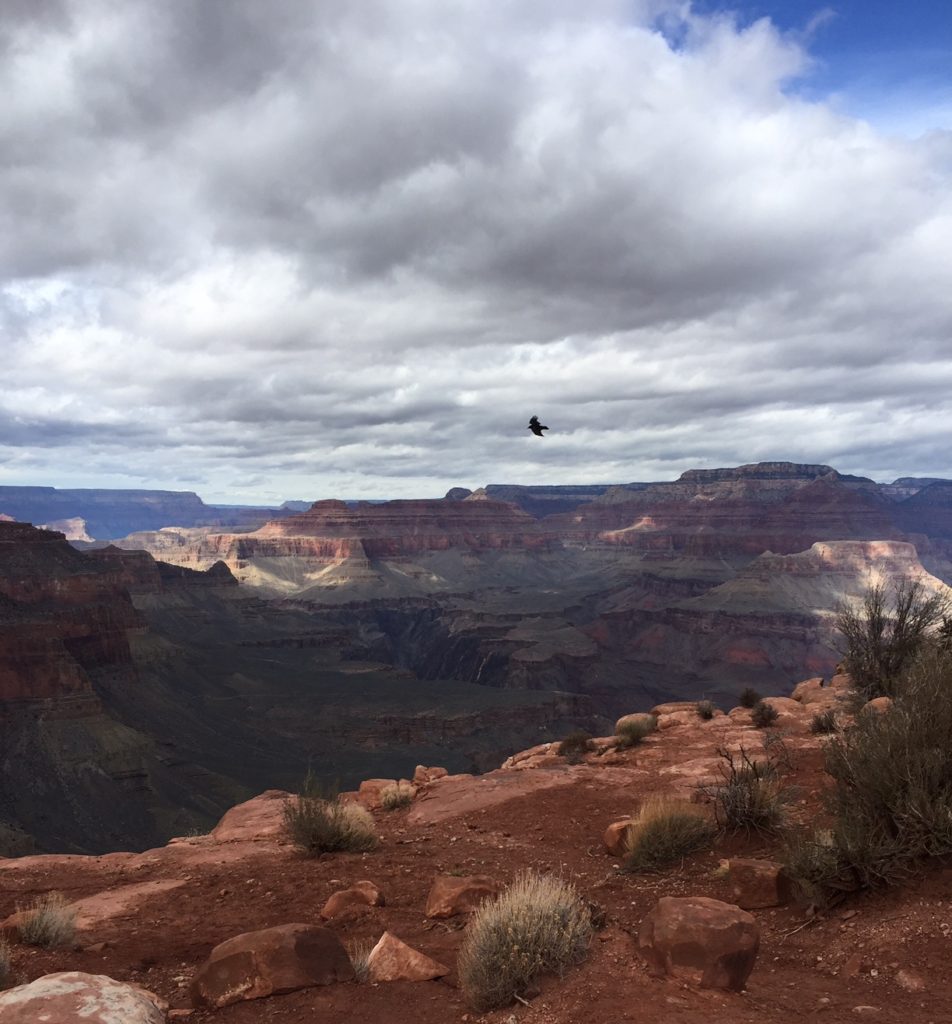
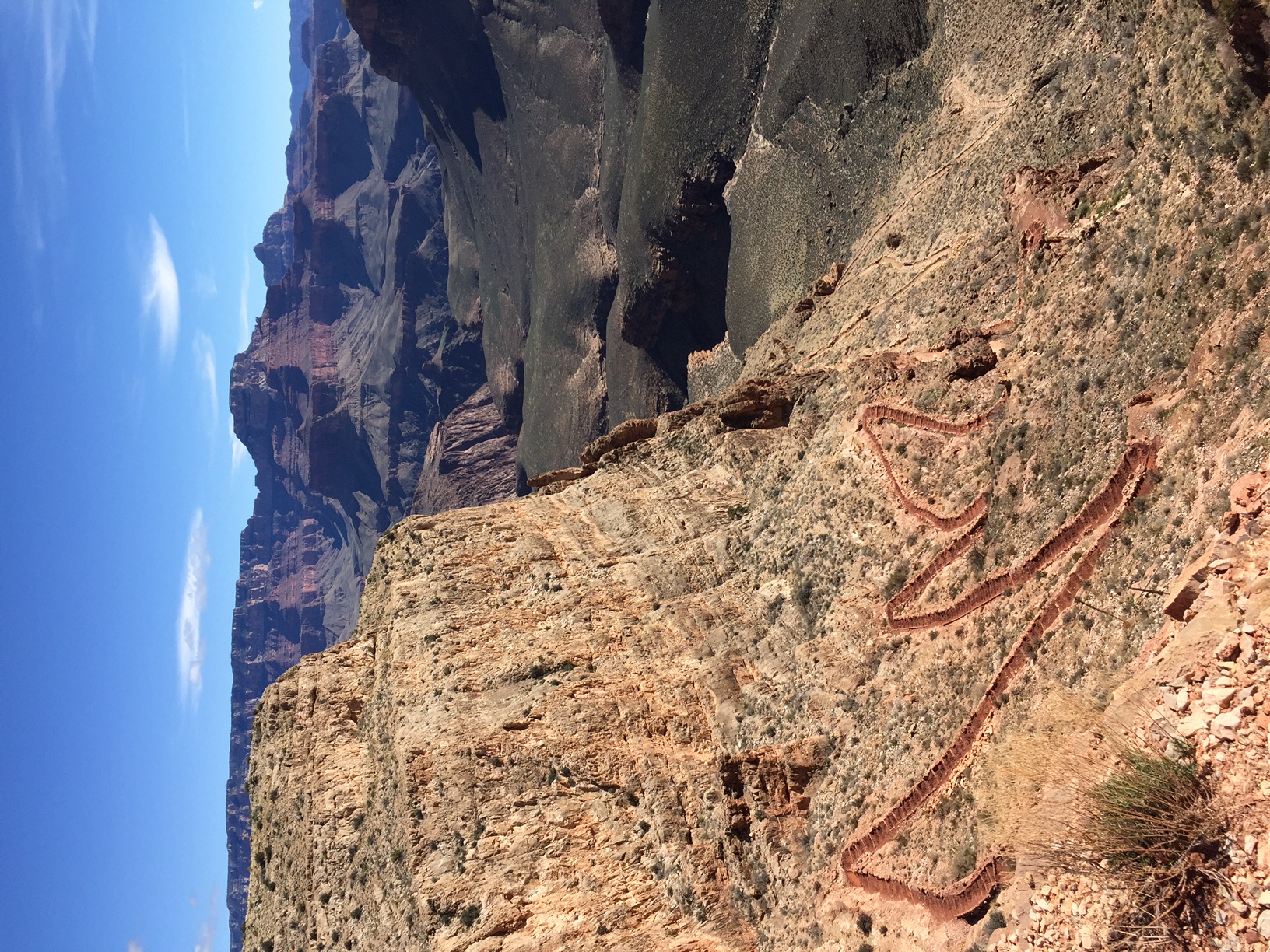
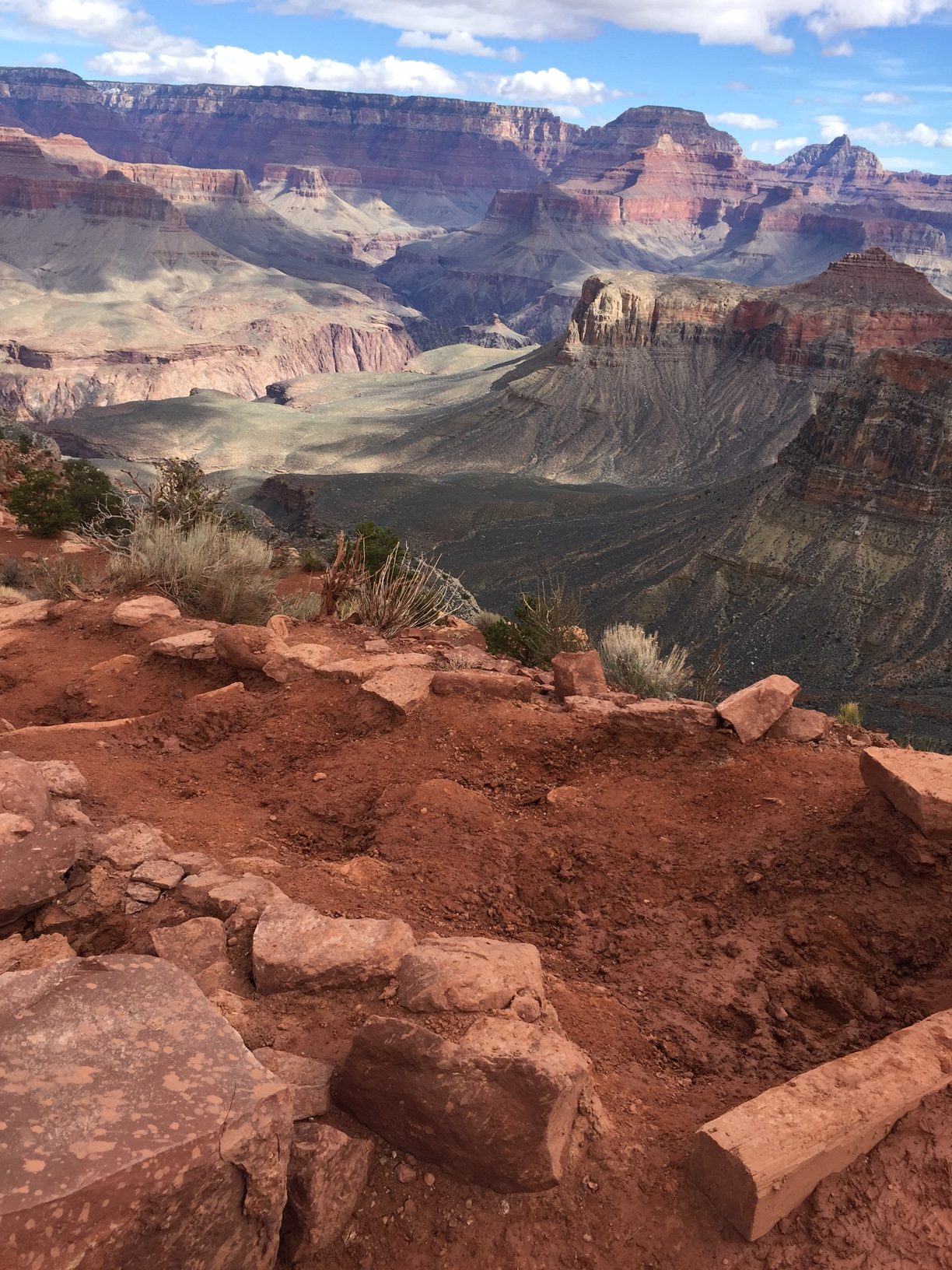
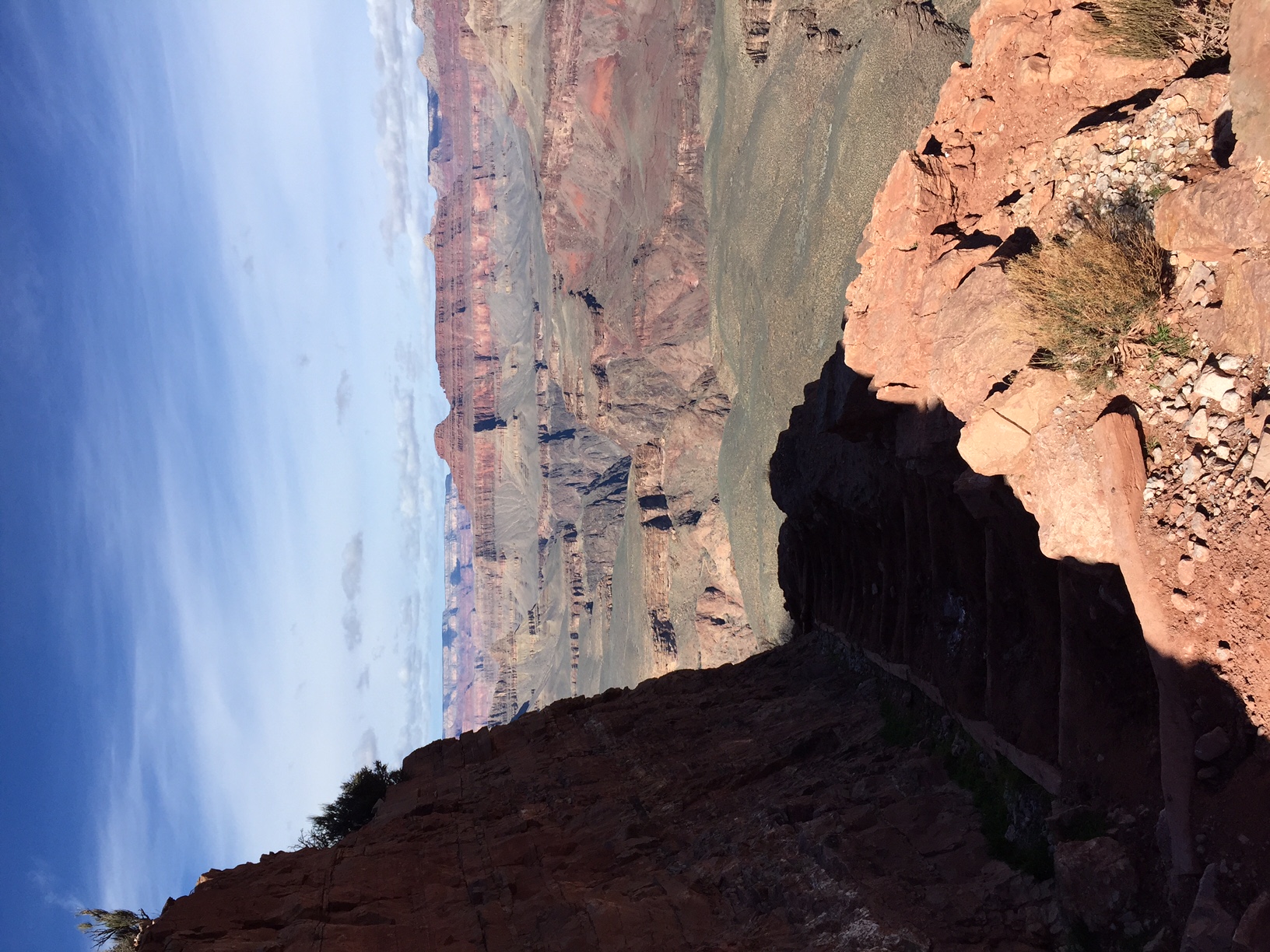
The sun danced with clouds through the whole day, light and shadow, warm in the sun, chilly in shade. I hiked down into the earth for hours, following long thin paths along the yellow, orange and magenta rock walls, colored like the sunrise. As I stopped for water and rest, always the ravens circled by twos, circling each other before lifting or drifting to the next island of earth in this ocean of air and time.
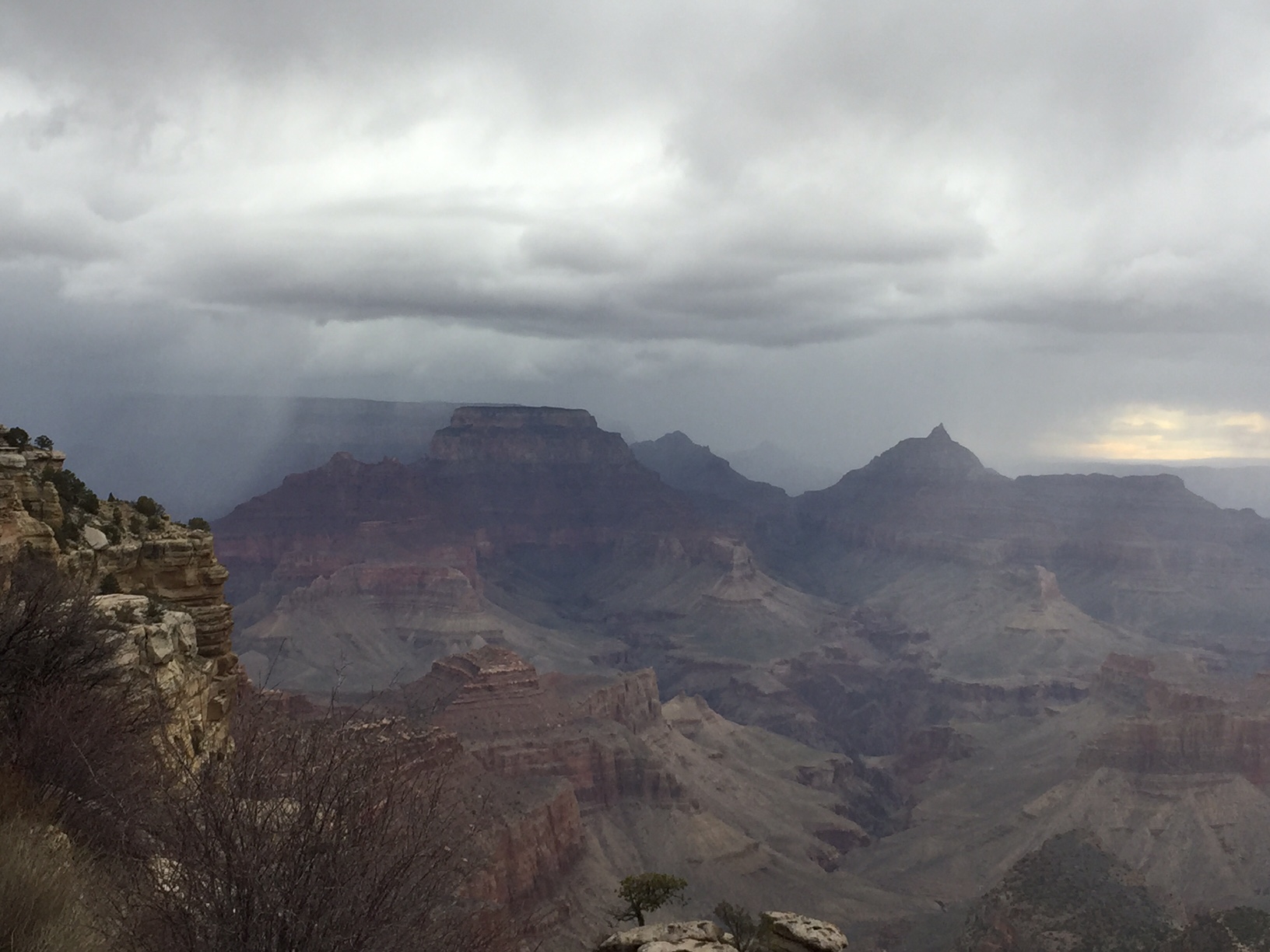
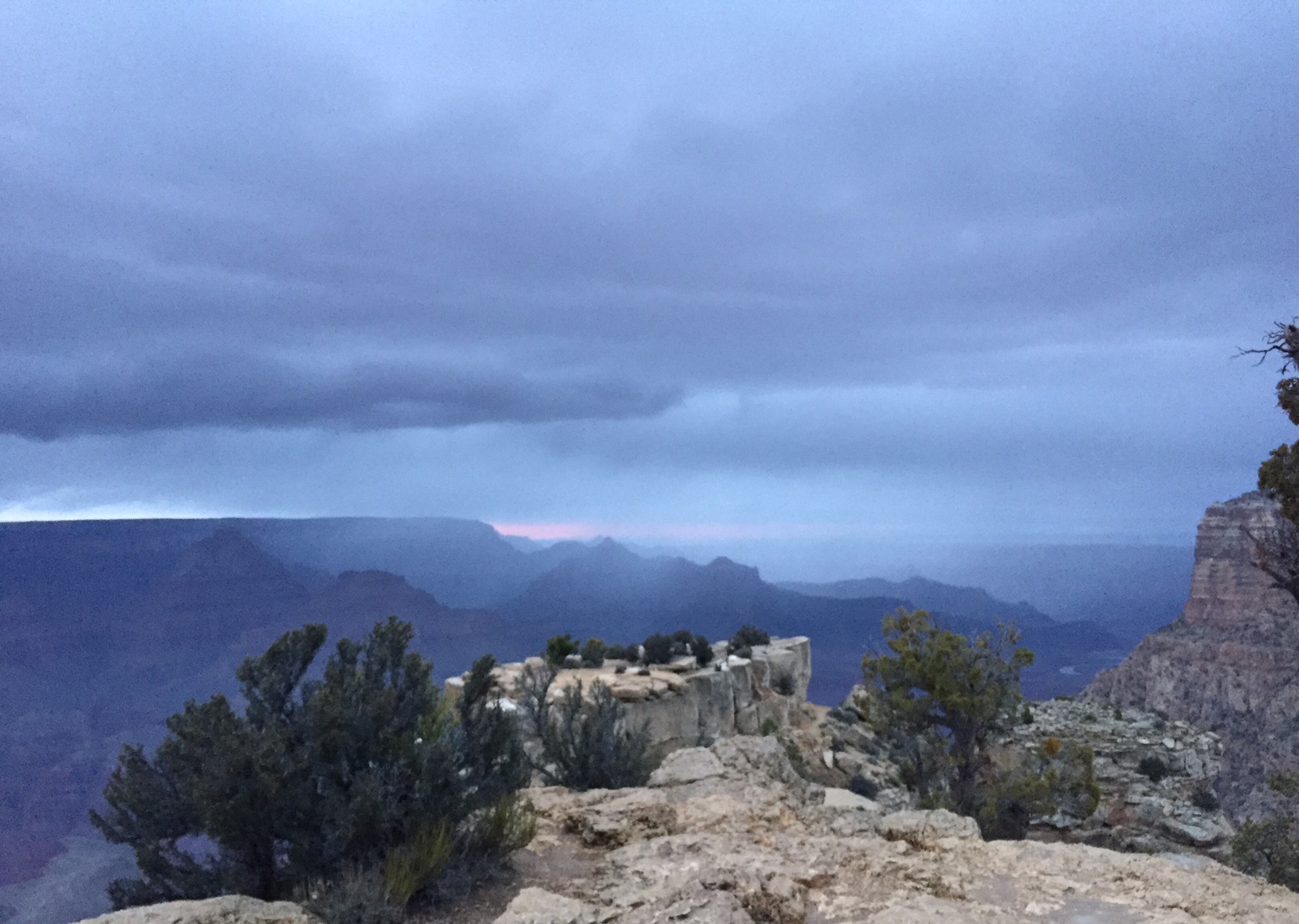
As evening approached, the clouds thickened, rolling over the immensity of the canyon. The sun set behind heavy rains rolling across the great depths, across the blackness of the void. The source. The blackness from which all light and life came, safe under the protective, sheltering wing of that now-familiar trickster, Raven. I stood in the rain, in the dark, on the edge of the Grand Canyon, in a space circled by thought and memory.
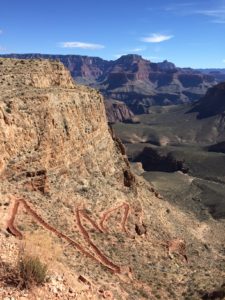 red mud trail
sliding down switchbacks
into depths
I have yet to know
this clay and sand
this earth and snow
today the ground
beneath my feet
is liquid pooling
every step
will suck me down
to the old world beneath
through the hole in the sky
at the bottom of the canyon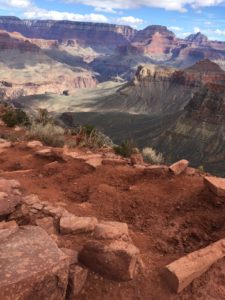
compelled to reach
my hands in
to this earth’s lifeblood
stain me red
and so it does
ochre of birth and death
across so many ages
my palms
now touch the sacred walls
of life
and from my fingers
forms a dripping tiny bird
its wings will dry
and I will fly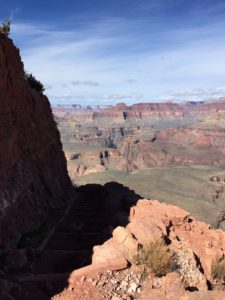
my path these smoothly worn
and muddy stones
that wind and rise
the edge
along this
vast
unending
precipice
January 29, 2017 / wanderinglightning / 0 Comments
Roughly 150 demonstrators greeted travelers Sunday afternoon as they emerged onto the Westin Plaza at Denver International Airport. Holding signs reading, “Diversity is our Strength” and “We the People welcome you,” protesters chanted, “No hate, no fear, refugees are welcome here.”
As multiple federal courts issued orders to temporarily stay the president’s executive order banning all refugees, as well as citizens from seven Muslim-majority nations, from entering the U.S., immigration attorneys have been mobilizing to gain access to travelers who may be detained currently in our nation’s international airports. Local members of the American Immigration Lawyers Association responded to alerts from the International Refugee Assistance Project. According to Denver attorney Christina Brown, approximately 20 immigration lawyers were at DIA on Saturday; on Sunday, more lawyers arrived as word spread through Facebook and email groups.
One of Sunday’s arrivals was Jennaweh Hondrogiannis, a private immigration law attorney. When asked about coming to DIA on the weekend, Hondrogiannis responded, “This is the work we do. When we’re needed, we’re here.”
Laura Lunn, a managing attorney with Rocky Mountain Immigrant Advocacy Network, and private attorney Kristin Knudson volunteered with the newly-formed DIA Pro Bono Legal Project. They explained the difficulty with helping immigrants and refugees to access their rights under the current executive order. People wanting to enter the U.S. “who assert a credible fear or a reasonable fear have a right to be interviewed,” noted Lunn, referring to a credible fear of persecution or torture if the person were to return to their home country or country of last residence. According to Knudson, the “credible fear interview” is to determine if the person may be eligible for asylum. These interviews are conducted by asylum officers of USCIS, known commonly as Immigration Services. Immigrants have a right to legal representation when seeking asylum.
Lunn explained that the current executive order is focusing on the “expedited removal process” for immigrants, which immediately returns people with “no expressed fear” to their country of origin. The problem, according to Knudson, is that refugees without legal “refugee” status often don’t know they have a right to speak up about the dangers that caused them to leave home. Lunn stated, “They don’t know the magic words that could open the doors.” U.S. Customs and Border Protection officers (CBP) of the Department of Homeland Security are supposed to directly ask immigrants why they left their home country and if they have fear or concern that they would be harmed if they returned home. At issue is the lack of access to legal counsel within this process, as immigrants are interviewed without having an attorney present, and may feel unsafe or unsure about what to say. People with legal “refugee” status have already been deemed unsafe to return to their home countries and determined eligible to enter the U.S. But now their entry is being blocked.
The attorneys at DIA said they have no way to know if the appropriate questions are being asked. Ordinarily, immigration attorneys call in to CBP to advise officers that they are on-site and wish to see their detainee clients. Now, no one at CBP seems to be answering their phone calls.
In addition, U.S. residents have been caught up in the expedited removal process. Citizen advocate Marcela Mendoza spoke up among the attorneys lined up in front of the International Arrivals gate at DIA. “The executive order is so overreaching – it included people with green cards,” she said, meaning people with lawful permanent resident status. “That’s why the ACLU filed a writ of habeas corpus in New York – but Homeland Security won’t follow it.” That court petition for writ of habeas corpus is Darweesh v. Trump, and includes the following statements:
“After conducting standard procedures of administrative processing and security checks, the federal government has deemed both Petitioners not to pose threats to the United States. Despite these findings and Petitioners’ valid entry documents, U.S. Customs and Border Protection (“CBP”) blocked both Petitioners from exiting JFK Airport and detained Petitioners therein. No magistrate has determined that there is sufficient justification for the continued detention of either Petitioner. Instead, CBP is holding Petitioners at JFK Airport solely pursuant to an executive order issued on January 27, 2017.”
A young black woman, Z., sat holding a sign for the DIA Pro Bono Legal Project, the name of this ad hoc congregation of Denver attorneys. She wore a nametag labeled, “Legal Monitor,” as all the volunteers with the project did. When asked why she had volunteered, Z. replied, “I am refugee. When I hear this, I feel bad.” She has been in Denver a little over six months. “Refugees – most of them are starving, most of my family are there. Maybe when they come here, they find peace.” “There” is Congo in east Africa; Z. said she left to escape war. She said the African Community Center in Denver helped her get her local identification documents when she “came with legal papers,” and also helped her find housing in Aurora.
She is still haunted by her journey, though. “Father not come – day of departure, his visa still not arrive, so we leave without him.” She and her sisters were 19 and older, so they were allowed to go. “Mother, we lost her, in the war. We don’t know if she alive or die. Lost her. Lost.” Z. tears up but maintains her composure. “Refugee story is bigger – is bigger story.” She smiled again, and turned with her sign. “I can’t fight against government. Our neighbors, Sudanese, they are starving. If I have possibility, I can make the peace.” She paused, then added, “I am Muslim.”
Behind her, attorneys shared updates. “Do we have a name?” “We have a birthdate.” Christina Brown noted, “No word yet, though.” Lunn added, “CBP won’t talk to us, won’t take our calls in there. We spoke to colleagues in D.C. – this is happening at all the airports.”